
Library Record
Images
Additional Images [6]
Metadata
Catalog Number |
2011.1.12 |
Object Name |
Book |
Summary |
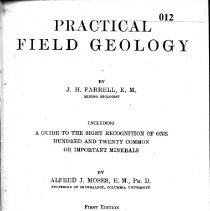
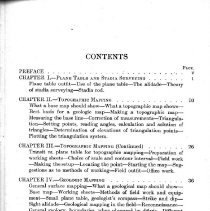
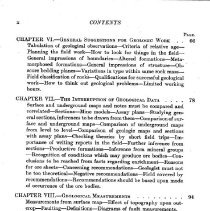
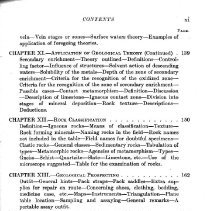
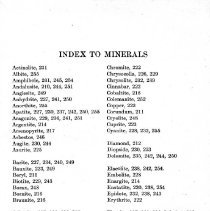
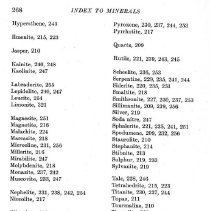
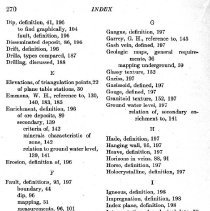
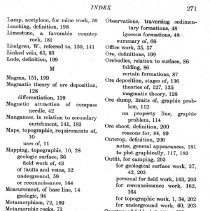
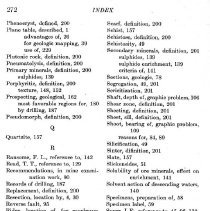
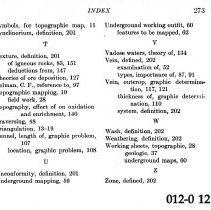
Practical Field Geology including a guide to the sight recognition of one hundred and twenty common or important minerals by Alfred J. Moses, E. M. Ph D. Author: J. H. Farrell, E. M. PUBLISHER: McGraw- Hill Book Company, Inc. 239 West 39th St, NY COPYRIGHT: 1912 CONTENTS PREFACE.......................................................................v CHAPTER I:PLANE TABLE AND STADIA SURVEYING ............................. Plane table outfit-Use of the plane table-The alidade-Theory of stadia surveying-Stadia rod. CHAPTER 1I.-TOPOGRAPHIC MAPPING........................................................ 10 What a base map should show-What a topographic map shows- Best basis for a geologic map-Making a topographic map Measuring the base line Correction of measurements-Triangulation -Setting points, reading angles, calculation and solution of triangles-Determination of elevations of triangulation points- Plotting the triangulation system. CHAPTER III.-TOPOGRAPHIC MAPPING (Continued).............................26 Transit vs. plane table for topographic mapping-Preparation of working sheets-Choice of scale and contour interval-Field work -Making the setup-Locating the point-Starting the map-Suggestions as to methods of working-Field Outfit-Office work. CHAPTER IV.-GEOLOGIC MAPPING..........................................................36 General surface mapping-What a geological map should show- Base map-Working sheets-Methods Of field work and equipment -Small plane table, geologist's compass-Strike and dip- Sight alidade-Geological mapping in the field-Reconnoissance- General geology, boundaries, when obscured by debris-Different types illustrated-Work within areas of the same formatiOn- Traversing-Points to be observed in working a sedimentary area -Points to be observed in working an igneous formation, phases, segregatiOns-Representing geological features on the map. CHAPTER V.-GEOLOGIC MAPPING (Continued).................................... 51 Economic geology-Mapping faults-Mapping veins-Field notes -Locations, sketches-Office work-Inking working maps- Posting the field tracing-Final field map-Preparation and Labeling of specimens-Underground mapping-Outfit, a good lamp, candles, mine notebOok-Working maps, scale, etc.-Work of underground mapping-RecOnnoissance-Starting the work- Features tO be mapped. CHAPTER VI.-GENERAL SUGGESTIONS FOR GEOLOGIC WORK . . 66 Tabulation of geological observations-Criteria of relative age- Planning the field work-How to look for things in the field- General impressions of boundaries-Altered formations-Metamorphosed formations-General impressions of structure-Obscure bedding planes-Variations in type within same rock mass- Field classification of rocks-Qualifications for successful geological work-How to think out geological problems-Limited working hours. CHAPTER VII.-THE INTERRUPTION OF GEOLOGICAL DATA . . . . 78 Surface and underground maps and notes must be compared and correlated-Sections-Mine models-Assay plans-Studying general sections, inferences to be drawn from them-Comparison of surface and underground maps-Comparison of underground maps from level to level-Comparison of geologic maps and sections with assay plans-Checking theories by short field trips-Importance of writing reports in the field-Further inference from sections-Productive formations-Inference from mineral groups -Recognition of conditions which may produce ore bodies-Conclusions to be reached from facts regarding enrichment-Reasons for ore sheets-Concerning recommendations-Geologist must not be too theoretical-Negative recommendations-Field covered by recommendations-Recommendations should be based upon mode of occurrence of the ore bodies. CHAPTER VIII.-GEOLOGICAL MEASUREMENTS....................................... 94 Measurements from surface map-Effect of topography upon outcrop -Faulting-Definitions-Diagrams of fault measurements. CHAPTER IX.-APPLICATION OF DESCRIPTIVE GEOMETRY TO MINING PROBLEMS. BY JOSEPH W. ROE ............................................................103 Introduction-Problems-To find the strike of a vein-To find the dip-To find the depth of a shaft-Length of a tunnel-Location of a tunnel-To find the bearing of a shoot -To find the thickness of a vein-To find the limits of an ore dump-Ore dump on a property line-Location of a ridge for maximum capacity-To plot the outcrop of a vein-To determine the outcrop of a folded seam. CHAPTER X.-APPLICATION OF GEOLOGICAL THEORY............................127 Theory of ore deposition-Introductory-Two kinds of natural processes-Association of ore deposits with igneous rocks-Sources of the metals-Origin of transporting solutions-Magma defined- Magmatic differentiation-End phases-Transition from dike to vein-Vein stages or zones-Surface waters theory-Examples of application of foregoing theories. CHAPTER XI.-APPLICATION OF GEOLOGICAL THEORY (Continued) . 139 Secondary enrichment-Theory outlined-Definitions-Controlling factor-Influence of structures-Solvent action of descending waters-Solubility of the metals-Depth of the zone of secondary enrichment-Criteria for the recognition of the oxidized zone- Criteria for the recognition of the zone of secondary enrichment- Possible cases-Contact metamorphism-Definition-Discussion -Description of limestone-Igneous contact zone-Division into stages of mineral deposition-Rock texture-Descriptions- Deductions. CHAPTER XII.-RocK CLASSIFICATION.............................................. 150 Definition-Igneous rocks-Means of classification-Texture- Rock forming minerals-Naming rocks in the field-Rock names not included in the table-Field names for doubtful specimens- Clastic rocks-General classes-Sedimentary rocks-Tabulation of types-Metamorphic rocks-Agencies of metamorphism-Types- Gneiss-Schist-Quartzite-Slate-Limestone, etc.-Use of the microscope suggested-Table for the examination of rocks. CHAPTER XIII.-GEOLOGICAL PROSPECTING.......................................162 Outfit-General hints-Pack straps-Pack saddles-Extra supplies for repair en route-Concerning shoes, clothing, bedding, medicine case, etc.-Maps-Instruments-Triangulation-Plane table location-Sampling and assaying-General remarks-A portable assay outfit. CHAPTER XIV.-GEOLOGICAL PROSPECTING (Continued) .................... 180 Generalities-Float-Color of outcrop-Inference to be drawn from nature of vein and country rock. CHAPTER XV.-PROSPECTING DY DRILLING....................................... 187 Diamond drill-Churn drill-Drilling as a method of prospecting- The geologist's work-Report forms-Final records. APPENDIX.............................................................................................195 Definitions-Lists of outfits-Measurement of gold and silver beads by means of microscope. SUPPLEMENT.-GUIDE TO THE " SIGHT RECOGNITION " OF ONE HUNDRED AND TWENTY COMMON OR IMPORTANT MINERALS. BY A. J. MOSES 207 INDEX TO MINERALS |
Author |
Alfred J. Moses, E. M. Ph D. |
Title |
Practical Field Geology including a guide to the sight recognition of one hundred and twenty common or important minerals |
Published Date |
1912 |
Cataloged by |
Graham, Tom |