
Archive Record
Images
Additional Images [6]
Metadata
Catalog number |
1997.2.2601 |
Object Name |
Newsletter |
Date |
1992 |
Description |
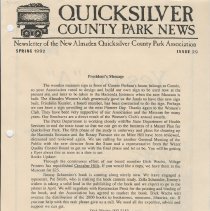
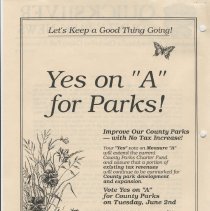
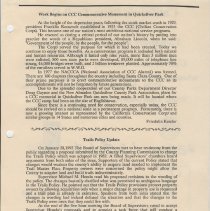
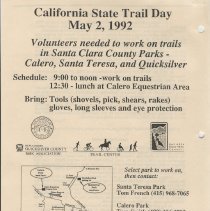
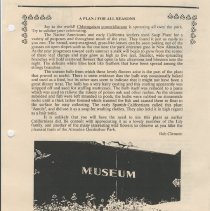
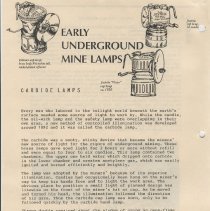
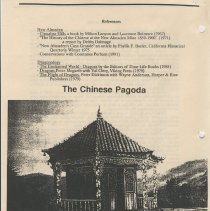
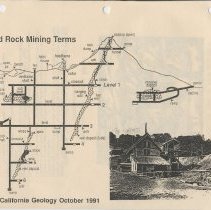
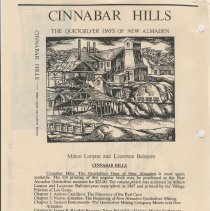
TITLE: Quicksilver County Park News SUBTITLE: Newsletter of the New Almaden Quicksilver County Park Association Issue # 29 Spring 1992 Newsletter of the New Almaden Quicksilver County Park Association SPRING 1992 ISSUE 29 President's Message The wooden museum sign in front of Connie Perham's house belongs to Connie, so your Association voted to design and build our own sign to be used now at the present site and later to be taken to the Hacienda Entrance when the new Museum is built. The Almaden Women's club generously gave us the funds to have this new sign built. Friedolin Kessler, a board member, has been contracted to do the sign. Perhaps we can have a sign unveiling at the next Pioneer Day. Thanks again to the Women's Club. They have been very supportive of our Association and the Museum for many years. Our Brochures are a direct result of the Women's Club's annual awards. The Parks Department is working closely with the State Department of Health Services to end the toxic issue so that we can get to the business of a Master Plan for Quicksilver Park. The fifth phase of the study is underway and plans for cleaning up the Hacienda Entrance and the Rotary Furnace site on Mine Hill have been reviewed, discussed and reviewed again. We are calling for another General Meeting of the Public with the new director from the State and a representative from the Water Quality Control Board to get on with the final phase and let us be. You will be getting a flyer about this as soon as a date is set. Books Update: Through the continuous effort of our board member Dick Wachs, Village Printers has republished Cinnabar Hills. If you would like a copy, we have them at the Museum for $25. Jimmy Schneider's book is coming along nicely now. We have engaged a typesetter, Pat Smith, who is making the book camera ready. Zella Schneider, Jimmy's widow is taking a solid lead in the publishing of the book and we expect to go to the printer in April. We will negotiate with Rosicrucian Press for the printing and binding of the book, and the Association has agreed to market the book. Dick Wachs will oversee the distribution of the 2000 books to bookstores, museums, libraries, etc. If you can help with this task please give us a call. We need all the expertise, advice and support we can get. Dick Wachs: 997-2153 Kitty Monahan: 268-6541 Thanks to all of you for your generous support over the year. We have been able to keep the Museum going, tours are at a maximum with almost every weekend this spring scheduled for hiking or truck adventures. If you would like to come on a tour or drive a truck or help in any way with a tour, just call me and we can set it up for you! Kitty Monahan Let's Keep a Good Thing Going! Yes on "A for Parks Improve Our County Parks - with No Tax Increase! Your 'Yes" note on Measure 'A" will extend the current County Parks Charter Fund and assure that a portion of existing tax revenues will continue to be earmarked for County park development and expansion.Vote Yes on 'A" for County Parks on Tuesday, June 2nd If you mould like to help the "Yes on A" campaign, contact Kitty Monahan at (408) 268-6541. YES on PARKS / YFS on A: 1922 The Alameda Suite 273, San Jose CA 95126 Aurelia Winsemias, Treasurer ID 862-140 Work Begins on CCC Commemorative Monument in Quicksilver Park At the height of the depression years, following the stock market crash in 1929, president Franklin Roosevelt established in 1933 the CCC (Civilian Conservation Corps). This became one of our nation's most ambitious national service programs. He rescued us during a critical period of our nation's history by putting into practice the words of a Republican president, Abraham Lincoln, when he said: "Government of the people, by the people, for the people". The Corps served the purpose for which it had been created. Today we continue to enjoy those benefits. As a conservation program it included both natural and human resources. Although it lasted only nine years, more than 3 million men were enlisted 800 new state parks were developed, 89,000 miles of telephone line strung, 46,OO0bridges were built, and 2 billion trees were planted. Approximately 70% of the enrollees served in W.W.II. In 1977 the NACCCA (National Association of CCC Alumni) was formed. There are 160 chapters throughout the country including Santa Clara County. One of their prime purposes is to erect commemorative monuments to the CCC so its accomplishments will not be forgotten by future generations. Due to the splendid cooperation of our County Parks Department Director Doug Gaynor and the New Almaden Quicksilver County Park Association, plans for a CCC memorial in Quicksilver Park are now being made. It will be located where the CCC camp had been on the site of Englishtown. Since there is a continuing need for conservation, especially today, the CCC should be revived on a national scale as a permanent program. Fortunately, there is now a growing interest as represented by. the California Conservation Corps and similar groups in 14 States and numerous cores and counties. Friedolin Kessler Trails Policy Update On January 28,1992 The Board of Supervisors met to hear testimony from the public regarding a proposal submitted by the County Planning Commission to change the Trails Policy which was adopted in 1982. A filled Supervisors chambers heard arguments from both sides of the issue. Supporters of the current Policy stated that changes would weaken the county's ability to acquire land needed to implement the Trail Master Plan. Property owners were concerned the policy might allow the County to acquire land and build trails indiscriminately. Supervisor Michael M. Honda read his proposed revisions to the wording of the policy. The changes basically clarified what was perceived as ambiguous language in the Trails Policy. He pointed out that the Trails Policy provisions protect property owners by allowing acquisition only when a major change in property use is requested and a trail plan is already in existence. Speakers from both sides stated that the changes in wording had indeed defused the situation and that the changes to the Trails Policy were ones that they could live with. At the end of the five hour meeting the Board of Supervisors voted to accept Supervisor Honda's proposals and to appoint a task force that will conduct a comprehensive review of the Trail Plan. The 15 person committee will consist of two representatives from the Parks and Recreation Commission, two from the Planning Commission, one from the Intergovernmental Council's Trails and Pathways Committee, and two representatives appointed by each of the five Supervisors. The task force will be chaired by Supervisor Honda. The study is expected to take approximately two years to complete. Dick Forst California State Trail Day May 2, 1992 Volunteers needed to work on trails in Santa Clara County Parks -Calero, Santa Teresa, and Quicksilver Schedule: 9:00 to noon -work on trails 12:30 - lunch at Calero Equestrian Area Bring: Tools (shovels, pick, shears, rakes) gloves, long sleeves and eye protection Select park to work on, then contact: Santa Teresa Park Tom French (415) 968-7065 Calero Park Tom Smith (408) 356-5702 Quicksilver Park Kitty Monahan (408) 268-6541 For more information call Calero Park 268-3883 Sponsored by Santa Clara Coumty Park Assn. Trail center. Bay Area Ridge Trail Council and ROMP. A PLANT FOR ALL REASONS Joy to the world! Chlorogalum pomeridianum is sprouting all over the park. Try to subdue your celebrating. The Native Americans and early California settlers used Soap Plant for a variety of purposes and throughout much of the year. They found it just as easily as you can. The broad, wavy-margined, grass-like leaves can be seen poking out of the grasses on open slopes such as the one near the park entrance gate in New Almaden. As the year progresses toward early summer a stalk will begin to grow from the center of these leaf clumps and may grow as high as five feet. Slender, wide-spreading branches will hold scattered flowers that open in late afternoon and blossom into the night. The delicate white lilies look like feathers that have been spread among the stringy branches. The unseen bulb from which these lovely flowers arise is the part of the plant that proved so useful. There is some evidence that the bulb was occasionally baked and used as a food, but its other uses seem to indicate that it might not have been a great dinner treat. The bulb has a very hairy coating and this coating apparently was stripped off and used for stuffing mattresses. The bulb itself was reduced to a paste which was used to relieve the misery of poison oak and other rashes. As the streams subsided and fish were left stranded in pools, the bulbs were rubbed on streamside rocks until a thick lather formed which stunned the fish and caused them to float to the surface for easy collecting. The early Spanish-Californians called this plant "Amole", and did use it as a soap for washing clothes. They also held it in high regard as a hair tonic. It is unlikely that you will have the need to use this plant as earlier Californians did. Be content with appreciating it as a lovely member of the Lily family, and another of the many interesting wild flowers to observe as you hike the pleasant trails of the Almaden Quicksilver Park. Bob Clement EARLY UNDERGROUND MINE LAMPS Every man who labored in the twilight world beneath the earth's surface needed some source of light to work by. While the candle, the oil-wick lamp and the safety lamp were overlapping in their own eras, a new method of controlled illumination was developed around 1892 and it was called the carbide lamp. The carbide was a sooty, stinky device that became the miners' new source of light for the rigors of underground mining. These brass lamps gave good light for 2 hours or more without refill and were equal to four to six candles. This lamp contained two chambers. The upper one held water which dripped onto carbide in the lower chamber and creates acetylene gas, which was easily ignited and burned efficiently and brightly. The lamp was adopted by the miners' because of its superior illumination. Candles had occasionally been hung on the miner's cap to keep his hands free and to light the work area. The obvious place to position a small light of planned design was likewise on the front of the miner's hat or cap. As he moved and turned his head, the illumination followed the direction of his gaze. Thus the carbide cap lamp was born, only to be followed quickly by the carbide hand lamp. Strong doubts remained about the wisdom of using an open-flame lamp underground. These concerns were to grow and ultimately, by the 1930's, battery-powered cap lamps became the only legal lights in mines. So stop by your museum and in the mining of the many styles and shapes they came John Slenter WAIT at the GATE The New Almaden Quicksilver museum is a treasure chest of memorabilia; but before you enter the museum, wait at the gate. The first impression of many people is that the pillars surrounding the gate are from totem poles, but these columns are remnants of a pagoda which was a gift from the Emperor of China in about 1851. Carved dragons are intertwined around the columns in Chinese tradition. A year earlier the Emperor had sent an emissary to New Almaden in order to establish trade based on cinnabar/quicksilver which was used in art in China. The emissary was well received and treated with courtesy at New Almaden. To show his appreciation, the Emperor had the pagoda prepared and sent to New Almaden. He also sent artisans to erect the structure when it arrived. It is said that the columns were carved by Chinese children, possibly the Emperor's. The pagoda was probably assembled east of the Casa Grande some time after 1854. For many years it served as a teahouse at which visiting dignitaries were entertained. The pagoda was later moved across Los Alamitos Creek to a position west of the Casa Grande. Later it was used as a real estate office, and finally in 1928 it had deteriorated to such an extent that it was dismantled. Some of the pillars were used to support an air conditioner at the former Casa Grande. When Connie Perham learned of this use, she effected a trade in which she supplied supports for the air conditioner in exchange for the columns. Heavy rains in 1955 caused Los Alamitos creek to overflow and flood the area, and some of the pillars floated downstream. Several years later they were discovered and returned to the location which they now occupy by the gate of the museum although the coloring had been washed off of them. The carvings on the columns represent dragons. Chinese dragons were more benevolent than western or European dragons. Chinese dragons seldom breathed fire, and they were usually wingless with long sinuous bodies. The number of scales on the dragon is significant. The number nine is Yang one of two interlocking principles of the Universe; Yang represents Heaven, Light, Vigor and Masculinity. Yin,the second principal represents Earth, Darkness, Passivity, and Femininity and is associated with the number six. Some say the dragons had nine times nine or 81 scales, but others contend that they possessed a combination of qualities, and the number of scales was 81 plus six times six or 36 which equals 117 scales. Note that the dragons are attempting to catch a ball. This represents a sacred pearl which was sent from China to the Japanese court. The pearl was lost en route but it was recovered by the dragon who ruled that part of the sea. The Japanese Lord Kamatori, who was responsible for the loss, was sent into exile near the Sea of Japan to the village of Fukazaki. There he fell in love with an ama (a maiden who dove for shellfish). She was determined to show her love for the Lord so she dove to the dragon's palace and retrieved the pearl. But the dragon's cohorts had seen her and gave chase. In order to hide the jewel she slit her breast and pressed the pearl into her flesh. She escaped and gave the pearl to Kamatori as proof of her love for him, but the wound was fatal. So when you view the Chinese New Year's parade, you will note a ball representing the pearl ever ahead of the following dragon. There is much to see inside the museum, but a moment spent at the gate should be a worthwhile prelude to what you will see after you pass through the gate. Richard Wachs References: New Almaden - Cinnabar Hills a book by Milton Lanyon and Laurence Bulmore (1967) - "The History of the Chinese at the New Almaden Mine 1850.1900" (1971) a report by Debby Dalmage - "New Almaden's Casa Grande" an article by Phyllis F. Butler, California Historical Quarterly Winter 1975 - Conservations with Constance Perham (1991) Dragonology - The Enchanted World - Dragons by the Editors of Time-Life Books (1984) - Dragons Peter Mogarth with Val Clery, Viking Press (1979) - The Flight of Dragons Peter Dickinson with Wayne Anderson, Harper & Row Publishers (1979) The Chinese Pagoda Hard Rock Mining Terms CINNABAR HILLS THE QUICKSILVER DAYS OF NEW ALMADEN z Milton Lanyon and Laurence Bulmore CINNABAR HILLS Cinnabar Hills- The Quicksilver Davs of New Almaden is once again available. The 5th printing of this popular book may be purchased at the New Almaden Quicksilver museum for $25.00. The volume, which was authored by Milton Lanyon and Laurence Bulmore,was copyrighted in 1967 and printed by the Village Printers of Los Gatos. Chapter 1: Andres Castillero- The Discovery of the Red Cave Chapter 2: Nuevo Almaden- The Beginning of New Almaden Quicksilver Mining Chapter 3: Samuel Butterworth- The Quicksilver Mining Company Moves into New Almaden Chapter 4: James B. Randol- Bonanza Years Establish a Unique Mining Settlement Chapter 5: Spanishtown- A Colorful Setting on the Slopes of Deep Gulch Chapter 6: Englishtown- A Unique Settlement of White Cottages and Colorful Gardens Chapter 7: The Hacienda- The Gateway to the Mines Chapter 8: Conclusion The volume contains 128 pages and more than 140 photographs. CALL FOR ACTION! For those interested in protecting unique recreational, cultural, and natural historic sites, your help is needed now! Bodie State Historic Park, which is located on the eastern side of the Sierras, is being threatened by mining interests. The park preserves "in a state of arrested decay" one of the most famous ghost towns in the American West. On March 3, Congressman Richard Lehman ( D-Fresno ) introduced HR 4370, the Bodie Protection Act of 1992, a critical step in the struggle to save Bodie from mineral activity. Please write your member of Congress and urge him to actively support HR 4370 and ensure the bill's passage. For more information contact John Slenter or write: California State Rangers Association, P.O. Box 292010, Sacramento, Ca. 95829-2010. NAQCPA WANTS YOU! MEMBERSHIP APPLICATION / MEMBERSHIP RENEWAL FORM Date: Membership: new renewal Name: Address: City: State: Zip Phone: (area code: Dues: $10 per year per household, tax deductible $ Additional tax deductible contribution $ Total amount enclosed Checks may be made payable to "Quicksilver Park Assn." |
People |
Clement, Bob Gaynor, Doug Forst, Dick French, Tom Kessler, Friedolin Monahan, Kitty Perham, Constance (Mrs. Kambish) Schneider, Mrs. Phillips S. Schneider, Phillips S. Slenter, John Smith, P. Wachs, Richard |
Cataloged by |
Meyer, Bob |