
Archive Record
Images
Additional Images [4]
Metadata
Catalog number |
1997.2.2583 |
Object Name |
Newsletter |
Date |
1989 |
Description |
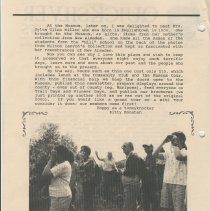
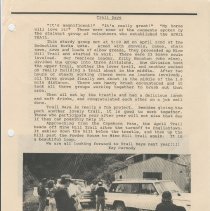
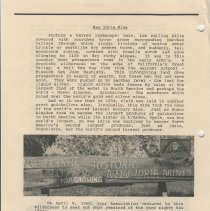
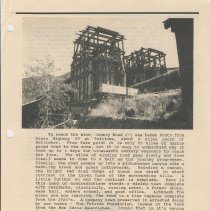
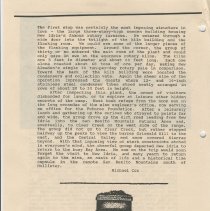
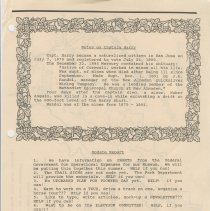
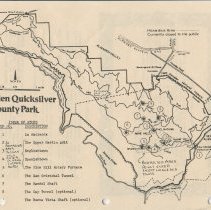
TITLE: Quicksilver County Park News SUBTITLE: Newsletter of the New Almaden Quicksilver County Park Association Issue # 20 Spring 1989 Newsletter of the New Almaden Quicksilver County Park Association Number 20 Spring 1989 President's Message The season of tours, hikes and meanderings through our beautiful Quicksilver Park has come upon us. Yesterday, as we toured with a history class from DeAnza College, I could not help but be elated and energized by such an enthusiastic group of residents of the Santa Clara Valley. This made any effort on my part pale in contrast to the return I received for a day's adventure up Deep Gulch. The professor, Bill Palmer, was knowledgeable about mining and had read extensively on the early days of Quicksilver Mining in New Almaden. I learned so much from his opening remarks while we looked at the marvelous hills above the Reduction site and discussed the living conditions in New Almaden from 1845 to the present. At the Upper Martin Adit, Chuck Rich, our remarkable miner, explained the rock formation and his experiences in the tunnels; when we arrived at the Cora Blanco tunnel and the Los Angeles Open Cut he described the air circulation. In Englishtown the history group was full of great questions for Friedolin Kessler, who told stories of the 1936-1938 years he spent as a member of the Conservation Corp. The cool breeze blowing through beautiful downtown Englishtown was a perfect setting for the history of the social life of inhabitants of Mine Hill. Chuck Rich again filled our minds with his expertise on the workings of the Rotary Furnace and his life living in Spanishtown looking down over the Almaden Valley, Calero and the surrounding East Foothills - such a beautiful sight yesterday. The San Cristobal, the Victoria, the Powder House and April Trellis rounded off the day's adventures. Since our Trail Days in April, the new April Trail has proven great fun. This particular outing included lunch at the New Almaden Community Club provided by Peggy Melbourne and her crew, adding a splendid touch to a perfect morning. Peggy cooked Cornish Pasties, homemade biscuits, salads and homemade strawberry pie with ice cream. The day finished with a grand tour of the Museum to see what we saw in our imagination as we toured the fascinating "restricted" area of the Quicksilver Park. At the Museum, later on, I was delighted to meet Mrs. Sylva Climo Miller who was born in Englishtown in 1900. She brought to the Museum, as gifts, items from her mother's collection from New Almaden. She.knew all the names of the students from the "Hill" school on the back of the photos from Milton Lanyon's collection and kept us fascinated with her remembrances of New Almaden. Now you can see why I love this place and wish to keep it preserved so that everyone might enjoy such terrific days, learn more and more about our past and the people who brought us to the present. By the way, tours such as this one cost only $15, which includes lunch at the Community Club and the Museum tour. With this financial help we keep the doors open to the Museum, publish this newsletter, prepare displays around the county - even out of county (eg. Mariposa), feed everyone on Trail Days and Pioneer Days, and publish our brochures (we just printed up another 5000 as we ran out of the original 5000). If you would like a grand tour or a mini tour consider it done; our members come first: Happy as a tommyknocker Kitty Monahan Park Ranger Office The Park Ranger office for Almaden Quicksilver County Park is located at Calero Reservoir County Park. The phone number is 408-268-3883. Trail Days "It's magnificent!" "It's really great!" "My horse will love it!" Those were some of the comments spoken by the stalwart group of volunteers who established the APRIL TRAIL. This sturdy group met at 9:00 AM on April 22nd at the Reduction Works gate. Armed with shovels, rakes, chain saws, saws and loads of elbow grease, they proceeded up Mine Hill Trail and started to work. There were 23 brave souls involved. Our fearless leader, Kitty Monahan (who else), divided the group into three divisions. One division took the upper trail, another the lower trail, and another worked on really building a trail about in the middle. After two hours of steady working (there were no loafers involved), all three groups finally met about in the middle of the 1.83 mile distance. There was heavy brush encountered and it took all three groups working together to brush out that area. Then all met by the trestle and had a delicious lunch and soft drinks, and congratulated each other on a job well done. Trail Days is really a fun project. Besides giving the park another lovely trail, it is good to work together. Those who participate year after year will not miss that day if they can possibly help it. Approaching from the Capehorn Pass, the April Trail heads off Mine Hill Trail after the turnoff to Englishtown. It ambles down the hill below the trestle, and then up the hill past the Powder House to Mine Hill Trail again. It is a beautiful loop. We are all looking forward to Trail Days next year!!!! Kay Carmody New Idria Mine Picture a barren landscape: bare, low rolling hills covered with scorched brown grass surrounding parched valleys through which single rivulets of scarce water trickle or deathlike dry washes twine, and suddenly, tall mountains rising, covered with fragile scrub and pine clinging to life on dry rocky slopes. It was to this country that prospectors came in the early 185o's. A desolate wilderness on the edge of California's Great valley, a full two day ride from the nearest outpost -Mission San Juan Bautista. This unforgiving land drew prospectors in search of wealth, but these men did not seek gold. They were pushed on by another fever - the lust for liquid silver. Liquid silver made famous by tales of the largest find of the metal in North America and perhaps the world - Nuevo Almaden. Quicksilver: The substance which ruled over the world's gold and silver mines. And so it was that in 1854, claim was laid to another great quicksilver mine. Ironically, this mine took the name of the world's second largest mercury mine. Just as Nuevo Almaden rose to become the largest producer of quicksilver in North America while its sister in Almaden, Spain, was the world's largest, so New Idria was destined to become North America's second largest producer, just as Idria, Yugoslavia, was the world's second largest producer. On April 8, 1989, your Association ventured to this wilderness to seek out what remained of the once mighty New Idria. To reach the mine, County Road J-1 was taken South from State Highway 25 at Paicines, about 8 miles south of Hollister. From this point it is only 53 miles of narrow paved road to the mine, but it is easy to understand why it took up to 5 days for nineteenth century wagoneers to reach San Juan. The miles of winding road pass slowly and time itself seems to come to a halt as the journey progresses. Finally, the road sweeps up into a picturesque canyon with a babbling brook and green cottonwoods. Rounding a corner, the bright red slag dumps of burnt ore stand in stark contrast to the brown hues of the surrounding hills. A little further on and the contrast is complete. Here in this land of contradictions stands a mining town complete with residents, electricity, running water, a former store, mess hall, modern school, and post office. Although the mines are now inactive, the town is a time capsule complete from the 1920's. A company town preserved in arrested decay by our hosts - The Futures Foundation, lessee of the town from the New Idria Associates. Ironic that in its waning days since closing in 1972, the mine now lives again to offer a glimmer of hope for the future of young people who desire to learn and grow and overcome the deficiencies of their past lives. With our generous and hospitable hosts at the helm, we set off to explore the major attractions of the old mine. The first stop was certainly the most imposing structure in town - the large three-story-high wooden building housing New Idria's famous rotary furnaces. We entered through a side door into the twilight of the kiln building and the flasking room. We could see some of the larger pieces of the flasking equipment. Around the corner, the group of thirty or so entered the main room of the plant and could only gaze in awe at the enormous rotary kilns. The kilns are 5 feet in diameter and about 60 feet long. Each one alone roasted about 60 tons of ore per day, making New Almaden's single 30 ton-per-day rotary pale in comparison. Toward the back of the kiln building were located the condensers and collection vats. Again the sheer size of the operation impressed the guests where 12- and 16-inch stainless steel condenser tubes stood neatly arranged in rows of about 20 to 30 feet in height. After inspecting this plant, the crowd of visitors disbanded for lunch, or to explore at leisure other hidden secrets of the camp. Most took refuge from the noon sun on the long verandas of the mine engineer's office, now serving as office for the Futures Foundation. After a leisurely lunch and gathering up the curious who strayed to points far and wide, the group drove up the dirt road leading from New Idria into the San Benito Mountain Natural Area and, eventually, to Clear Creek on the west side of the range. The group did not go to Clear Creek, but rather stopped halfway up the peaks to view the barren Griswald Hill to the east, and the Central Valley and snow covered Sierras beyond. With that imposing view of stark constraints etched in everyone's mind, the cheerful group departed New Idria to return to the busy Bay Area. No one on the trip would soon forget the visit to New Idria, and many yearn to return again to the mine, an oasis of life and a historical time capsule in the remote San Benito Mountains south of Hollister. Michael Cox The Pygmy Forest Almaden Quicksilver Park has its share of forest monarchs: Stately Black Oaks, a few impressive Valley Oaks, stands of sturdy Blue Oaks, spreading Bay Laurels and lofty Big-leaf Maples. Sometimes, however, we can't see the real forest for the trees. The most extensive forest-type in California also covers much of the park. This pygmy forest, or "chaparral", exerts a heavy influence on the very nature of the park. We get so used to overlooking or sometimes cursing the dense mini-forest that we rarely appreciate the true forest functions that it performs. The thick brush cover protects the land from the erosive forces of wind and rain. It serves as a food source and home for a surprisingly large variety of large and small mammals---from tiny shrews to mule deer and mountain lions. A year long pageant of birds moves through the tangled maze of branches in search of food and nesting sites. The "voice of the chaparral", the Wrentit, proclaims his year long residency in this unique habitat. Myriad swarms of humming and buzzing insects sweep back and forth across the brushy landscape. In spring and early summer, the sun-drenched hillsides burst forth in a resplendent rainbow of floral displays. Showy and tenacious Bush Monkey Flower and a multitude of brilliant but short-lived annuals all vie for their place on nature's canvas. Modern man sees little use for chaparral, but native Americans found it a cornucopia of useful products. The diminutive Scrub Oak yielded nutritious acorns to be ground into meal. The fruits of Manzanita and Holly-leaf Cherry were extensively utilized, and plants such as Yerba Santa supplied medicinal products to soothe the aches and pains of the day. The chaparral community is adapted to semi-aridity. The low-growth, intertwining members of this forest live in a two season world. one season is short, cool and moist and the other is long, dry and hot. The longer, harsher season produces the images we usually bring to mind when we think of brushlands: somber hued, desiccated semi-dormant shrubs, oppressive heat and imminent fire-danger. The long-term cycle of life for the pygmy forest is perpetuated by fire. Fire may have disastrous consequences for human residences tucked among the dense thickets, but the forest itself rises from the ashes with amazing rapidity. Most chaparral shrubs send verdant shoots up from their blackened stumps within a few weeks after a fire. Buried seeds burst into life with the first moisture and feed on the ashes of the past generation. The blush of new color heralds the beginning of a new cycle in the growth and development of this much maligned forest. A cast of familiar players ---Manzanita, Bush Monkey Flower, Toyon, Ceanothis, Mountain Mahogany, Scrub Oak, Poison Oak, ... and a legion of supporting characters stride forth as the pygmy forest once again assumes center stage. Bob Clement Mariposa Mineral and Mining Museum On April 29th, a small group of N.A.Q.C.P.A. board members took a trip to Mariposa. Our museum is contributing an explanatory display for that museum that gives an idea of where New Almaden is and its importance in the gold and silver mining era in California. After a very pleasant ride, we arrived finding the museum was not quite finished. It will have a very nice display of rocks, minerals and gems of California. It will open to the public on May 20. A very extensive and expensive gold display will be the focal point during its grand opening. our display is in a prominent place with displays from other mining areas in California. Our organization feels it is important to be represented in a mining museum in California. Someday, we will have to organize a field trip to Mariposa and visit the completed museum. Peggy Melbourne Notes on Captain Harry Capt. Harry became a natualized citizen in San Jose on July 7, 1879 and registered to vote July 24, 1880. The December 22, 1895 Mercury contained his obituary: "Native of Cornwall, worked in mines all his life. Was supt. of mines when died after being ill since September. Made Supt. Dec. 1, 1891 by J.H. Randol, manager of the New Almaden Quicksilver mining company. He was a leading member of the Methodist Episcopal Church at New Almaden." Four days after the captain died, a miner, Nabor Angulo, was killed in a cave-in while excavating a drift at the 600-foot level of the Harry Shaft. Randol was at the mines from 1870 - 1892. Update Report 1. We have information on GRANTS from the Federal Government for Operational Expenses for our Museum. We will be putting this together this summer. HELP if you can! 2.The TRAIL SIGNS are not made yet. The Park Department will provide the materials. HELP if you can! 3.No UPGRADED PLAN FOR PIONEER DAY yet. HELP! If you can! 4.Want to work on a TOUR, drive a truck on one, organize a horse tour??? HELP if you can! 5.Like to type, write articles, mock-up a NEWSLETTER??? HELP if you can! 6.Want to be on the ELECTION COMMITTEE! HELP, if you can!!! The March and April Board Meetings were great. Members came and we organized sections of the Museum, prepared displays, planned Trail Days and set up docents for Saturdays. Our Board meetings are at 7:00 PM at the Museum, 2nd Wednesday of each month - you are always welcome! Great desserts, munchies and drinks. Kitty Monahan |
People |
Kessler, Friedolin Rich, Chuck Melbourne, Peggy Monahan, Kitty Carmody, Kay Cox, Michael Harry, James (Captain, Jr.) Clement, Bob |
Cataloged by |
Meyer, Bob |