
Archive Record
Images
Metadata
Catalog number |
1997.2.1791 |
Object Name |
Clipping, Newspaper |
Date |
1963 |
Description |
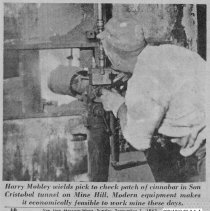
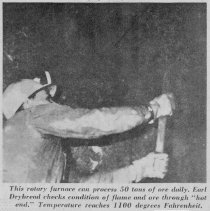
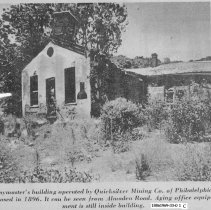
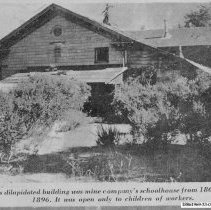
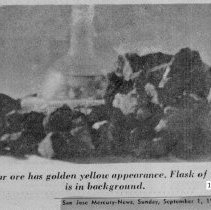
TITLE: Little Mining Town shows New Life at 118 AUTHOR: Douglas Hayward PUBLISHER: San Jose Mercury News, September 1, 1963 Sleepy, serene little New Almaden, south of San Jose, will celebrate its 118th birthday today with a strong flavor of youthful zest, for some big things are starting to happen to the tiny village of some 200 souls. The big things are (1) the developments on and in Mine Hill just a few yards from the edge of town, (2) the prospects of a residential development virtually in New Almaden's back yard, and (3) the strong chances of incorporation for the first time as a bonafide city. All three constitute a mighty strong jolt of adrenalin in the bloodstream for this old mining town that in its day became vitally important to the economic line of march of the American hemisphere. For Mine Hill, rising nearly 1,700 feet above sea level on the south edge of town, is honeycombed with more than 100 miles of tunnels that make up the fabulous New Almaden quicksilver mine. Its output thus far totals nearly $120 million, more than twice that of the richest single gold mine in the United States. And in its time, it became the third-greatest quicksilver, or mercury, mine in the world, ranking next to the Almaden - after which its was named - in Spain and the Idria in Austria. What's happening on The Hill today? Here's an example: Harry Mobley, Albert McFarland, Larry Miller, and Jerry Sisely are partners in a sublease in the San Cristobal, one of about two dozen tunnels that make up the New Almaden. Just part of their daily work includes a fascinating little 20-minute job known as "changing the retort," in which they scrape white-hot rock out of a metal tube and shovel in about 400 pounds of cinnabar ore, which contains the mercury. At one end of this tube, they draw off the mercury that has collected, between three and five 76-pound flasks per day. A flask is bringing $185 on the market today. They also bring out quite a bit of comparatively low-grade cinnabar, sometimes 20 or 30 tons a day. Another good example is Andy Camilleri's modern rotary furnace reduction mill just below the crest of Mine Hill. Ex-showman and gold miner Camilleri had reached an output level totaling near 50 flasks per week just last month Since 1954, Mine Hill - its former owners ceased full-scale operation in 1925 because at that time they couldn't make it pay its way - has been the scene of numerous "strikes," some breathtaking, some hilarious. Independent "high-graders" took over where the Century Mining Corp. left off in 1925. They have scraped, shoveled, and washed the surface to find cinnabar, and have carefully felt their way down into the Egyptian blackness of tunnels and shafts filled with rotting timbers, soft earth and cave-ins. But never a year has gone by that they haven't extracted at least 100 flasks. High-graders are good men. They have a strong respect and admiration for real miners, which high-graders cannot afford to be. They work their tunnels and diggings with care and precision, not just because it's safer and pays more, but because they take pride in what they do. The high-grader looks for rich pockets and outcroppings of cinnabar that can be worked by a few men equipped with as little machinery as possible. They can't afford to push through "country" without cinnabar in order to find ore. So they pursue their work scientifically and methodically, spending days and even weeks and months studying old mine records of every type, as well as existing "glass maps" before they start to dig. In this way, they know where the old miners stopped tunneling, in what type of ore, and under what conditions (such as flooding, carbon dioxide gas, and a volatile condition known as "running ground," in which oxidized rock will actually flow like putty due to the great pressure exerted on it by the rock around it). What was poor ore in 1925 and earlier can well be excellent ore today, due to major advances in equipment and techniques of ore reduction. But not all of these latter-day strikes have been scientific. For instance, the $100,000-plus find by Andres Baldorama. He and Harry Mobley were bulldozing a road down a steep hillside to the mouth of an old tunnel. Baldorama wanted to work. The bank gave way and the 'dozer lurched down the hill: Mobley tried to stop his wild charge by dropping the big blade. Luckily for both men, it didn't work. Instead, the blade scraped into the richest, reddest cinnabar Baldorama had seen in years and years. He couldn't take his eyes from it as he yelled abstractedly after the boiling cloud of red dust that was Mobley and his behemoth, still plunging downhill, "It's okay, Harry, you can stop the tractor!! We've hit it! We've hit it!" Mobley was shaken but uninjured, and later Baldorama gave him a sublease to work the deposit on a percentage. What about real estate development? A local syndicate of six men bought the 4,500-acre New Almaden in September 1960, for an estimated $6.5 million. The view from the proposed lots is promising. For just a few miles up the valley can be seen the Almaden Country Club and the mushrooming cluster of subdivisions that have sprouted almost overnight there at prices ranging between $15,000 and $35,000. It is that cluster of subdivisions that all eyes in New Almaden seem focused on these days. For those sub-divisions are located at the southernmost tip of a "strip-zone" extending like a finger from sprawling San Jose. And that finger points right at New Almaden. PHOTO A CAPTION: Harry Mobley wields pick to check patch of cinnabar in San Cristobal tunnel on Mine Hill. Modern equipment makes it economically feasible to work mine these days. San Jose Mercury-News, Sunday, September 1, 1963 PHOTO B CAPTION: This rotary furnace can process 50 tons of ore daily. Earl Drybread checks condition of flame and ore through "hot end." Temperature reaches 1100 degrees Fahrenheit. PHOTO C CAPTION: Paymaster's building operated by Quicksilver Mining Co. of Philadelphia closed in 1896. It can be seen from Almaden Road. Aging office equipment is still inside building. PHOTO D CAPTION: This dilapidated building was mine company's schoolhouse from 1865 to 1896. It was open only to children of workers. PHOTO E CAPTION: Cinnabar ore has golden yellow appearance. Flask of mercury is in background. |
People |
Balderama, Andre Camilleri, Andy Drybread, Earl MacFarland, Al (Albert) Miller, Larry Mobley, Harry Sisley, Jerry |
Cataloged by |
Boudreault, Art |