
Archive Record
Images
Additional Images [8]
Metadata
Catalog number |
1997.2.2623 |
Object Name |
Newsletter |
Date |
1998 |
Description |
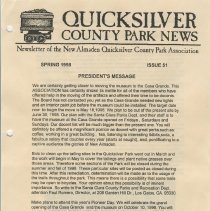
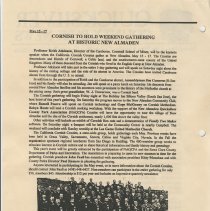
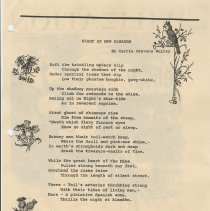
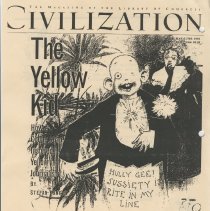
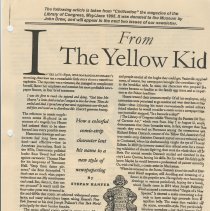
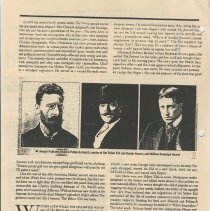
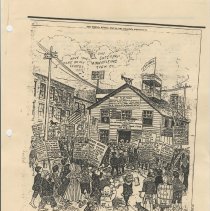
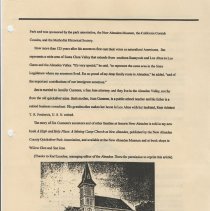
TITLE: Quicksilver County Park News SUBTITLE: Newsletter of the New Almaden Quicksilver County Park Association Issue # 51 Spring 1998 Newsletter of the New Almaden Quicksilver County Park Association SPRING 1998ISSUE 51 PRESIDENT'S MESSAGE We are certainly getting closer to moving the museum to the Casa Grande. This ASSOCIATION has certainly shown its mettle for all of the members who have offered help in the moving of the artifacts and offered their time to be docents. The Board has not contacted you yet as the Casa Grande needed new lights and an interior paint job before the museum could be installed. The target date now to begin the move is May 18,1998. We plan to be out of the present site by June 30, 1998. Our plan with the Santa Clara Parks Dept. and their staff is to have the museum at the Casa Grande opened on Fridays , Saturdays and Sundays. Our docent list will be much bigger than the present one. You will definitely be offered a magnificent position as docent with great perks, such as: coffee, working in a great building , tea, listening to interesting tidbits, soda, a fabulous salary that doubles every year (starts at naught), and, pontificating to a captive audience the glories of New Almaden. Bids to clean up the tailing sites in the Quicksilver Park went out in March and the work will begin in May to cover the tailings and plant native grasses over those areas. Therefore some sections of the Park will be closed during the summer and fall of 1998. These particular sites will be posted as closed during this time. After this remediation, determination will be made as to the usage of the trails throughout the park. This means there is a possibility that some trails may be open to bicycles. Your opinion about this possibility is of imminent importance. So write to the Santa Clara County Parks and Recreation Dept. attention Paul Romero, Director, at 208 Garden Hill Dr., Los Gatos, CA. 95030. Make plans to attend this year's Pioneer Day. We will celebrate the grand opening of the Casa Grande and the museum on October 10, 1998. You will receive a special invitation as the time grows nearer and plans are finalized. Kitty(408) 268-6541 May 15-17 CORNISH TO HOLD WEEKEND GATHERING AT HISTORIC NEW ALMADEN Professor Keith Atkinson, Director of the Camborne, Cornwall School of Mines, will be the keynote speaker when the California Cornish Cousins gather at New Almaden, May 15 - 17. The Cousins are descendants and friends of Cornwall, a Celtic land, and the southwestern-most county of the United Kingdom. Many of them descend from the Cornish who lived in the English Camp at New Almaden. Professor Atkinson will take part in the entire 3-day gathering and will speak on Saturday night about the history of the mining college and the role of its alumni in America. The Cousins have invited Cambome alumni from through the U. S. to attend. In addition to the participation of Keith and the Camborne alumni, Assemblyman Jim Cunneen (R-San Jose) and his family will also be attending. Tun will speak at a pasty lunch on Saturday. He descends from several New Almaden families and his ancestors were prominent in the history of the Methodist church at the mining camp. Jim's great grandfather, W. J. Trevorrow, was a Cornish bard. The Cornish gathering will begin Friday night at The Holiday Inn Silicon Valley (South San Jose), the host hotel of this year's gathering. On Saturday the program moves to the New Almaden Community Club, where Russell Pearce will speak on Cornish technology and Gage McKinney on Cornish Methodism. Robyn flouts will lead a Cornish cooking workshop. With the support of the New Almaden Quicksilver County Park Association (NAQCPA) Cousins will have the opportunity to tour the village of New Almaden and the site of the Cornish settlement, nearly 1,600 feet above the valley floor. Other activities will include an exhibit of Cornish Rex cats and a demonstration of Family Tree Maker software. On Saturday night a banquet will be held at the Community Center in nearby Campbell. The weekend will conclude with Sunday worship at the Los Gatos United Methodist Church. The California Cornish Cousins, a state-wide group, holds gatherings each May. Previous events have been held in Grass Valley, Sacramento, Sonora, Calico and Virginia City, Nevada In the Fall the organization sponsors regional luncheons from San Diego to Redding. The 400-member group works to stimulate interest in Cornish culture and to share historical information and family history and genealogy. This year's event will be greatly enhanced by the participation of NAQCPA and the Santa Clara County Department of Parks and Recreation. The Association is preparing to open its new museum in time for the gathering. Cornish president John Faull has consulted with association president Kitty Monahan and with County Parks Director Paul Romero in planning the gathering. Anyone interested in participating in the May event, or in more information about the Cornish Cousins, should contact John Faull at (408) 448-6427. Non-members can participate in the entire gathering for only $50, members $45. Membership is $12 per year and includes an impressive quarterly newsletter. NIGHT AT NEW ALMADEN Soft the trickling.watters slip through the shadows of the night, Under spectral trees' that dip Low their phantom boughs, grey-white. Up the shadowy mountain side Climb dim redwoods to the skies, Gazing out on Night's star-tide As in reverent surprise. Giant ghost of chimneys rise Dim from summits of the steep, "Neath which fiery furnace eyes Know no night of rest or sleep. Brawny men their toil-watch keep, Where the drill and pick-axe chime,-In earth's strongholds dark and deep Break the treasure-vaults of Time. While the great heart of the Mine Pulses strong beneath our feet, Overhead the roses twine Through the length of silent street. There - Toil's arteries throbbing strong With their tides of living men,-Here - a plaintive Spanish song, Thrills the night at Almaden. From: THE SANTA CLARA, A monthly Magazine February 1893 The following article is taken from "Civilization" the magazine of the Library of Congress, May/June 1995. It was donated to the Museum by John Drew, and will appear in the next two issues of our newsletter. N THE LATE 189oS, WILLIAM RANDOLPH,HEARST'S morning American ran a remarkable little story about a waterfront explosion. The reporter was a virtuoso; she managed to compliment herself, flatter her employer and mention his most profitable news-paper feature, in four brief sentences: I was the first to reach the injured and dying. "God bless Mr. Hearst, "a tiny child cried as 1 stooped to lave her brow. Then she smiled and died. I spread one of our comic supplements over the pale, still face and went on to distribute Mr. Hearst's generous bounty. How a colorful character lent his name to a new style of newspapering By and people needed all the laughs they could get. Vaudeville supplied some, of course, but newspapers brought the comedians right to the breakfast table. In time, the characters who peopled $,e comics became as familiar as the family egg timer, and as imps'. tant as the Palace headliner. Hearst treated their creators royally. Of all his employees, only cartoonists were permitted to go coat ess and wear their hats at their desks-thus irritating his more conventionally attired editoft Asked whether he would consider a comic artist a newspaperman one journalist snapped, "Is a barnacle a ship?" The Library of Congress exhibit "Featuring the Funnies: 100 Years of Cartoon Art," which runs from May 5 to August 12, amptl demonstrates that those barnacles were, in fact, stronger than Sal vessels they attached to.( Foremost among the crustaceans we, Richard Felton Outcault, creator of the Yellow Kid, America's firsi true comic-strip character. Outcault started out as a technical artist in Cineinnad, where his draftsmanship caught the eye of Thommt Edison. In 1889 the inventor named him official artist for a travel-ing exhibition of electric lighting, then took the whole show off to Paris. For several months Outcault studied and sketched in the city's Latin Quarter, honing his skills. But for what? He didn't quite. know. Maybe he would become a professional oil painter somedstf Or, with real luck, a comic artist in Manhattan. When he returned to the States, Outcault joined the staff of Elect trical World magazine, still doodling and dreaming of a future in the popular arts. He regularly sent humorous drawings to various periodicals, hoping for a break, which finally came in 1894 when Joseph Pulitzers World accepted a cartoon tided "Origin of a New Species." It showed a snake consuming a dog only to have canine legs protrude from t reptilian belly. The snake then waddled off the scene, crocodile-style. Not particularly hilarious nowadays-but that's because Out. cault's gag has been plagiarized by newspaper and movie cartoonists for a hundred years. In 1895 the artist finally struck lucky: TheWorld agreed to run his one-panel strip, Hogan's Alley. Outcault delightedly quit his magazine job and became a gentleman of the press. The strip drew its inspiration from the immigrants who at that time were changing and revitalizing city neighborhoods. Germans. Jews. Trish, Italians. Chinese, Hungarians, Poles, Ukrainians and other groups jealously defended their turfs. At various points they chafed against each other, separated, accommodated and skirmished again. mostly over jobs and political control. Outcault's strip reflected their energy and concerns. The comedy-drama unfolded in neighborhoods brimming with mongrels and alley cats, hooligans and ragamuffins. Chief among the characters was Mickey Dugan. a bald. pp-toothed boy in a smudged nightshirt. He served as a vaudeville-style inter weapon: money. I He enticed Outcault to jump ship, taking his car Loon character with him. Hogan sAlley joined The Journal's up, and the Kid started wearing new legends on his shirt.f In one panel, a gramophone asked, "Why is de Sunday Journal's colored. supplement de greatest ring on earth?" The Kid supplied the, answer: 'Say!!! Dat's too easy. It's a rainbow of color, a dream of-beauty. a wild bust of lifter an regular hot stuff."J Infuriated, Pulitzer decided to beat Hearst at his own game. He outbid The journal for the lifter and hot stuff and brought Outcault back to his starting place. The story goes that Hearst then upped his offer-and the artist again switched allegiances. At this, point Pulitzer chose a new tactic: He went to court and persuaded a judge that Hogan's Alley was the property of the place that gave Joseph Pulitzer;Rlchard Felton Outcault, creator of the Yellow Kid and Buster Brown; and William Randolph Hearst locutor, with mischievous misspellings graffitied on his clothing: "If some pretty girl wot has got a good altogether will pose for me I'll paint a nood." Like the rest of the Alley denizens, Mickey started out in black and white. When four-color presses were developed, his shirt varied from tan to light blue. But no one liked the pastel tints, and one memorable day Charles Saalberg, foreman of The World's color press, tried something different. With an intense new shade at his disposal, he impulsively dyed Mickey's nightshirt bright yellow. The garment stood out like a banner. The Yellow Kid was born. W ITHIN A FEW WEEKS, THE YELLOW KID WAS ON top of The World, the paper's star attraction. In time he vaulted beyond the boundaries of his strip to become a merchandising phenomenon-the Bart Simpson or Teenage Mutant Ninja Turtle of his time. The Kid's wide grin appeared on buttons, cracker tins, cigarette packs, ladies' fans. A character modeled on him even starred in a Broadway show. None of this was lost on Heart, who fought back with his own Sunday supplement-"eight pages of polychromatic effulgence that make the rainbow look like a lead pipe." When readers failed to buy the requisite numbers, the press lord used his ultimate it birth. A new artist. George Luks, was assigned to do the snip. Out cault shrugged, moved his Kid to a new block, titled the sail McFadden's Flats, and stayed with Hearst. Now there were two Yellow Kids in town. Newspaper reader delighted in the rivalry and talked more about it than politics or international affairs. But critics thought the tail of popular art was wagging the dog of print media. Indeed, the editor of the upright' Nei:. York Press believed that the migrations of the Yellow Kid embodied all the ills of modern communication: inconstancy venality; vulgarity. Shaking his head over Heart's and Pulitzer's' checkbook battle for supremacy, he dubbed it "Yellow Journalism." The label stuck. Pulitzer hated the new designation; Hearst welcomed it. When a subordinate referred to him as the Yellow Kid he embraced the man. A new era had begun. THE ARRIVAL OF THE SOLDIERS Late spring and early summer is when the troops arrive. They don't arrive by train or plane or march in to the sounds of blaring bands. Their orange and black-brown uniforms will soon be apparent on grasses and flowers all over the grasslands of the bay area. Feeding on leaves, flowers, and the occasional small insect, these attractive creatures pose a hidden threat to some in our community. The troops are legions of Soldier Beetles, they belong to a group of beetles known as blister beetles. They produce cantharidin, a potent substance that can cause blisters to people who are particularly sensitive. However, its not people that are most threatened by these interesting creatures. Since horses play a big part in the activities of the Almaden community, it is important to point out that they are the animals that have a problem with the beetles. The West does not have as severe a problem as do some other parts of the country but the symptoms of poisoning are often difficult to diagnose. Blister beetles may occur in large numbers in alfalfa or hay fields even during the harvest season. Many hundreds of beetles may get "baled" and delivered to the feed barn. As few as 30 beetles may kill an adult horse. For those that ingest fatal numbers of beetles, death may occur within a few hours to a few days. Symptoms of sub-lethal doses resemble many gastro-intestinal problems that may afflict horses so beetles are not often diagnosed as the problem. Scarring of the gastro-intestinal tract means that even those that recover usually are more susceptibles to problems for the rest of their life. Only a quick urine sample can readily identify cantharidin poisoning. Sick horses may need lots of expensive veterinary treatment. The common sense approach is to avoid the problem. Check bales for beetles before and after purchase. Don't buy, or get rid of contaminated feed. Its a lot easier to find beetles if horses are fed with individual flakes rather than dumping whole bales in the yard. Be aware that abundant rains have produced abundant food sources for a possible bumper crop of soldier beetles this year. Watch your horse's health so that you may both enjoy many happy trails. ---Bob Clement Thanks to His Grandmother, Local Assemblyman Has a Place in History by Gage McKinney author of A High & Holy Place: A Mining Camp Church at New Almaden reprinted from the Almaden Times, November 1997, page 1 State Assembly member Jim Cunneen (R - San Jose) may be making his mark in politics, but it's his 94-year-old grandmother who has given him a place in history. As Jim was growing up in the Santa Clara Valley he learned about the valley's past and his family's part in it from Mary Trevorrow Frederick, his maternal grandmother. She was born in 1903 at the famous New Almaden quicksilver mine, arguably the richest mine in California and now a national historic landmark and county pa& "My grandmother has so many wonderful memories of life in the mining camp at the turn of the century," Tim said. "She was one of the last babies born there." Jim's ancestors, his grandmother taught him, were immigrants from Cornwall, a Celtic land and the southwest-most county of England. They were skilled in hard-rock raining, and having mined tin and copper in the old country, they came to California seeking opportunity. Having tried other mining camps in the West, Tim's ancestor John Trevorrow arrived at New Almaden in the 1860s and there settled to raise a family with his wife Kate. They lived there with more than 100 other Cornish families and with immigrant families from the mining districts of Mexico and Chile. As both of Jim's great grandparents were born on the hill at New Almaden, he descends from several families that were prominent at the mine and especially in the camp's Methodist church. Among his ancestors were local preachers, Sunday school teachers and the church organist and choir director, Emma Morcum Tregoning, who had one of the best voices. Standing beside the only to his grandmother's home is the iron boot scraper that once stood outside the door of the New Almaden church, and that many a miner used to clean his boots before going inside for chapel or a temperance meeting. Many of the stories Jim has heard were about his great grandfather, William J. Trevorrow, who was born at New Almaden in 1871. In keeping with the tenants of their Methodist faith, the Cornish families stressed the importance of education, and the mining camp school was thought to be among the best in the valley. There William Trevorrow applied himself and graduated with an eighth grade education that included higher mathematics. He mined for a time before continuing his education at a mechanics institute in San Francisco. He eventually became an officer in the U. S. Navy and had a second career as a public school teacher. Mr. Trevorrow wrote about the values that he learned as a boy in a community where skilled workers earned only $2.50 a day. "Sunday forenoon, boys would wear clean every-day clothes, but after the noon dinner they would change to their 'Sunday best' store clothes, and then on to to Sunday school, where there were boys' and also girls' classes, and Bible classes for the grown-ups who attended. I learned much of Bible history from Mr. William Reed and Mr. Edwin Tregoning. Then a walk along the new road and home to 'tea' (supper), before we went to church. Never were clothes so carefully guarded. Monday mornings, before washing by hand the week's clothes, mother would brush the suit and carefully fold it away in a bureau drawer, not to be worn again until the next Sunday." If Tim is especially proud of his immigrant heritage, it may be because in the 1930s and 40s his great grandfather became the best-known Cornish-American in the state, an authority on Celtic customs and literature, the president of a Cornish association, and a popular speaker. In 1937 the Cornish invited him back to the old country to make him a Cornish bard and confer on him, the first American to be so honored, a blue bardic robe. This made Trevorrow part of a society of poets, writers and historians that has it's origins in ancient times. Heritage was impressed on Jim in many ways when he was young. "As a boy my grandparents would take us to large reunions at the various miner camps," he recalled. The most recent reunion was two years ago when descendants of the New Almaden church gathered to remember the role that faith played in the lives of their ancestors. Tun spoke at the event, which was attended by four generations of his family. The Cunneen clan joined in singing hymns and shared Cornish pasties (a sort of meat and potato pie) and stories with the 150 others who attended. The church reunion was held at the New Almaden County QuicksilverPark and was sponsored by the park association, the New Almaden Museum, the California Cornish Cousins, and the Methodist Historical Society. Now more than 125 years after his ancestors first cast their votes as naturalized Americans, Jim represents a wide area of Santa Clara Valley that extends from southern Sunnyvale and Los Altos to Los Gatos and the Almaden Valley. "It's very special," he said, "to represent the same area in the State Legislature where my ancestors lived. I'm so proud of my deep family roots in AImaden," he added, "and of the important contributions of our immigrant ancestors." Jim is married to Jennifer Cunneen, a San Jose attorney, and they live in the Almaden Valley, not far from the old quicksilver mine. Jim's mother, Joan Cunneen, is a public school teacher and his father is a retired business consultant. His grandmother makes her home in Los Altos with her husband, Rear Admiral T. R. Frederick, U. S. N. retired. The story of Jim Cunneen's ancestors and of other families at historic New Almaden is told in my new book A High and Holy Place: A Mining Camp Church at New Almaden, published by the New Almaden County Quicksilver Park Association, and available at the New Almaden Museum and at book shops in Willow Glen and San Jose. (Thanks to Karl Laucher, managing editor of the Almaden Times for permission to reprint this article). rein se r,e o. s Church as it stood as a place of worship and a valley landmark for more than forty years. It was located just below and tc the west of Church Hill and had been built in the early eighties by the Wesleyan Methodists of the Cornish Camp. One former effort was destroyed by fire end anther by s windstorm. LTTERS Dear Kitty, Thank you for the informative tour we had today. The Texas town that had cinnabar mining is Terlingua. With an approximate population of 25, it is all but a ghost town now. The Chisos Mining Co. store, post office and restaurant and bar called"Starlight Theatre" are still active. Some families live in the remains of the adobe houses in the Mexican section. In the 1800's the area was inhabited by a few Mexicans but mainly Apache and Commanche Indians. With the discovery in 1890, the city grew to 2500. The Chisos Mining Co. operated from 1902 to 1942. Rich cinnabar ore worth millions was mined till 1942 when the quicksilver boom tapered off. Thought this might be of interest to you. Vi Garrison Oakland Museum History Guild A WALK THROUGH THE PAST San Jose's Oak Hill Memorial Park by Pat Loomis This most interesting book will be available for purchase by the first of May. Lavishly illustrated with black and white and color photographs, the book contains 170 autobiographical sketches of some of Santa Clara Valley's most facinating and notable citizens. Included are Richard Bertram "Bert" Barrett and Capt. James Harry. For information contact : The Argonauts Historical Society P.O. Box 107 New Almaden, CA. 95042 |
People |
Monahan, Kitty Atkinson, Keith Trevorrow, William J. Pearce, Russell McKinney, Gage Houts, Robyn Walter, Carrie Stevens Clement, Bob Frederick, Mary (Mary Trevorrow Frederick) |
Cataloged by |
Meyer, Bob |