
Archive Record
Images
Additional Images [12]
Metadata
Catalog number |
1997.2.2615 |
Object Name |
Newsletter |
Date |
1996 |
Description |
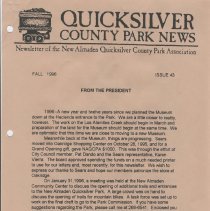
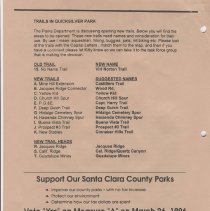
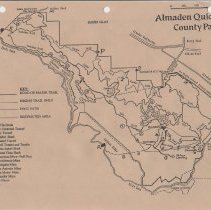
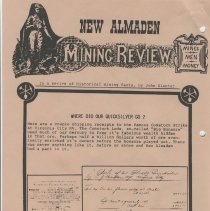
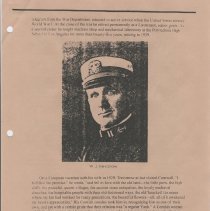
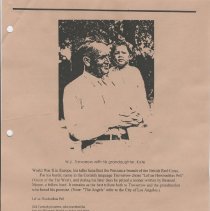
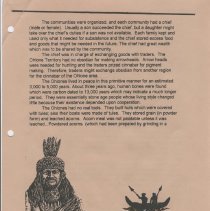
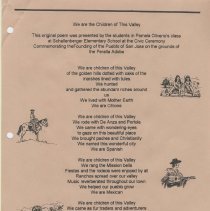
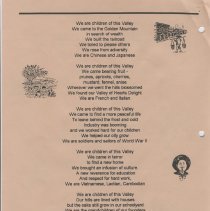
TITLE: Quicksilver County Park News SUBTITLE: Newsletter of the New Almaden Quicksilver County Park Association Issue # 43 Fall [actually winter] 1996 Newsletter of the New Almaden Quicksilver County Park Association FROM THE PRESIDENT 1996--A new year and twelve years since we planned the Museum down at the Hacienda entrance to the Park. We are a little closer to reality, however. The work on the Los Alamitos Creek should begin in March and preparation of the land for the Museum should begin at the same time. We are optimistic that this time we are close to moving to a new Museum. Meanwhile back at the Museum, things are progressing. Sears moved into Oakridge Shopping Center on October 28, 1995, and for a Grand Opening gift, gave NAQCPA $1000. This was through the effort of City Council member, Pat Dando and the Sears representative, Karen Vierra. The board approved spending the funds on a much needed printer to use for our letters and, most recently, for this newsletter. We wish to express our thanks to Sears and hope our members patronize the store at Oakridge. On January 31,1996, a meeting was held at the New Almaden Community Center to discuss the opening of additional trails and entrances to the New Almaden Quicksilver Park. A large crowd was on hand to discuss the opening of trails for mountain bikes. A task force was set up to work on the final draft to go to the Park Commission. If you have some suggestions regarding the Park, please call me at 268-6541. Enclosed you will find maps and some suggestions presented by the Parks Department. Kittly Monahan TRAILS IN QUICKSILVER PARK The Parks Department is discussing opening new trails. Below you will find the areas to be opened. These new trails need names and consideration for their use. By use I mean: equestrian, hiking, buggies, pets, mt.biking etc. Please look at the trails with the Capital Letters , match them to the map, and then if you have a comment please let Kitty know so we can take it to the task force group that is making the decision. OLD TRAIL 15. No Name Trail NEW NAME Virl Norton Trail NEW TRAILS A. Mine Hill Extension B. Jacques Ridge Connector C. Yellow Kid D. Church Hill Spur E. P.G.&E. F. Deep Gulch Trail G. Hidalgo Cemetery Spur H. Hacienda Chimney Spur I. Buena Vista Trail J. Prospect #3 Trail K. New Stables NEW TRAIL HEADS R. Jacques Ridge S. Calif. Ridge T. Guadalupe Mines SUGGESTED NAMES Castillero Trail Wood Rd. Yellow Kid Church Hill Spur Capt. Harry Trail Deep Gulch Trail Hidalgo Cemetery Spur Hacienda Chimney Spur Buena Vista Trail Prospect #3 Trail Cinnabar Hills Trail Jacques Ridge Cal. Ridge/Quartz Canyon Guadalupe Mines Support Our Santa Clara County Parks Improve our county parks -with no tax increase n Protect our environment r Determine how our tax dollars are spent Vote "Yes" on Measure "A" on March 26, 1996 NEW ALMADEN MINING REVIEW In a series of historical mining facts, by John Slenter WHERE DID OUR QUICKSILVER GO 7 Here are a couple shipping receipts to the famous Comstock Strike at Virginia City NV. The Comstock Lode, so-called "Big Bonanze" used much of our mercury to free it's fabulous wealth hidden in that ore. Perhaps half a billion dollars worth of ore even-tually enriched it's owners before the bonanza played out. There was never anything like it, before or since and New Almaden had a part in it. RECEPTION FOR THE NEW DIRECTOR,PAUL ROMEO Come and meet Paul On Saturday, March 9,1996 At the New Almaden Mining Museum 4:OOp.m. to 6:OOp.m. Wine and Cheese Sponsored by N.A.Q.C.P.A. "To Our New Director..." by Christopher Crockett, Parks Volunteer Coordinator I wood like to forego my regular message this issue so that I may introduce you to an important, member of our County Parks family He is the new Director o: the Santa Clara County Parks & Recreation Department- Mr. Paul Romero He comes to us from Riverside County in Southern California where he worked for twenty-three years with he Riverside County Parks & Open Space District Paul is a graduate of California State University at Long Beach where he received Bachelors and Masters degrees in Biology. While in college he worked in the University's natural history museum, conducting taxidermy and exhibit design As a graduate student he also aid salt marsh research for the California Department of Fish & Game at Anaheim Bay This work lead to a Masters Degree and the designation of the marsh as Anaheim Bar, National .Wildlife Refuge While studying for the Masters Degree, Paul worked for two years as a park ranger with the City of Long Beach There, he received law enforcement training and helped develop the Ranger Program. This experience was rewarding to Paul. and ultimately led to his long careerin parks & recreation administration. After graduate school, Paul joined the Riverside County Parks Department as an Interpetive Specialist. While there he created the Departments Interpretive Program, and helped develop various interpretive centers. After seven years working as an Interpretive Specialist, Paul was promoted to Deputy Director in charge of planning, development and operations In 1985, Paul was selected as the Riverside County Parks Director During his tenure. Paul was actively affiliated with many professional and community organizations including the Boy Scouts of America, the National association of Interpreters, the California Pules & Recreaton Society and the County Parks & Open Space Administrators Association of California. Paul also received many awards during his time in Riverside County including the California Trails Council Trail Leadership Award, the California Parks & Recreation Society Presidents Award, and the President's Environmental Challenge Award The latter award presented to him by then V'icePresident Dan Quayle Also during his time with Riverside County, Paul was a parks administration instructor at Mt San Jacinto College. Before leaving Riverside County Paul was instrumental in obtaining special distinct status for the Department through the California State Legislature It a a great honor to have Paul Romero assume the role Parks Director for the Santa Clara Parks & Recreation Department He comes to our area with his wife Joanne, and his sons. Jacob and Adam Paul looks forward to making the Santa Clam valley his home, and promises to devote full energy to the Santa Clam County Parks & Recreation Department He .has already stepped into action only two weeks after starting with the Department, by attending the December 1995 Volunteer Coordinating Council meeting. Welcome Paul County Parks Volunteers wish you and your family all the best In closing, I hope you all had the happiest of holiday seasons. and that you have only the best :n 1996 William J. Trevorrow: North America's "First" Cornish Bard by Gage McKinney /Editor's note. This article appeared in the Autumn 1995 issue of Cornish Worldwide, published by the London Cornish Association. NACQPA thanks editor Richard Bowden-Dan for permission to reprint it here). No one counts on the promise made by a child, except sometimes the adult who was that child. "When a small boy at New Almaden Mine in northern California-my birthplace," wrote the son of a miner, "I heard from the lap of my beloved Cornish grandmother the folklore, legends and old customs of her native land. She probably intended to plant the seed of Cornwall in my heart and mind. I promised when a man I would visit her native village. Long years passed." Fifty long years passed before the boy, grown into full maturity, fulfilled his promise. He went at last to Cornwall and in his affections adopted the land of his grandmother, which in turn adopted him. William John Trevorrow (1871-1951), son of John and Kate Trevorrow, was born at North America's largest mercury mine, situated in the coastal mountains of California, fifty miles south of San Francisco. His family descended from Trevorrows near Trevorrow Farm at White Cross, and from Bluetts and Geaches at Tywardreath, Cornwall. His ancestor John Bluett, a mine blacksmith, traveled to Peru with Richard Trevethick, the celebrated inventor and engineer. An entire generation of his family came to America and found their way to New Almaden. There William's childhood revolved around his family, the Methodist church and the mining camp school. He remembered his best suit that he wore only to church, the preaching and hymn singing. He remembered his mother making clotted cream; his first taste of ice cream one Fourth of July; the annual profusion of Spring wildflowers on the hillsides surrounding the camp-butter cups, white and yellow violets, jack-in-the-pulpits, blue flowers and golden poppies. At 14 he graduated from what he called an excellent grammar school where a learned headmaster taught physics and algebra to quadratics. He immediately went to work at the mine as a fireman for the boilers, and later beside his father and uncles underground. At 18 he went to San Francisco to serve a four-year apprenticeship as a machinist, working ten hour days, six days a week, starting at $4 per week. (This was probably less than half of what he had been earning at New Almaden. At the time an experienced miner earned about $20 a week). After his shift he took evening classes at the Mechanics Institute or an evening high school. On Sundays he read at the Mechanics Library or watched the ships at the waterfront. "If I had only gone to college!," Trevorrow wrote years later, but there was no encouragement for that. After completing his apprenticeship, Trevarrow joined the United States Navy as a machinist in August 1894, earning $70 a month and rations. He continued his education, completing courses in marine engineering. In May 1898, during the Spanish-American War, he was in the engine room of Admiral Dewey's flagship when the U. S. fleet made its daring raid into Manila Bay, destroyed the Spanish fleet and captured the city. The following year he stood with his shipmates on the capitol steps in Washington as President McKinley presented the Admiral a sword. Continuing his naval career he visited every continent and learned the ways of many cultures. Trevorrow retired from the navy in 1910, but after receiving a telegram from the War Department, returned to active service when the United States entered World War I. At the close of the war he retired permanently as a Lieutenant, senior glade. .As a second career he taught machine shop and mechanical laboratory at the Polytechnic Hihg School in Los Angeles for more than twenty-five years, retiring in 1939.. On a European vacation with his wife in 1929. Trevarrow at last visited Cornwall. "I fulfilled the promise," he wrote, "and fell in love with the old land-the little ports. the high lift,. the peaceful. quaint villages, the ancient stone antiquities, the lovely medieval churches. the hospitable people with their old-fashioned ways, the old 'knacked' tin mines where my kin had worked for many generations, the beautiful flowers-all, all of it awakened in my heart; appreciation." His Cornish cousins took him in, recognizing him as one of their own. and yet with a certain pride that their relation was "a regular Yank." A Cornish woman told Mrs. Trevorrow, also born to Cornish parents at New Almaden, that she spoke "just as the cinema stars do." Trevorrow returned to California, his luggage weighted with books on Cornish history, customs, mining, biography and especially the poems of Robert Stephen Hawker the Victorian vicar of Morwenstow. A few years later Trevorrow read a Los Angeles Times columnist's account of life in California's Mother Lode region. which included derogatory remarks about the Cornish in Grass Valley. The Cornish, the columnist wrote, had taken the mining jobs during World I when the Americans were in the military. and now. clannish and unpatriotic, they locked the .Americans Out. Trevorrow, whose grandfather began mining in California in the 1860's. refuted tile columnist's claims in a lengthy letter that appeared not only in The Times. but also in the Grass Valley Union and The Cornishman of Penzance. He described Cornwall's ancient mining heritage and explained the important role the Cornish played in Developing California s mineral resources. The letter concluded with the words. "I greet you in the old language of my kin Lowena re-gas-bo, lemmyn ha wosa hemma' (May you Face joy, now and hereafter)." (The newspapers deleted Trevorrow's insinuation that the columnist had been drinking.) Trevorrow received an apology from The Times and several laudatory letters. including one from R. Morton Nance of St. Ives, the Grand Bard of tile Gorsedd of Cornwall. Their correspondence continued over several years. About the same time Trevorrow began giving talks on Comwall before such groups as Lions clubs, the American University Women, Masonic lodges, the Fine Arts Club of Pasadena and the Laguna Woman's Club of Laguna Beach. He spoke in numerous Methodist churches and at the Welsh Presbyterian Church in Los Angeles. Sometimes he appeared jointly with the Cornish Choir of the Southern California Cornish Association and sometimes with a photographer who showed film footage of Cornwall. He spoke on such topics as "Ballads of Cornwall," "King Arthur, the Grill and the Bards," and "Folk Verse and Idioms of the Cornish Language," making more than 100 appearances before various groups. He was the state's best-known Cornish-American. In Spring 1937 Trevarrow was surprised to receive a letter from Nance inviting him to "the ancient stone circle of Boscawen-Un to be initiated into the Order of the Bards" at a gathering called the Gorsedd. The Trevorrows crossed the ocean to attend the bardic ceremony. taking in Ireland and Scotland on the way. "Mrs. Trevorrow. who was on top of a J stone hedge overlooking the circle. and I at that historical place made venerable by our kin of old." Trevorrow wrote, "heard the words and songs of the Gorsedd in the Comish language of our folk. that was spoken by them the thousands of years-against the 200 to 300 years of English--and felt that in 'old time' we had heard it before." Trevorrow was one of thirteen who became bards in accordance, so far as one knows, with ancient ceremony. Among those inducted with him were a well-known singer, a music director, a clergyman who had written a local history, a founder of a Methodist historical society and others, including several who had passed an examination in the Cornish language. Perhaps it was Trevorrow's presence that prompted a speech by one of the bards. Canon H. R. Jennings, regarding the "Cornish across the seas." They "seem more loyal and zealous" than the Cornish at home, he said. It was the duty of the Comish at home, and of those he called Sojourners who had adopted Cornwall as their land, to help those overseas "become self-conscious that they are a race apart with great traditions and a noble heritage." Newspapers in California and Cornwall reported Trevorrow% s unique stature as the "First" bard in the New World. (Actually two other Americans, Roger and Laura Hibbard Loomis, had been made "honorary bards" in 1930. Authorities on Arthurian legend. they were professors at Columbia University.) Newspapers in San Jose and Oakland wrote editorials praising his accomplishment. Following his initiation he enjoyed contacts with Celts in many lands and every Christmas he sent special cards to each of the roughly 135 bards. He continued giving his talks on Cornwall as well as on Abraham Lincoln and the poems of Emily Dickinson. Sometimes he spoke about his experiences at sea. After the opening of World War II in Europe, his talks benefited the Penzance branch of the British Red Cross. For his bardic name in the Cornish language Trevorrow chose "Lef an Howlsedhas Pell" Voice of the Far West), and during his later days he prized a sonnet written by Bernard Moore. a fellow bard. It remains as the best tribute both to Trevorrow and the grandmother who heard his promise. (Note: "The Angels" refer to the City of Los Angeles.) Lef an Howlsedhas Pell Old Cornish pioneers. who traveled far Into the Western World to delve and mine, Found kindly Fortune on their labours shine, And made new homes beneath an alien star. So you returned from storm and stress of war to join the angels." earthly, not divine, And planned to finish off your Life's design 'Neath sunny skies where peace and plenty are. Then the clear call that would not he denied Brought .you across the fare,estranging seas To Cornish shores silvered with fret of foam. And in the little ports, on morelands wide. In ancient churches, quiet villages. And Cornish hearts. you knew that you were home. By all accounts the ceremonies were disappointing the year that Trevorrow was initiated. "Once more the Gorsedd of Cornwall has assembled, performed its rites for an hour, and dispersed as barren of result as the very stones that outcrop on the Cornish moors," read a column in the Royal Cornish Gazette (18 August 1937, p. 4). The Western Morning News wrote. "The Gorsedd has scarcely touched the life of the common people of Cornwall at a single point." Though these writers anticipated its early demise. the Gorsedd has survived through the years, creating bards, encouraging study of the Cornish language and recognizing those in Cornwall, the United Kingdom and around the world who have manifested the Celtic spirit in work done for Cornwall. Since Trevorrow's time the Gorsedd has initiated at least ten Americans, and several bards now live in Canada. Most recently, in 1993, the Gorsedd initiated Edgar Hellum. who worked for much of his life to create the Pendarvis Historic Site in Mineral Point, Wisconsin. In 1995 it initiated Jim Jewell, also of Wisconsin, who wrote a history of a Cornish settlement and worked to make Cornish literature available in America. from "THE NEW ALMADEN CORNISH CENSUS" (Note : The "New Almaden Cornish Census" is an ongoing research project that is attempting to catalog all the inhabitants of the "Englishtown" settlement on Mine Hill. The census primarily includes individuals and families from Cornwall, Ireland and England. Gage McKinney is the project director: Ruth Brown and John Fault. researchers. and Russ Pearce. advisor). TREVORROW, John Birth date: June 1847 Place of birth: Cornwall, England Occupation. miner Employed by Quicksilver Mining CO. Relations: Katherine Geach Trevorrow, wife Birth: Dee 1855 Place England Children: William J. Trevorrow, son Birth: 6 Oct 1871 Place: New Almaden Kate O. Trevorrow, dau Birth: Oct 1892 Place. California Cora M. Trevorrow, dau Birth: Nov 1895 Place: California Sources: A Contested Election, 1887: Census, Santa Clara County, 1900, p 21: Great Register 1906. Notes: John Trevorrow worked in Virginia City and Bodie as well as New Almaden. Their son William was a Lieutenant in the U. S. Navy and chief machinist on Dewey's Flagship Olympia at the Battle of Manila in, 1898. After retiring from the navy he was a teacher at J H Polytechnic High School in Los Angeles. He became a student of Conish culture and was made a bard in 1937, First North American to obtain the full honor. Cora Trevorrow Bach attended Methodist Church Day at New AImaden on 13 May 1995. March 6,7.8,9,10 San Mateo Trade Show 2p.m. to 10p.m. we will have a Park booth If you can help call Kitty 268-6541 March 17, 1996 New Almaden Community Club Progressive Dinner. Call Peggy Melbourne 268-8331 March 9, 1996 Reception for Paul Romero, Park Director, at New Almaden Mining Museum, 4:OOp.m. to 6:OOp.m. March 30, 1996 Wild Flower Hike. Meet at 9:OOa.m. at the MacAbee entrance. Bring lunch. March 31, 1996 Hike Fortini Trail at Santa Teresa Park at 10:OOa.m. Meet at Stiles Ranch entrance on Fortini Rd. Bring lunch. April 6, 1996 Volunteer Recognition. Sanborn Park 11:OOa.m. April 20, 1996 Earth Day. Clean up of Coyote Lake. Meet at Coyote Lake 10:OOa.m. Call Kitty for further info. April2l, 1996 Equestrian tour Quicksilver 9:30a.m. Meet at Hacienda entrance, bring lunch. April 27, 1996 TRAIL DAY: NEW ALMADEN QUICKSILVER PARK Meet at the Hacienda entrance. Bring hoe, shovels, rakes, gloves 9:OOa.m. to 12 noon. We will provide lunch and a morning snack. June 1, 1996 National Trail Day: We will be working on a trail at Calero Park. 9:OOa.m. at Ranger Station at Calero. June2, 1996 Preservation Conference , National Assoc. Tour of Quicksilver Park 9:30a.m. to 2:30 p.m. June 9, 1996 Equestrian Tour, Trail Watch Program Quicksilver Park. 9:30a.m. meet at the Hacienda, bring horse and lunch. Vote "Yes" on Measure "A" on March 26, 1996 Ohlone Triblets Thousands of years ago, groups of people crossed a narrow strip of land from Asia to North America. As time passed, some of these people wandered to the south to milder climates. One such group settled in the San Francisco Bay Area. These were the Ohlones. The Spanish called these people Costanoans, which means people of the coast, but the descendents prefer to be called Ohlone (Oh-lone ee). California did not have tribal nations such as the Navaho, and this -caused problems with the federal government because the Bureau of Indian Affairs does not recognize triblets such as those which existed in what is now California. For that reason, protection and benefits have been difficult for the Ohlone decedents to obtain. Fortunately, local municipalities have been more cooperative in observing Ohlone's rights to property in recent developments. The Tamien (named for the triblet of this area) Station of the Santa Clara light rail system proceeded after archaeological research had been performed. The people who lived in the Bay Area occupied a roughly rectangular area from south of North San Francisco Bay to Soledad and from the Pacific Ocean to the Diablo Range. They consisted of 40 triblets with similar traits. It has been estimated that there were 10,000 people living in this area when the Spanish arrived in about 1769 and they spoke eight to 12 different languages. The communities were organized, and each community had a chief (male or female). Usually a son succeeded the chief, but a daughter might take over the chiefs duties if a son was not available. Each family kept and used only what it needed for subsistence and the chief stored excess food and goods that might be needed in the future. The chief had great wealth which was to be shared by the community. The chief was in charge of exchanging goods with traders. The Ohlone Territory had no obsidian for making arrowheads. Arrow heads were needed for hunting and the traders prized cinnabar for pigment making. Therefore, traders might exchange obsidian from another region for the cinnabar of the Ohlone area. The Ohlones lived in peace in this primitive manner for an estimated 3,000 to 5,000 years. About three years ago, human bones were found which were carbon dated to 13,000 years which may indicate a much longer period. They were essentially stone age people whose living style changed little because their existence depended upon cooperation. The Ohlones had no real tools. They built huts which were covered with tules; also their boats were made of tules. They stored grain (in powder form) and leached acorns. Acorn meal was not palatable unless it was leached ...Powdered acorns (which had been prepared by grinding in a mortar and pestle to baby powder consistency) were soaked in boiling water until the tanin was removed. The Ohlones made watertight baskets which were heated by carefully immersing hot stones into the basket of water; the, acorn meal was then introduced. The acorn paste was an important part of the diet. Men were the hunters and fishermen. They prepared for the hunt by spending time in the sweat house in order to purge human odors and prepare spiritually. Hunters would don deer helmets and blend in with the deer until close enough to shoot an arrow. The deer would be returned to the village to be shared by all members of the triblet. Fish were shared also. There were rules for choosing a mate. They could not marry within a family or the triblet. At a ceremonial gathering of triblets, a boy would select a girl. The boy's uncle would deliver gifts to the girl's triblet. If the arrangement was satisfactory, the boy would stay at the girl's triblet for several months during which time he was evaluated. If the family approved of him, the couple would be married at the girl's triblet, but return to live at his triblet as a married couple. Divorce was not encouraged but it was accepted if the couple were not compatible. The Ohlones had a spiritual leader/doctor known as the shaman, usually a man in spiritual matters and a woman for curing sickness. The European conquistadores arrived in 1769 but did not stay. The conquistadors were followed by the Franciscans who came to save souls. They built missions of which six were in Ohlone territory. The two most familiar to us are Mission San Jose and Mission Santa Clara. The Ohlones went to the mission out of curiosity. They were baptized. and, as a result, lost their freedom and religion. Unfortunately, the Europeans brought diseases which the Ohlones had not encountered and the population decreased from 10,000 when the Europeans arrived to100 by about 1800. So it was that the Ohlones, who lived at peace and with the land for thousands of years. were ravaged by a civilization which sought to save them! Richard Wachs Illustrations by Michael Harney from The Ohlone Way by Malcolm Margolin We are the Children of This Valley This original poem was presented by the students in Pamela Oliverio's class at Schallenberger Elementary School at the Civic Ceremony Commemorating the Founding of the Pueblo of San Jose on the grounds of the Peralta Adobe We are children of this Valley of the golden hills dotted with oaks of the marshes lined with tules We hunted and gathered the abundant riches around us We lived with Mother Earth We are Ohlone We are children of this Valley We rode with De Anza and Portola We came with wondering eyes to gaze on this beautiful place We brought padres and Christianity We named this wonderful city We are Spanish We are children of this Valley We rang the Mission bells Fiestas and the rodeos were enjoyed by all Ranchos spread over our valley Music reverberated throughout our town We helped our pueblo grow We are Mexican We are children of this Valley We came as fur traders and adventurers We discovered the beauty of the land We found gold in the foothills and riches in business We brought Statehood We are American We are children of this Valley We came to the Golden Mountain in search of wealth We built the railroad We toiled to please others We rose from adversity We are Chinese and Japanese We are children of this Valley We came bearing fruit -prunes, apricots, cherries, mustard, fennel, anise Wherever we went the hills blossomed We found our Valley of Hearts Delight We are French and Italian We are children of this Valley We came to find a more peaceful life To leave behind the frost and cold Industry was booming and we worked hard for our children We helped our city grow We are soldiers and sailors of World War 11 We are children of this Valley We came in terror to find a new home We brought an infusion of culture. A new reverence for education And respect for hard work, We are Vietnamese, Laotian, Cambodian We are children of this Valley Our hills are lined with houses but the oaks still grow in our schoolyard We are the grandchildren of our founders We are the hope of our parents We are children of this Valley We are the future Illustrations from Ralph Rambo's Pen and Inklings |
People |
Crockett, Chris (Christopher) McKinney, Gage Monahan, Kitty Romero, Paul Slenter, John Trevorrow, William J. Wachs, Richard |
Cataloged by |
Meyer, Bob |