
Archive Record
Images
Additional Images [10]
Metadata
Catalog number |
2015.8.434 |
Object Name |
Manuscript |
Description |
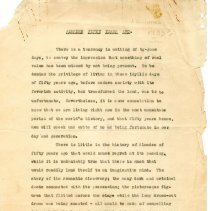
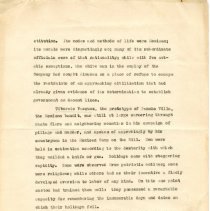
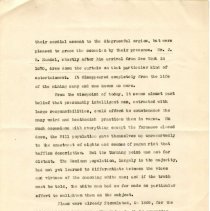
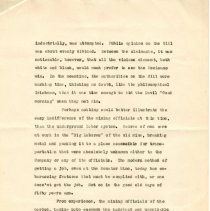
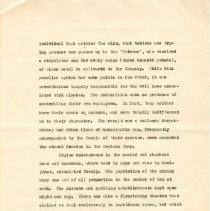
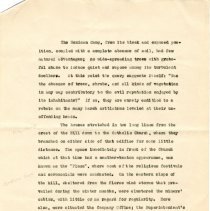
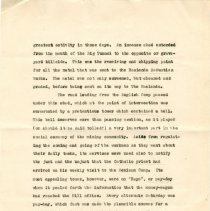
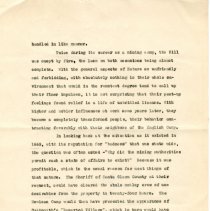
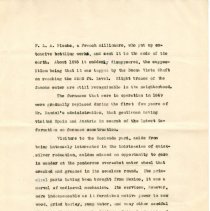
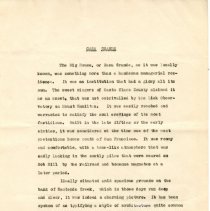
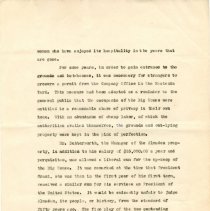
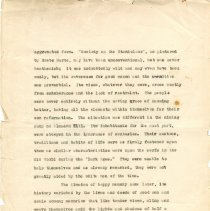
ALMADEN FIFTY YEARS AGO written by A. C. Innis in 1925. There is a tendency in writing of by-gone days, to convey the impression that something of real value has been missed by not being present. To be denied the privilege of living in to those idyllic days of fifty years ago, before modern society with its feverish activity, had transformed the land, was to be unfortunate. Nevertheless, it is some consolation to know that we are living right now in the most momentous period of the world's history, and that fifty years hence, men will speak and write of us as being fortunate in our day and generation. There is little in the history of Almaden of fifty years ago that would cause regret at its passing, while it is undeniably true that there is much that would readily lend itself to an imaginative mind. The story of its romantic discovery; the many dark and criminal deeds connected with its possession; the picturesque figures that flitted across the stage while the long drawn-out drama was being enacted - all could be made of compelling interest in the hands of an artist, but nothing to weep over. For nearly twenty years, California had been a member of the Sisterhood of States; yet the New Almaden Mines, for all practical purposed, remained a Mexican institution. Its modes and methods of live were Mexican; its morals were disgustingly so; many of its subordinate officials were of that nationality; while with few notable exceptions, the white men in the employ of the Company had sought Almaden as a place of refuge to escape the restraints of an approaching civilization that had already given evidence of its determination to establish government on decent lines. Tiburicio Vasquez, the prototype of Pancho Villa, the Mexican bandit, was still at large careering through Santa Clara and neighboring counties in his campaign of pillage and murder, and spoken of approvingly by his countrymen in the Mexican Camp on the Hill. Men were held in estimation according to the dexterity with which they wielded a knife or gun. Holidays came with staggering rapidity. Some were observed from patriotic motives; some were religious; while others had as their incentive a finely developed aversion to labor of any kind. On this one point custom had trained them well; they possessed a remarkable capacity for remembering the innumerable days and dates on which their holidays fell. One of the peculiar things connect with the numerous saturnalias of wanton waste and debauchery, was the complacent attitude of the mining authorities. To all appearances these worthy gentlemen not only gave their cordial assent to the disgraceful orgies, but were pleased to grace the occasion by their presence. Mr. J. B. Randol, shortly after his arrival from New York in 1870, drew down the curtain on that particular kid of entertainment. It disappeared completely from the life of the mining camp and was known no more. From the viewpoint of today, it seems almost past belief that presumably intelligent men, entrusted with large responsibilities, could afford to countenance the many weird and heathenish practices then in vogue. On such occasions with everything except the furnaces closed down, the Hill population gave themselves up unreservedly to the enactment of sights and scenes of pagan riot that baffles description. But the turning point was not far distant. The Mexican population, largely in the majority, had not yet learned to differentiate between the vices and virtues of the oncoming white man; and if the truth must be told, the white man had so far made no particular effort to enlighten them on the subject. Plans were already formulated, in 1869, for the regeneration of Almaden. The delay in their execution arose from the fact that title to the vast properties was still in abeyance. Until that important matter had been definitely decided, no progress, either socially or industrially, was attempted. Public opinion on the Hill was about evenly divided. Between the claimants, it was noticeable, however, that all the vicious element, both white and black, would much prefer to see the Mexicans win. In the meantime, the authorities on the Hill were marking time, thinking no doubt, like the philosophical Irishman, that it was time enough to bid the Devil "Good morning" when they met him. Perhaps nothing could better illustrate the easy indifference of the mining officials at this time, than the underground labor system. Scores of men were at work in the "Big Labores" of the old mine, breaking metal and packing it to a place accessible for transportation that were absolutely unknown either to the Company or any of its officials. The modern method of getting a job, even at the Senator mine, today has embarrassing features that must be complied with, or one doesn't get the job. Not so in the good old days of fifty years ago. From experience, the mining officials of the period, taking into account the indolent and unreliable character of the element they had to contend with, had simplified matters as far as work in the big metal producing "Labores" was concerned. Instead of the present practice of taking the name, time and ability of each individual that entered the mine, that tedious and trying process was passed up to the "Patrone", who received a stipulated sum for every cargo (three hundred pounds), of clean metal he delivered to the Company. While this peculiar system had some points in its favor, it was nevertheless largely responsible for the evil name associated with Almaden. The authorities made no pretense of controlling their own employees. In fact, they neither knew their names or numbers and were totally indifferent as to their character. The result was - outlaws; desperadoes; and other kinds of undesirable men, frequently accompanied by the female of their species, were accorded the utmost freedom in the Mexican Camp. Orgies underground in the worked out chambers were not uncommon, where beer in kegs and wine in demijohns, circulated freely. The population of the mining camp was out of all proportion to the number of men at work. The saloons and gambling establishments kept open night and day. There was also a flourishing theatre that claimed to deal exclusively in legitimate drama, but which would hardly survive the critical gaze of the modern censor. Money was plentiful, as payment for clean metal could be had on delivery, a kind of glorified pay-day, which was admirably suited to the improvident Mexicans. The Mexican Camp, from it's bleak and exposed position, coupled with a complete absence of soil, had few natural advantages; no wide-spreading trees with grateful shade to induce quiet and repose among its turbulent dwellers. At this point the query suggests itself: "Was the absence of trees, shrubs, and all kinds of vegetation in any way contributory to the evil reputation enjoyed by its inhabitants?" If so, they are surely entitled to a rebate on the many harsh criticisms leveled at their unoffending heads. The houses stretched in two long lines from the crest of the Hill down to the Catholic Church, where they branched on either side of that edifice for some little distance. The space immediately in front of the Church which at that time had a weather-beaten appearance, was known as the "Plaza", where most of the religious festivals and ceremonials were conducted. On the eastern slope of the hill, sheltered from the fierce wind storms that prevailed during the winter months, were clustered the miner's cabins, with little or no regard for regularity. Here also, were situated the Company Office; the Superintendent's residence, and various other buildings for the accommodation of the Company employees. The "Big Planilla", which occupied all the flat space at the base of Mine Hill, was the scene of Almaden's greatest activity in those days. An immense shed extended from the mouth of the Big Tunnel to the opposite or graveyard hillside. This was the receiving and shipping point for all the metal that was sent to the Hacienda Reduction Works. The metal was not only screened, but cleaned and graded, before being sent on its way to The Hacienda. The road leading from the English Camp passed under this shed, which at the point of intersection was surmounted by a pretentious tower which contained a bell. This bell deserves more than passing mention, as it played (or should it be said tolled?) a very important part in the social economy of the mining community. Aside from regulating the coming and going of the workmen as they went about their daily tasks, its services were used also to notify the just and the unjust that the Catholic priest had arrived on his weekly visit to the Mexican Camp. Its most appealing tones, however, were on "Raya", or pay-day when it pealed for the information that the money-wagon had reached the Hill office. Every alternate Saturday was pay-day, which fact was made the plausible excuse for a half-holiday. Its use as a fire alarm was purely perfunctory, as there was no water for any purpose in the Mexican Camp except that which was brought in on the backs of a burro pack-train. Fire wood for domestic use was also handled in like manner. Twice during its career as a mining camp, the Hill was swept by fire, the loss on both occasions being almost complete. With the general aspects of Nature so unfriendly and forbidding, with absolutely nothing in their whole environment that would in the remotest degree tend to call up their finer impulses, it is not surprising that their pent-up feelings found relief in a life of unbridled license. With higher and nobler influences at work some years later, they became a completely transformed people, their behavior contrasting favorable with their neighbors of the English Camp. In looking back at the situation as it existed in 1869, with its reputation for "badness" that was state wide, the question was often asked - "Why did the mining authorities permit such a state of affairs to exist?" Because it was profitable, which is the usual reason for most things of that nature. The Sheriff of Santa Clara County at their request, could have cleared the whole motley crew of undesirables from the property in twenty-four hours. The Mexican Camp would then have presented the appearance of Goldsmith's "Deserted Village", which in turn would have disastrously affected the financial arrangements of the local firm of Butterworth and Brenham, who held the concession as sole trader from the New York company. THE ENGLISH CAMP A few white families comprised what was known then, and has been since, as the English Camp. Their modest cottages, in irregular fashion, nestled amid the rank shrubbery on the sloping hillsides. It was mutually understood and for a great many years strictly adhered to, that Mexicans or their families would not be permitted to take up their residence within the sacred precincts of the English Camp. While no ruling had been issued by the authorities on the matter, the understanding nevertheless was religiously observed for a life time. If any racial feeling existed, it was diplomatically submerged. Many of the Mexicans were American citizens, having become so through the admission of the State into the Union, while the English residents could only obtain that distinguished honor through the usual legal process. The rise of the English Camp was rapid after Mr. Randol's arrival. With the store as a central point, the Hill office and other Company buildings were removed from the Mexican Camp and conveniently arranged to meet the changes that were imminent. The better class of white workmen were extended a cordial welcome. Being mostly English, they availed themselves of the offer and in many cases built cozy homes in anticipation of bringing their relatives from the Old Country to share their fortunes in the New World. In outward appearance, most of the houses in the English Camp were plain and unpretentious; giving but slight intimation of the refined and artistic arrangements of the interior. In later years the Mining Company fostered and stimulated in various ways, all efforts on the part of workmen to make their homes neat and presentable. Aiming to be impartial, a glance at the local officials of the time reveals the melancholy fact that there were no giants among them. From the kind of work and the class of workmen, it could hardly be expected that men of unusual stature would thrive. Later, when large things had to be done, large men were found to fit the occasion. THE HACIENDA Always recognized as the seat of the mighty, it has enjoyed the benefit of constant and interested supervision from those in authority. Having many natural advantages, it only required a touch here and there to keep it in a state of perpetual prettiness. The changes have been so gradual and easy that it would be difficult to tell accurately when the Hacienda reached the zenith of its glory. We know that years after the decline of the mining industry on the Hill, when things in the bustling camp had visibly slowed down, the Hacienda still retained a spick-and-span appearance, strong in its belief that Almaden, phoenix-like, would rise again. From the earliest times until about twenty years ago, it was considered quite a distinction to be permitted to live at the Hacienda. Families with budding aspirations have been rudely shocked on being informed that a probationary period on the Hill would be necessary before their claims to admission could be considered. Fifty years ago, the County Road came to an abrupt end at the Post Office. Beyond that was Company property. The Hotel, which some years later was burned to the ground, stood on what is now the vacant space between the gate and the Blacksmith shop. A rather substantial building, painted a bright yellow, with vermilion colored roof and trimmings, it harmonized nicely with the surroundings. Immediately behind the Hotel, nearly in the center of what is now the creek-bed, stood the pagoda-like structure that covered the famous medicinal spring, known far and wide as the "Almaden Vichy Spring". During the Civil War it had been used as a source of revenue, the concession being held by F. L. A. Pioche, a French millionaire, who put up extensive bottling works, and sent it to the ends of the earth. About 1895 it suddenly disappeared, the supposition being that it was tapped by the Buena Vista Shaft on reaching the 2200 ft. level. Slight traces of the famous water are still recognizable in the neighborhood. The furnaces that were in operation in 1869 were gradually replaced during the first few years of Mr. Randol's administration, that gentleman having visited Spain and Austria in search of the latest information on furnace construction. Visitors to the Hacienda yard, aside from being intensely interested in the intricacies of quicksilver reduction, seldom missed an opportunity to gaze in wonder at the ponderous over-shot water wheel that creaked and groaned in its ceaseless round. Its principal parts having been brought from Mexico; it was a marvel of mediaeval mechanism. Its services, however, were indispensable as it furnished motive power to saw wood, grind barley, pump water, and many other needful things. It was among the last remaining land-marks of the Mexican occupancy to be removed. CASA GRANDE The Big House, or Casa Grande, as it was locally known, was something more than a handsome managerial residence. It was an institution that had a glory all its own. The sweet singers of Santa Clara County claimed it as an asset, that was not outrivaled by the Lick Observatory on Mount Hamilton. It was easily reached and warranted to satisfy the soul cravings of the most fastidious. Built in the late fifties or the early sixties, it was considered at the time one of the most pretentious homes south of San Francisco. It was roomy and comfortable, with a home-like atmosphere that was sadly lacking in the costly piles that were reared on Nob Hill by the railroad and bonanza magnates at a later period. Ideally situated amid spacious grounds on the bank of Hacienda Creek, which in those days ran deep and clear, it was indeed a charming picture. It has been spoken of as typifying a style of architecture quite common in the South during slavery days, with broad verandas and complete absence of useless ornamentation. Aside from its charm as a country residence, its chief claim to be remembered will rest on the remarkable number of famous men and women who have enjoyed its hospitality in the years that are gone. For some years, in order to gain entrance to the grounds and hot-houses, it was necessary for strangers to procure a permit from the Company Office in the Hacienda Yard. This measure had been adopted as a reminder to the general public that the occupants of the Big House were entitled to a reasonable share of privacy in their own home. With an abundance of cheap labor, of which the authorities availed themselves, the grounds and out-lying property were kept in the pink of perfection. Mr. Butterworth, the Manager of the Almaden property, in addition to his salary of $25,000.00 a year and perquisites, was allowed a liberal sum for the up-keep of the Big House. It was remarked at the time that President Grant, who was then in the first year of his first term, received a similar sum for his services as President of the United States. It would be eminently unfair to judge Almaden, its people, or history, from the standard of fifty years ago. The fine play of the two contending civilizations were at work then, the outcome of which was never in doubt. Other mining communities in California were passing through, or had passed, the same ordeal in less aggravated form. "Society on the Stanislaus", as pictured by Bret Harte, may have been unconventional, but was never heathenish; it was undoubtedly wild and may even have been woolly, but its reverence for good women and the amenities was proverbial. Its vices, whatever they were, arose mostly from exuberance and the lack of restraint. The people were never entirely without the saving grace of knowing better, having all the elements within themselves for their own reformation. The situation was different in the mining camp on Almaden Hill. Its inhabitants for the most part, were steeped in the ignorance of centuries. Their customs, traditions and habits of life were as firmly fastened upon them as similar characteristics were upon the serfs in the Old World during the "Dark Ages." They were unable to help themselves and as already remarked, they were not greatly aided by the white men of the time. The Almaden of happy memory came later, its history enriched by the lives and deeds of good men and noble women; memories that like tender vines, cling and weave themselves amid the lights and shadows of half a century. A.C. INNES. |
People |
Hauck, Fred (F.P., Jr., Sr.) Innes, Alex (A.C.) (Ennis) Vasquez, Tiburcio Randol, James Butterworth Pioche, F.L.A. |
Cataloged by |
Wicks, Susan |
Credit line |
Donated by the Wright-Hauck family |