
Archive Record
Images
Additional Images [12]
Metadata
Catalog number |
1997.2.2622 |
Object Name |
Newsletter |
Date |
1997 |
Description |
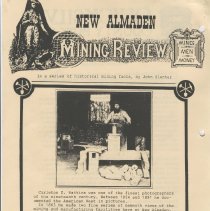
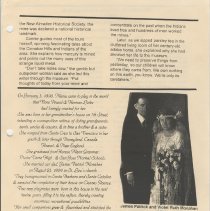
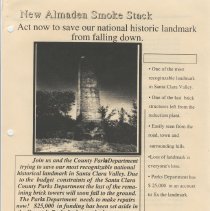
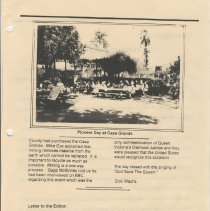
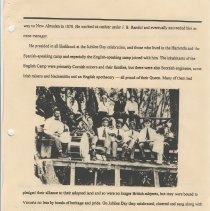
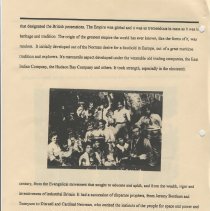
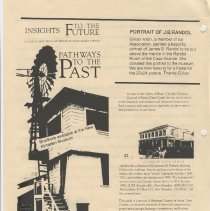
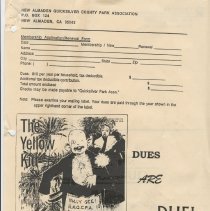
TITLE: Quicksilver County Park News SUBTITLE: Newsletter of the New Almaden Quicksilver County Park Association Issue # 50 Winter 1997 - 1998 QUICKSILVER COUNTY PARK NEWS Ncwslcttcr of the New Almaden Quicksilvcr County Park Association WINTER 1997-1998ISSUE 50 PRESIDENT'S MESSAGE After some months of negotiation, retrofitting for earthquakes, and financial planning, the Casa Grande became part of the Santa Clara County Parks and Recreation Dept. on December 31, 1997. Now, we as an association have our work cut out for us. When Howard Shurman has the plans completed and the cases, etc. ready for installation we will call on you for some help in moving the artifacts to their new site. Many of you have already given your name and number and I will be contacting you when the time comes. The designer has been given the deadline of March 30. 1998 to be completely finished with the Museum ready to open. In addition to helping set the artifacts in their proper places, we hope to have more docent hours available so that we can be open Fridays, Saturdays and Sundays. If you can give some hours throughout the year after March 30, please contact me as to your availability. At present, the docents do four hours five or six times a year There are 17 board members and 12 docents who together have put in 3649 hours just in the past two years. This is truly remarkable for a volunteer association within the S.C.C. Parks Dept. The New Almaden Quicksilver County Park has a new face at the Hacienda entrance in New Almaden. The site has been cleaned and trees have been planted along with native grasses. A landscaping plan is in progress which will feature the facade of the old mine office for the museum's outdoor artifacts, picnic tables, trails, parking for trailers in the equestrian area and parking for picnikers and hikers. The Parks Dept. will be calling on you for ideas for this site. A public meeting will be held to get your input. Exciting times! Finally!The rest of the park stays the same for the present. In March a bid will go out for the clean-up of five other sites in the park. Notification will be given to the public when these sites are closed for a few days as work is being completed. After this, probably in 1999, the entire park will be opened to the public. Lets keep working to make this-happen. So 1998 proves to be a very interesting and exciting year. Thanks for all of your concerns and input during 1997. The Association has close to 515 members who care for this park and the history, geology, recreation and natural habitat that provide such a relief in this fast-paced world. Kitty (408) 268-6541 In a series of historical mining facts, by John Slenter Carleton E. Watkins was one of the finest photographers of the nineteenth century. Between 1854 and 1891 he documented the American West in pictures. In 1863 He made two fine series of mammoth views of the mining and manufacturing facilities here at New Almaden. This picture was called "Preparing the flasks", analbumen silver print. It shows a man filling flasks with quick-silver and weighing them with 76 pounds of mercury. BREAKFAST-TIME WAS A GOOD TIME TO CALL by Pat Loomis I knew Clyde Arbuckle a very long time-since I was a brunette and Clyde had hair. I was a cub reporter on the San Jose News when I discovered this city's greatest historical resource. He helped me write of A. D. M. Cooper, four months after I joined the News staff. It was the first of many historical articles I would write with the help of Clyde Arbuckle. For more than 40 years I interrupted the Arbuckles' breakfasts looking for sources of information for "Signposts" and other historical pieces. I attended his night school classes at old San Jose High, at Lowell, and at Markham. I have 29 notebooks filled with notes taken in Clyde's classes at Markham and on the bus trips dating back to the Overland trek of 1977, my first with Clyde and Mary Mueller. There were many other trips, but still get shivers remembering the deep wagon ruts at Guernsey, Wyoming, and walking with Clyde and Nebraska historian Paul Henderson at Courthouse Rock. I still feel the sadness and disappointment shared with Frazier Reed and Clyde when we discovered the grave marker of Mrs. Keyes vandalized at Alcove Springs. Clyde always had a way of making history come alive and the people who made our history real. He made history exciting and colorful, and he never let anyone down who asked a historical question. I owe a great deal to that tall, gentle man, as do all of us in the Argonauts, OCTA, and the other historical and educational groups throughout the West who had the honor of knowing him. In me, Clyde instilled the need for accuracy in reporting history. He made me want to dig deep for little known facts. to search beyond what is known, and to share information as he did. Thank you, Clyde. [From The Argonauts Newsletter, April, 1994] FAREWELL TO THE BULLMORE/CARSON MUSEUM You have served us well. 1949 - 1997 Excerpts from Motorland," magazine of the California State Automobile Assn., March-AprIL 1978 The mining area itself, in the hills above New Almaden, was purchased by Santa Clara County recently and is now Quicksilver County Park. Several miles of hiking and riding trails.take visitors past some of the closed shafts and red-dish tailing dumps. The main trailhead and a picnic area lie on Mockingbird Hill Road, a mile off Almaden Road. The area's most noted landmark is the New Almaden Museum on Almaden Road, operated by a remarkable 69-yearold woman, Constance Perham. Her family purchased several adobes in Hacienda in 1926 and Connie soonbecame intrigued with the mining history of the area. She opened the museum in 1949 and displayed her collection of mercury memorabilia ranging from old mining tools to modern mercury switches. For several years the adventurous couple spent weekdays living with the Yokut Indians, and they added many Indian artifacts to the museum collection. Since her husband's death a few years ago, Connie has operated the museum herself. She spends her spare time convincing assorted groups of the historical significance of New Almaden. In 1963, through efforts by Connie and the New Almaden Historical Society, the mine was declared a national historical landmark. Connie guides most of the tours herself, spinning fascinating tales about the Cinnabar Hills and Indians of the area. She explains how mercury is mined and points out the many uses of this strange liquid metal. "Don't take notes now," the gentle but outspoken woman said as she led this writer through the museum. "Put thoughts of today from your mind and concentrate on the past when the Indians lived free and hundreds of men worked the mines." Later, as we sipped parsley tea in the cluttered living room of her century-old adobe home, she explained why she had devoted her life to the museum. "We need to preserve things from yesterday, so our children will know where they came from. We own nothing on this earth, you know. We're only its caretakers." On January, 3, 1898. mama came to play in the world That Flora Pinard & Herman Leibe had lovingly created for her. (She was born in her grandmother's house on 7/h (Street, inheriting a cosmopolitan retinue of doting grandparents. aunts, uncles & cousins, & in time a brother & e sister. (She romped from (San/a Cruz to (San (Francisco in her youth & later through 'Disneyland Canada. Hawaii and New England. (She graduated from Horace Mann grammar, Notre Dame High, & San Jose Normal Schools, She married our dad, James Patick Monahan august 25, 1924 in (St. Leo's church. 'They honeymooned in (Santa Barbera and (SanTa Catalina & awaited the completion of their house on Cleaves' venue. Five new playmates were born in this house in the next twelve years. filling it to the rafters, /hereby creating enormous recreational possibilities.Her small companions grew & flourished and stretched the seems of the house with fifteen more playmates who have so for honored her with eleven tiny editions of themselves. After Dad's death in this house Mama became the bookkeeper of the Municipal Court.(She desires to remain in this house of her own design & her own memories. James Patrick and Violet Ruth Monahan 1924 WELCOME TO THE CASA GRANDE MUSEUM 1998 THE FAMOUS NEW ALMADEN MINE by Jimmie Schneider From "The Pony Express," August 1949 Today, bright and attractive houses line the county road all the way to the Casa Grande. Here, sad and forlorn days have befallen what was once the most stately and lovely mansion in all California. Some intimation of its dignity yet remains but it has waged a losing battle against the fingers of commercialism and it now stands forsaken by the history it was so instrumental in creating. In 1854, John Young and Henry Halleck, the mine's legal manager, felt that the mine was sufficiently secure that thought could be given to constructing a fairly elaborate building; thus the Casa Grande took form not as a residence but a hotel. The plan called for a one story building of modest dimensions. It was supervised by Francis Meyer, a carpenter of unusual skill who spent all his life at the mine. It was constructed of brick and adobe and heavy timbers, and despite all the neglect it has suffered during its many days it is apt to stand for many a year to come. As it developed, Young and Halleck began to eye it with other thoughts in mind, and before the ground floor was up they had obtained permission to add a second floor and convert it into a residence. Through the succeeding years, in quiet methodical fashion that captured everything of natural beauty, it was surrounded by a deep forest of trees and garden. An artificial lake was constructed between the house and the Alamitos by Butterworth, who was simply captivated by its romantic beauty. When Mr. Randol took it over, an Austrian landscape gardener was brought over from Europe to add final touches at a cost of $25,000. During the regime of the Barrons, the Casa Grande was simply a beautiful residence. It was an unpretentious architectural jewel without a single fancy line, nothing that screeched with vulgarity as did the monstrosities that later California and Nevada millionaires built in San Francisco. It suggested a variety of styles without being any one in particular. It was cool in the hot Hacienda summers and warmed by a dozen fireplaces in the winter. As John Young and his associates used it, it was a pattern of calm living. With Butterworth it was quite another picture, for this fine old gentleman was gregarious by instinct, and it was well for the Quicksilver Mining Company that such was the case for Butterworth's influence with the Bank of California was all that save this pirate concern from early and complete bankruptcy. He was entranced with it when he first beheld it and his initial excursion through it simply intoxicated his imagination. He noted that the fireplaces were inlaid mother-of-pearl. They had come from Spain around the Horn. Every room was carpeted with the most luxurious rugs and there were candled crystal chandeliers. Butterworth immediately had all the rooms refurnished with nothing but mahogany and rosewood, including a concert grand piano, and all this, too, came around the Horn. The basement was stocked with the best vintages of wine from France and solid silver service came along with everything else. Adjoining farms 6 furnished the table with every sort of fresh food, and there was, of course, wild game of all varieties at all seasons of the year. Butterworth's flair for entertainment transported every eastern refinement to the scene, and his hospitality and company added everything else. He entertained everyone of importance who came to California, distinguished gentlemen and fine ladies, scientific men, scholars and millionaires; it made not the slightest difference. His inner circle, however, was Ralston's Bank of California ring, William Sharon, Thomas Bell, D. O. Mills, William Ralston and Haywards. There were dinners and dances with full orchestras, there were tight knit conferences on finance and politics for bigwigs frequently congregated here to plot and plan. Sometimes parties commenced at the Casa Grande and ended at Hayward's newly completed Congress Springs Hotel, and at other times the design was reversed and sometimes bed were used and not at others. Butterworth's salary was the same as the President of the United States, and his expense account was often the largest item on the company's statements. It was just as well he possessed this retreat from worry for the plight of the avaricious Quicksilver Mining Company was not an enviable one during those days though the mine was producing more quicksilver than any such mine had ever turned out previously. As long as Butterworth was able to run just a bit faster than the wheels of events moved, all went well, but, of course, this dream was much too good to last forever. It terminated abrupty in 1869 when the mine rapidly failed, and when the directors attempted to cut down Butterworth's expenses, he resigned. Thereupon they sent his nephew, James Butterworth Randol, a young man in his very early thirties, out from the New York office to put the mine back on its feet though he knew not one thing about mining. Mr. Randol did not occupy the Casa Grande for several years, but with the event of the Comstock boom and the rapid rise in the price of mercury he took up quarters in the Casa Grande with his golden red-haired wife, Crissie, and fashionable, if not splendid, life continued to flow graciously in the Casa Grande. The full-fledged parties of Butterworth were not repeated, but the Casa Grande continued to entertain celebrities. An emissary of the Chinese Emperor was so well entertained that a year later the company was presented with a lovely tea house richly ornamented with mother-of-pearl. Even the Chinese artisans were sent along with it for its assembly. Baron Rothchild stayed at the Casa Grande during the time he made a visit through the mine, and James Fair of the Comstock remained there as he examined the mine with the idea of his group purchasing it. When Mr. Randol departed in the nineties, Robert Bulmore moved in with his extensive family to enjoy the loveliness of the place in quiet living and with Sunday School classes held on the wide lawns. Others followed and each in turn was captivated by the Casa Grande; Thomas Derby and the eccentric Nones whose monument to posterity stands beside the wide curve in the county road approaching Casa Grande. Nones' imagination was constantly besieged with ideas of grandeur, none of which had the slightest thing to do with mining. One of these was his desire to build an electric line from San Jose to the Hacienda with 1 a spur to the Senador mine at the far end of the property. Two railroads already served the property, and both were dying on the vine for lack of business, but this made no difference to promoter Nones. Speeches were made and funds raised and a steam shovel set to work carving out the roadbed in the bluff above the aforemented curve. Then Nones went east and ended in Sing Sing, and the venture blew up with only the hillside cut to mark his labor: Nones Bluff. He was followed by Landers, a mining engineer with a fine and solid scheme for rehabilitating the mine. He easily fell in with Casa Grande and his scheme went astray through no fault of his own, as he scooted to and fro between the Hacienda and the Saint Claire Club in San Jose in his Stutz Bearcat roadster. In 1924 a centennial celebration was held at the Casa Grande. Uncle George Sexton by then controlled the mine, a fine gentleman with the best intentions in the world but woefully lacking in mining abilities. There were speeches and fireworks, during which events it was announced that the Casa Grande would be turned into an elaborate club house, that a golf links would be constructed along the base of the Capitancillos ridge and an exclusive subdivision put on the market. No idea could have been more alluring or appropriate, but the following year the mine petered out and this grand scheme evaporated. Shortly thereafter the mining company sold all the Hacienda and furnace-yard and the Casa Grande became simply a summer resort with swimming pools replacing the lake, summer crowds the solitude, and finally ownership wrangles. In this process the lawns dried out and what little remained of the garden disappeared and many of the stately trees, too. Thus had this patrician of mansions come to an uncertain rest in its long colorful journey. It still stands full of pride, reflecting days and scenes that were wonderful indeed. Act now to save our national historic landmark from falling down. Join us and the County ParksDepartment trying to save our most recognizable national historical landmark in Santa Clara Valley. Due to the budget constraints of the Santa Clara County Parks Department the last of the remaining brick towers will soon fall to the ground.The Parks Department needs to make repairs now! $25,000 in funding has been set aside inthe County's Parks budget to do the emergency repairs.Send a letter of support to Paul Romero, Santa Clara County Parks Director, 298 Garden Hill Drive, Los Gatos, California 95030 One of the most recoginzable landmark in Santa Clara Valley. New Almaden County Park Association P.O. Box 124 New Almaden, California, 95042 Parks Department has $ 25,000 in an account to fix the landmark. everyone's loss. Easily seen from the road, town and 'Loss of landmark is One of the last brick structures left from the reduction plant. surrounding hills. 14TH ANNUAL PIONEER DAY, OCTOBER 11, 1997 John Slenter was master of ceremonies for this annual event which was held at the Casa Grande for the second consecutive year. It was planned to be held at the Victoria Shaft to celebrate the 100th Anniversary of the Diamond Jubilee of Queen Victoria, but rain during the week made the road impassable. Dave Wolf, Methodist minister, delivered the invocation honoring those who came here to mine. He reflected on Queen Victoria. John Goldsworthy was thanked for the music and Nancy and Dutch Mapes for the food they prepared for the occasion. John Slenter introduced Gage McKinney who told us how the 60th Anniversary of Queen Victoria's reign was celebrated around the world of the British Empire in 1897. Cornish miners at New Almaden took part in that event. The Empire no longer exists as it once did, but it was a major civilizing force in the world and continues to be a strong ally of the United Nations. Jo Schneider Young, dressed as Queen Victoria, was next on the program. The Queen told of the books which were for sale here. Ross Pearce told of Robert Bulmore who held various capacities with the Quicksilver Mining Co. during 1878 to 1899. J.B. Randol, living in San Francisco while managing the mine, depended on Bulmore for information. Paul Romero, Santa Clara Parks Director, told of the activities of the Parks Department. He explained how the sale of the Casa Grande by Terry Espeland to the County had been successfully completed. The museum will be located in this building. Mr. Slenter introduced Omar Mararsot. He first visited this area in about 1920. Omar joined the Civilian Conservation Corp in 1933. There were 136 CCC camps in California. Kitty Monahan, in a few words, explained how Plan D for the location of Pioneer Day evaporated. Rain on Friday made it impossible to use the Victoria Shaft. Kitty presented Courtney Gavin who sold the raffle tickets and conducted the raffle. John Faull and family arrived here in 1876 to mine up on the Hill. His grandson, John, is president of the Cornish Cousins who will have a gathering here in May. Jo Young introduced John Drew. John Drew's grandfather was the last superintendent of the mine. A table of Drews represented the family at the celebration. Paul Chegnin recalled an airplane crash near the CCC Camp. John Tobar recalled how hard his father worked in the mine. He finally got a job drilling and made good wages. Cherie Pope Gavin was a member of the last family to live in the Casa Grande and was delighted that the 10 Pioneer Day at Casa Grande County had purchased the Casa Grande. Mike Cox explained that mining removes material from the earth which cannot be replaced. It is important to recycle as much as possible. Mining is a one way process. Gage McKinney told us he had been interviewed on BBC regarding this event which was the only commemoration of Queen Victoria's Diamond Jubilee and they were pleased that the United States would recognize this occasion. The day closed with the singing of "God Save The Queen." Dick Wachs Letter to the Editor: Dear Editor,Oct. 15,1997 Saw that dog joke in the Quicksilver News and cracked up. Think it is great you are getting some humor in the publication. Keep up the good work. Best regards, Pat Patrick Saturday, October 11, Gage's remarks for Pioneer Day Diamond Jubilee Day, 1897 - It was the greatest day in the greatest year in the history of the largest Empire ever known. It was the sixtieth anniversary of Queen Victoria's coronation. The celebrations began on remote Pacific islands and in townships in New Zealand and Australia. Festivities followed the sun around the globe, in Hong Kong and Rangoon, across the Indian subcontinent, among sweltering African rain forests, on Malta and Gibraltar, throughout Britain, across the Canadian prairies. The processions through the streets of London included Rajput princes and Dyak headhunters, Cypriots in fezzes and Chinese in conical straw hats. There were gentlemen riding, with mustaches and steel-blue eyes, and Indian lancers jangling, and Australia troopers marching in formation. A member of the American delegation, especially sent toLondon by President McKinley, reported, "I was close to the Queen and saw her eyes suffused with tears. It was this wonderful combination of monarch and woman which has made her sixty years' reign so phenomenal." And after her Majesty dried her eyes and returned to her palace, she sat to write in her journal, "truly marvelous" and "deeply touching." And about that hour, on the other side of the world, the celebration was continuing on the hill at New Almaden. We don't know very much about the celebration on Mine Hill, but we know the man at the head of it. Robert Bulmore, the last managing agent of the Quicksilver Mining Company, was thoroughly British. He had held a commission in the British army and had served during one of its most horrendous campaigns, the Indian Mutiny of 1857. He had served in the civil service as an assayer in the Calcutta Mint. He came to California to work in the San Francisco office of the Commercial Bank of India and from there he found his 12 way to New Almaden in 1878. He worked as cashier under J. B. Randol and eventually succeeded him as mine manager. He presided in all likelihood at the Jubilee Day celebration, and those who lived in the Hacienda and the Spanish-speaking camp and especially the English-speaking camp joined with him. The inhabitants of the English Camp were primarily Cornish miners and their families, but there were also Scottish engineers, some Irish miners and blacksmiths and an English apothecary -- all proud of their Queen. Many of them had pledged their alliance to their adopted land and so were no longer British subjects, but they were bound to Victoria no less by bonds of heritage and pride. On Jubilee Day they celebrated, cheered and sang along with that quarter of the world's population that was British. It's easy to understand why the New Almadeners were proud. Most of us are old enough to remember the Empire as it was represented on classroom maps. Looking at any world that pre-dated the Second World War it was impossible not to be impressed by the great expanses (colored in pink on the map I remember) that designated the British possessions. The Empire was global and it was as tremendous in mass as it was in � heritage and tradition. The origin of the greatest empire the world has ever known, like the forms of it, was random. It initially developed out of the Norman desire for a foothold in Europe, out of a great maritime tradition and explorers. It's mercantile aspect developed under the venerable old trading companies, the East Indian Company, the Hudson Bay Company and others. It took strength, especially in the nineteenth century, from the Evangelical movement that sought to educate and uplift, and from the wealth, vigor and inventiveness of industrial Britain. It had a succession of disparate prophets, from Jeremy Bentham and Tennyson to Disraeli and Cardinal Newman, who excited the instincts of the people for space and power and sacrifice. It was a force for profit and power, but the Empire also saw itself as a civilizing force that brought justice, the rule of law, the rights of individuals. Wherever there was polo and cricket, there also was "fair play"; wherever a magistrate judged between people, there also was the common law; wherever English was spoken, there also were the rights of men and women. 14 "So their pride was understandable," writes the historian Jan Morris, "as they contemplated their possessions that summer [of 1897]. It was a world of their own that they commanded, stamped to their patterns and set in motion by their will." [Jan Morris, Pax Britannica, 1987, p. 522]. Nehru of Indian wrote, "Are we to complain of the cyclone that uproots us and hurls us about, or the cold wind that makes us shiver? The British . . . represented mighty forces which they themselves hardly realized." [Quoted in Morris, Farewell the Trumpets, p 559]. In the fullness of time, of course, the Empire died, and one might convincingly argue that it died in 1965 with Winston Churchill, its last great defender. It died in a blaze of glory that was truly Britain's finest hour. For more than two years, before the United States entered the war, the British were the sole defenders of freedom against the terrors of Nazism and the rise of militarism in the Pacific. What had been partially exhausted in the years of 1914-1918 was fully exhausted in winning the second, greater war, and at the end Britain had to be rebuilt along with Germany and the rest of Europe. The British people, an island people who had for more than three centuries made the force of their ideas felt around the world, at last returned to their island. At from their island, and as part of the North Atlantic alliance and the European Community, they continue to exercise the influence of a great nation and our special ally. And the language and the culture that they gave to people around the world, to all the inhabitants of New Almaden, and all of us here today, continues to be a cause for celebration. So we can all say as Americans, and with sincerity and admiration, God save the Queen! INSIGHTS TO THEFUTURE A GUIDE TO HISTORICAL MUSEUMS OF SANTA CLARA COUNTY PORTRAIT OF J.B.RANDOL Gillian Alters, a member of our Association, painted a beautiful portrait of James B. Randol to be put above the mantle in the Randol Room of the Casa Grande. She donated this portrait to the museum. We are now looking for a frame for the 20x24 picture. Thanks Gillian. Welcome to the Valley of Heart's Delight. Heritage Council of Santa Clara County invites you to discover the historical and architectural treasures of our county. Each museum welcomes you to step back in time to gain a new perspective on our future. exhibits the collection of Constance B. Perham, showing blacksmith workings, history, geology and workings of the mines, life in three mine "towns" during the heyday-1845-1912. and modem day mining until 1976. The museum will move to the Casa Grande, shown above in 1870, by early 1998. 12350 Almaden Rd.. New Almaden, (408) 268-1729. Mail address: P.O.Box 124, New Almaden, CA 95042. Call for current hours. This guide is a service of Heritage Council of Santa Clara CounTy, a non-profit network of historical organizations, preservation groups, heritage commissions, and history museums and archives. Heritage Council is organized to foster an a' areness of, and appreciation for, the physical and cultural heritage of Santa Clara County, California. Dues: $10 per year per household, tax deductible.$ Additional tax deductible contribution.$ Total amount enclosed$ Checks may be made payable to 'Quicksilver Park Assn.' Note: Please examine your mailing label. Your dues are paid through the year shown in the upper righthand corner of the label. |
People |
Alteri, Gillian Arbuckle, Clyde Chegnin, Paul Cox, Michael Drew, John Faull, John Gavin, Cherie (Pope) Goldsworthy, John Halleck, Henry (Wager, Sr., Jr.) Loomis, Pat (Patricia) Mapes, Dutch (Warren J.) Mapes, Nancy Mararsot, Omar McKinney, Gage Meyers, Francis Monahan, James Patrick Monahan, Kitty Monahan, Mrs James Patrick (Violet Ruth) (Miss Leibe) Patrick, Pat Pearce, Russell Perham, Constance (Mrs. Kambish) Romero, Paul Schneider, Jimmie Schneider, Jo (Jo Schneider Young) Slenter, John Tobar, John F. Wachs, Richard Watkins, Carleton E. Wolf, Dave (Rev.) Young, John |
Cataloged by |
Meyer, Bob |
Collection |
Perham 2 |