
Archive Record
Images
Additional Images [4]
Metadata
Catalog number |
1997.2.2603 |
Object Name |
Newsletter |
Date |
1992 |
Description |
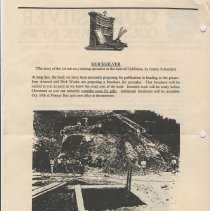
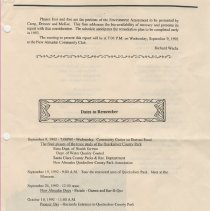
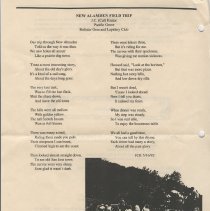
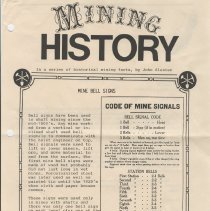
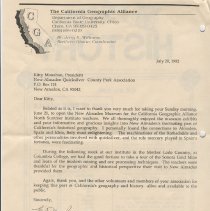
TITLE: Quicksilver County Park News SUBTITLE: Newsletter of the New Almaden Quicksilver County Park Association Issue # 31 Fall 1992 Newsletter of the New Almaden Quicksilver County Park Association FALL 1992 ISSUE 31 PRESIDENT'S MESSAGE Could you believe, we will be celebrating our 10th Annual Pioneer Day on October 10, 1992? This year we will be honoring the alumni of the National Association of Civilian Conservation Core. The alumni of the Mt. Madonna CCC at New Almaden resided in Englishtown during the 1930's. Their work and historical significance is depicted in a monument, designed and built by NAQCPA Board Member Fredolin Kessler, and will be dedicated during Pioneer Day on October 10th. Please put this date on you calendar. We will be leaving the Hacienda entrance to the Quicksilver Park at 11:00 A.M. Transportation up and down the hill will be provided for everyone by your association. The dedication at the Monument, led by the alumni of the CCC, will be from 12:00 noon to I:00 P.M. A Bar-B-Que luncheon will follow. All this for $5.00 per adult! During the luncheon we will hear great stories from our pioneers and their families. If you need any further instruction for this fabulous day, please call (408)2686541. Kitty Monahan QUICKSILVER (The story of the Ist mercury mining operation in the state of California, by Jimmy Schneider) At long last, the book we have been anxiously preparing for publication is heading to the printer. Jean Atwood and Dick Wachs are preparing a brochure for pre-sales. This brochure will be mailed to you as soon as we know the exact cost of the book. Jimmie's book will be ready before Chnstmas so you can certainly consider some for eifts. Additional brochures will be available Oct 10th at pioneer Day and soon after at the museum. Cop 8 133 - Yellow Kid Stops, where the Harry Shaft broke surface from 500' level California Environmental Protection Agency Department of Toxic Substances Control NOTICE OF PUBLIC MEETING ON THE ALMADEN QUICKSILVER COUNTY PARK SAN JOSE, CALIFORNIA The Department of Toxic Substances Control (OTSC) announces a public meeting to discuss the risk assessment which has been completed as part of the overall study of mercury contamination at the Almaden Quicksilver County Park in San Jose, Santa Clara County. The meeting date and location are: Wednesday, September 9, 1992, at 7:00 p.m. New Almaden Community Center 21727 Bertram Road San Jose, California Representatives from DTSC will be present to discuss the following topics and to answer questions from the public: Risk Assessment Feasibility Study Future Phases of Work For more information, please call Shirley Buford, DTSC Public Participation Coordinator, at (510) 540-3909, or Mark Piros, DTSC Project Manager, at (510) 540-3832, or write to these individuals at the following address: Cal-EPA, Department of Toxic Substances Control, 700 Heinz Avenue, Berkeley, California 94710. Reports pertaining to the investigation of mercury contamination at the park and the risk assessment are available far public review at this address, and will also be available at libraries in the San Jose area in the near future. Review for Status Report of Environmental Assessment of Quicksilver Park Meeting: Wednesday September 9, 1992 at the New Almaden Community Club The New Almaden Quicksilver County Park Association (NAQCPA) was formed on February I, 1982. The goals of the Association were stated as follows: I. To increase public awareness, understanding and enjoyment of the historical, recreational, biological and geological resources of Almaden Quicksilver County Park. 2. To enourage and facilitate community involvement in: a The development, maintenance and protection of recreational facilities within the park; b. The commemoration, restoration, interpretation, and protection of historical resources within the park; c. The interpretation, management, and protection of natural resources within the park, d. The establishment and operation of interpretative programs and facilities within the park NAQCPA attained non-profit status in June 1984, and plans for construction of a visitors center were to be drawn by an architectural firm to be selected. Architects Alton and David Lee prepared plans for a center to be located at the reduction works site. When the State of California learned of the project and realized mercury mining had occurred at the location, it required the County to have an environmental assessment undertaken. There are five phases in such an assessment 1. Development of a conceptual work plan, 2. Development of a detailed work plan, 3. Performance of sampling and monitoring program, 4. Data assessment and remediation planning, and 5. Remediation and development of park. This was the first site development in the state in which mercury was involved, consequently the Department of Health Services (DHS) proceeded with utmost caution. The County was required to hire consultants to perform the work of the several phases. Woodward - Clyde was hired to prepare the first two phases and a report was presented to the State in June 1987. A public meeting was held at the New Almaden Community Club on January 12, 1988 to review the findings of the report. The report was optimistic in that it anticipated 1989 for the development of the park to begin. The sampling and monitoring phase was performed in 1988 by the firth of Dames and Moore. Several "hot" spots were located. The four types of soil sampled included two areas of stream sediments on areas of alluvium (soil), calcines (roasted mercury ore), and silicacarbonate (the host rock for cinnabar). This work led to a second round of sampling and a risk assessment to define areas requiring further study of remediation. The analysis did not differentiate between soluble and insoluble mercury. DHS called a meeting on October 25, 1989 to present the Dames and Moore findings. The results were not completely available for that meeting, and another meeting was held at the Community Club on March 6, 1990_ Martha Schuss conducted a study of the wild pigs between 1986 and 1988. The study was mainly concerned with the pig population and its interaction with human beings. Although pigs are rooters, those analyzed did not show high levels of mercury. Phases four and five are the portions of the Environment Assessment to be presented by Camp, Dresser and McKee. This firm addresses the bio-availability of mercury and presents its report with that consideration. The schedule anticipates the remediation plan to be completed early in 1993 The meeting to present this report will be at 7:00 P.M. on Wednesday, September 9, 1992 at the New Almaden Community Club. Richard Wachs Dates to Remember September 9, 1992 - 7:OOPM - Wednesday. Community Center on Bertram Road The final phases of the toxic study of the Quicksilver County Park State Dept. of Health Service Dept. of Water Quality Control Santa Clara County Parks & Rec. Department New Almaden Quicksilver County Park Association September 19, 1992 - 9:00 AM. Tour the restricted area of Quicksilver Park. Meet at the Museum. September 26, 1992 - 12:00 noon. New Almaden Days - Parade - Games and Bar-B-Que October 10, 1992 - 11:00 A.M. Pioneer Day - Hacienda Entrance to Quicksilver County Park November 7, 1992 - 9:00 A M. Tour of the New Almaden Quicksilver County Park. Meet at the Museum parking lot NEW ALAMDEN FIELD TRIP J.C. (Cal) Keator Pacific Grove Holister Gem and Lapidary Club Our trip through New Almaden Told us the way it was then. We saw holes all aroun Like a prairie dog town. 'Twas a most interesting story, About the old day's glory, It's a kind of a sad song, About the days long gone. The very last task, Was to fill the last flask, Shut the place down, And leave the old town. The hills were all mellow With golden yellow. The tall Scotch broom Was in full bloom. There was many a trail, Riding them made you pale Their steepness I can boast, Climbed high to see the coast. Then looked almost straight down, To see old San Jose town. The curves were very sharp, Sure glad it wasn't dark. There were hikers three, But it's riding for me. The curves with their quickness, Was giving me motion sickness. Howard said, "Look at the horizon," But that was more pizen. Nothing but steep hills, And low down dry rills. But I wasn't dead, 'Cause I looked ahead. Now I tell you dears, It calmed my fears. When dinner was ready, My step was steady, So I was real able, To enjoy the bounteous table We all had a good time, You can tell by this rhyme. Each driver had many a story, About all the past glory. JCK 5/16/92 MINING HISTORY a series of historical mining facts, by John Slenter Bell signs have been used in shaft mining since the mid 1800'5. Any mine worked from a vertical or inclined shaft used bell signals to communicate with the hoist engineer on top. Bell signals were used to lift or lower miners, lift ore, and move material to and from the surface. The first mine bell signs were made of wood but probably did not last long in wet mines. Porcelainized steel was later used as well as painted tin until the 1920'5 when cloth and paper became common. These signs were used only in mines with shafts and there was only one bell sign on each level plus one at th headframe MINE BELL SIGNS CODE OF MINE SIGNALS BELL SIGNAL CODE 1 Bell . .Hoist . 1 Bell - Stop (if in motion) 2 Bells - - - Lower 3 Bells - Men on, run slow When men are to be hoisted or lowered, give the signal for men on, run slow 3 bells. Men must then get on cage or bucket, then give the signal to hoist or lower (1 or 2 bells.) 4 bells: Blasting signal; engineer must answer by raising bucket a few feet and letting it back slowly; then 1 bell; hoist the men away from blast. 9 bells: Danger signal; (in case of fire or other danger); then ring number of station where danger exists. Engineer must slow up when passing stations when men are on the cage. STATION BELLS First Station - - 2-1 Bells Second " . . 2-2 Third - - 2-3 Fourth " - - 2-4 " Fifth . . 2.-5 Sixth . . 3.-2 Seventh " - - 3-3 Eighth 3-4 Ninth - - 3-5 " Tenth 4-1 Eleventh 4-2 Twelfth 4-3 Thirteenth 4-4 Fourteenth 4-5 Fifteenth 5-1 Where electric bells or flashlights are used in connection with other bells. The California Geographic Alliance Department of Geography California STATE University. Chico Chico, CA 95929-0425 (916i) 898-6219 . Dr. Jerry R Williams. Northerrn District Coordinator July 20, 1992 Kitty Monahan, President New Almaden Quicksilver County Park Association P.O. Box 124 New Amaden, CA 95042 Dear Kitty, Belated as it is, I want to thank you very much for taking your Sunday morning, June 21, to open the New Almaden Museum for the California Geographic Alliance North Summer Institute teachers. We all thoroughly enjoyed the museum exhibits and your informative and gracious insights into New Almaden's fascinating part of California's historical geography. I personally found the connections to Almaden, Spain and Idria, Italy most enlightening. The machinations of the Rothschilds and other personalities involved with quicksilver, and the role mercury played in Spain's fortunes, were fascinating. During the following week at our institute in the Mother Lode Country, at Columbia College, we had the good fortune to take a tour of the Sonora Gold Mine and learn of the modern mining and ore processing techniques. The teachers were thankful for the geographic and historical perspective their visit to New Almaden provided them. Again, thank you, and the other volunteers and members of your association for keeping this part of California's geography and history alive and available to the public. Sincerely, Dr. Ed Myles Professor of Geography California State University, Chico |
People |
Atwood, John Kessler, Friedolin Monahan, Kitty Schauss, Martha Slenter, John Wachs, Richard |
Cataloged by |
Meyer, Bob |