
Archive Record
Images
Additional Images [13]
Metadata
Catalog number |
1997.2.2614 |
Object Name |
Newsletter |
Date |
1995 |
Description |
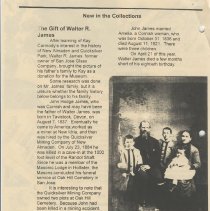
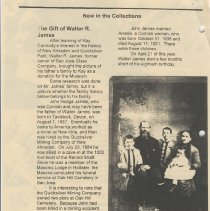
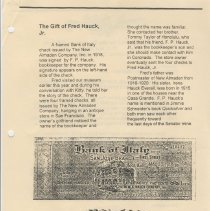
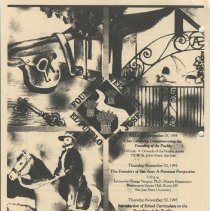
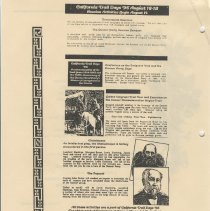
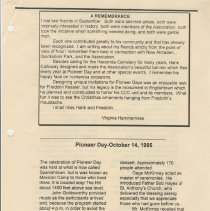
TITLE: Quicksilver County Park News SUBTITLE: Newsletter of the New Almaden Quicksilver County Park Association Issue # 42 Fall 1995 Newsletter of the New Almaden Quicksilver County Park Association FALL 1995 ISSUE 42 FROM THE PRESIDENT The sales of Quicksilver, the book by Jimmie Schneider, have fallen off, but the exceedingly good news is that, due to the wonderful generosity of Zella Schneider, the book now belongs to your Association. In her letter to the Association, Zella writes, "It has been such a long time since I have seen you or Almaden. However, I am so very grateful for your continued enthusiasm and hard work. Jimmie certainly would have loved you for keeping his "Almaden" alive. I hereby bequeath to the New Almaden County Park Association any and all copies of New Almaden Quicksilver, the Complete History of Santa Clara's New Almaden Mine. _ Zella lives at the Los Gatos Meadows, 110 Wood Road, Los Gatos, 95030. I am sure she would love to hear from members who have enjoyed the book. Zella has been very active in seeing that the book was published and financed the entire operation. I am most grateful to her for allowing our Association the privilege of working with her in the promotion of the book and overwhelmed with the latest gift to the Association. She is a wonderful person and even though her health has declined, she continues to support us. May she enjoy better health. Kitty Monahan Share your love of New Almaden with friends across the country. We will gift wrap and mail our books, Cinnabar Hills and Quicksilver, to any address in the United States, either singly or as a set. Other unique gifts are also available at the museum shop. Monument to Almaden On your way to visit our museum or if you are in the area, go west from Almaden Blvd. on Camden Ave. up several blocks and on the south side you will see Parma Park There in the park you will notice a monument dedicated to the history of Almaden. Stop and see it closely. You will see that it is cinnabar in color, 1/2 inch cut steel. Outlined are the figures of a little Indian girl with a Hispanic man standing behind her, a miner with a shovel, and a rancher on horseback. At the very top is the figure of a cougar. All these figures represent the different times of our Almaden Valley, from the time it was a wild unsettled area, to the Indian era, to the time when the Quicksilver mines were at their peak, and then the orchards and ranches. This beautiful sculpture was fashioned and constructed by Los Gatos artist, John Battenberg. The $45,000 it took to have this lovely piece made was raised completely from local donations and gifts. It took three years for these funds to be collected and it took many diligent hours given by the volunteers who took part in this task. Stop and take a close look at this monument to the history of our Almaden Valley. Read the names on the plaques of the donors. You will find our own Assocation one of them along with the names of those previous and present residents who gave to preserve our history in this way. You will come away with a deeper appreciation of what used to be Kay Carmody SPECIAL INVITATION TO 1993 PIONEER DAY. Friedolin Kessler It is very hard to write about a friend, who I feel will walk into the Museum anytime or show up in the Park as I walk, when indeed he has -one before us. Friedolin was a true friend and beloved member of the card of Directors of the Association. He designed all of our programs for Pioneer Days, and laid out the display at the Museum of the C.C.C. camps. His humor and love for New Almaden endeared him to all of its members. Do you remember his talk in Englishtown about his days in the C.C.C. camp? The day was so very hot and Friedolin continued his talk even though a lady fainted and the ambulance came. He gave new meaning to professionalism for our Association and we will truly miss him. We have laid a wreath at the monument in Englishtown to honor a man dedicated to creativity and perfection and who designed a fitting remembrance to man's endeavors for conservation. May the Almighty enjoy Friedy's love of life and his cartoons depicting such. New in the Collections The Gift of Walter R. James After learning of Kay Carmody's interest in the history of New Almaden and Quicksilver Park, Walter R. James, former owner of San Jose Glass Company, brought the picture of his father's family to Kay as a donation for the Museum. Some research was done on Mr, James' family, but it is unsure whether the family history below belongs to his family. John Hodge James, who was Cornish and may have been the father of Walter James, was born in Tavistock, Devon, on August 7, 1837. Eventually he came to America, worked as a miner at New Idria, and then was hired by the Quicksilver Mining Company of New Almaden. On July 23, 1'884 he was killed in a cave-in at the 1000 foot level of the Randol Shaft. Since he was a member of the Masonic Lodge in Hollister, the Masons conducted his funeral service at Oak Hill Cemetery in San Jose. It is interesting to note that the Quicksilver Mining Company owned two plots at Oak Hill Cemetery. Because John had been killed in a mining accident, either the Company or the Miners' Fund paid the funeral expenses. All Cornish people were buried at Oak Hill during Quicksilver Mining Company's tenure of the mines. John James married Amelia, a Cornish woman, who was born October 31, 1836 and died August 11, 1921. There were three children. On April 21 of this year, Walter James died a few months short of his eightieth birthday. The Gift of Fred Hauck, Jr. A framed Bank of Italy check issued by The New Almaden Company, Inc. in 1918, was signed by F. P. Hauck, bookkeeper for the company. His signature appears on the left-hand side of the check. Fred visited our museum earlier this year and during his conversation with Kitty, he told her the story of the check. There were four framed checks, all issued by The New Almaden Company, hanging in an antique store in San Francisco. The owner's girlfriend noticed the name of the bookkeeper and thought the name was familiar. She contacted her brother, Tommy Taylor of Honolulu, who said that his friend, F. P. Hauck, Jr., was the bookkeeper's son and she should make contact with him in Coronado. The store owner eventually sent the four checks to Fred Hauck, Jr. Fred's father was Postmaster of New Almaden from 1916-1920. His sister, Irene Hauck Everall, was born in 1915 in one of the houses near the Casa Grande. F. P. Hauck's name is mentioned in Jimmie Schneider's book Quicksilver and both men saw each other frequently toward the last days of the Senator mine. California Council for the Promotion of History P. 0. Box 221476 Sacramento, California 95822 October 27, 1995 For More Information: Jacqueline Lowe CALIFORNIA COUNCIL FOR THE PROMOTION OF HISTORY 1996 MINI-GRANTS APPLICATIONS NOW AVAILABLE The California Council for the Promotion of History is proud to announce that applications for the 1996 Mini-Grant program are currently available. Now in its seventh year the Mini-Grant program makes awards to assist with projects promoting quality history experiences for Californians, encourages historian-involvement in local projects and fosters professional development of heritage organizations throughout California. Grant awards typically range from $100 to $750. Grants have supported a variety of projects including printing of interpretive brochures, development of grade school materials, publication of local histories and historical surveys, development of local history walking tours, and exhibition-related activities. Grantees must be non-profit organizations or units of state or local government. Successful applications generally demonstrate a combination of strong local support of the project along with the participation of qualified historical consultants. Appliations are reviewed by a three-member panel representing a variety of history-related disciplines as well as geographic diversity. In past years, the grants committee has been particularly interested in awarding mini-grants to assist small and emerging institutions in their efforts to professionalize their historical research, presentation or interpretation. The deadline for 1996 CCPH Mini-Grant applications is Friday, January 12, 1996. Mini-Grant recipients will be announced June 1, 1996. To receive an application or for more information contact the Mini-Grant Committee Chair: Jackie Lowe, Community Memorial Museum, P. O. Box 1555, Yuba City, CA 95992 (916) 741-714 Hamilton Smith-Foremost among Mining Engineers During the 1870s the Quicksilver Mining Company employed the dean of Western mining engineers-----Hamilton Smith. Jr (1840-1900). He was the mentor of the professionally trained engineers who worked at New Almaden, including Arthur Foote, Hennen Jennings, H. C. Perkins, Charles Butters and Samuel Christy. Smith was not educated at an university as were most of these men, yet such was his learning, experience and personality that he commanded their respect. He was the kind of man who made others proud to follow the profession. Before his birth Smith's ancestors were established for a century in Durham, New Hampshire, where his grandfather was a judge. His father, an attorney, relocated to Kentucky and practiced law with brilliant success. Smith was born near Louisville on July 5, 1840. His mother died when he was small. Smith lived with his grandparents in Durham and attended the village school. At fourteen he returned to Kentucky to work for his father, who had accumulated a cotton factory and coal mines. Industrious, competent and with an unusual aptitude for mathematics, he demonstrated his ability and at an early age became the chief of engineering and accounting at a coal mine in Cannelton, Indiana. During the 1860s he helped to develop other collieries in Kentucky and Indiana. In 1869 he came West as engineer and manager of the Triunfo mine in Baja California, but his most notable work was at the North Bloomfield Gravel Mining Company in Nevada County, and the Bald Mountain and Ruby Drift Gravel mines in Sierra County, where he became the recognized authority on hydraulic mining. For several years Smith played an important role at New Almaden. He was consulting engineer at the mine in the 1870s, during a time when he was also general manager at the North Bloomfield. As a consultant he did not reside at New Almaden, but visited and reviewed the work of assisting engineers. Smith's assistants knew that he did not take suggestions easily. When a new shaft was sunk at New Almaden in 1876, and the underground surveys were critical, Smith himself stood behind the transit. In her reminiscences, Mary Hallock Foote, author and wife of Arthur Foote told the story: He (Smith) fumed and swore because the same angle would not read twice alike; the transit must be out of adjustment. It was taken on top and half the morning wasted finding nothing wrong. They were working in the bottom of a tunnel where a stratum of carbonic acid gas had been stirrred by their movements; a ray of light passing through this variable medium was deflected as by water. Taking his life in his hands (Arthur) Foote suggested that when he made surveys in that tunnel he found it necessary to place his lights by actual measurement, on a level with his eye, instead of sighting downwards through mixed gas and air .. .."Why in hell didn't you say so before!" roared Smith, and for a few seconds there was more than carbonic acid gas, heavier (and hotter) than air in that tunnel. Smith's interest in anyone he liked resembled the 'softness' of Baloo (the bear in Kipling's Jungle Book)--you were liable to be all bruised with it," Mrs. Foote remembered. Yet for all his gruffness there was something high-minded and bracing about Smith. "He was a man," Mrs. Foote recalled, "my keen young husband loved to work under." All the young engineers did, and mine managers relied on him. The surviving correspondence of general manager James Randol shows that throughout his tenure at New Almaden he sought Smith's counsel. People around the world sought Smith's advice, including Baron Edmond de Rothchild, from the Paris branch of the prominent banking family. Once Smith became consulting engineer for the Rothchild interests, he began to operate on a global scale. He reported on the El Callao gold mine in Venezuela in 1881, and profitably developed it. Handing that operation over to others, Smith opened a consulting office in London. "Over there," he once explained referring to England, "they know how to treat an engineer"----meaning they knew how to pay one. He and a partner organized a company that developed mines throughout the world, most notably in South Africa, where gold had been discovered in 1885. He became connected with mines in Alaska and Mexico and with the Anaconda Copper Mining Co in Montana. He was responsible for securing British capital for mines in the United States and for the employement of American engineers throughout the British dominions. Smith reinforced his commanding reputation with technical writing. His book, Hydraulics: The Flow of Water through Orifices, over Weirs, and through Open Conduits and Pipes (New York and London, 1886), established him as an engineer of the first order, a top notch scholar without benefit of a degree. The heavy, over-sized volume gives hundreds of tables useful to any engineer interested in the movement of water. Smith's scholarship shows exhaustive reading in the technical literature of Europe, and he wrote with confidence when correcting the established sources. To support the findings in his book, Smith conducted experiments at water plants on the East Coast, and at various mining sites, especially in Nevada County, California, and at New Almaden. In April 1877 he conducted 53 precisely laid experiments with pipes at the quicksilver mine, the mine apparently providing supplies and assistants. Later in life, after returning to the United States from London, Smith established offices in New York and Washington, D. C. , and he traveled widely. At sixty he was in robust health and actively engaged in engineering and in developing the Mariposa grant that once belonged to John C. Fremont and in which he had secured controlling interest. He often returned to the ancestral home in Durham, New Hampshire. He accidentally drowned there during a July Fourth holiday in 1900. One concludes that he left a considerable fortune. Today we know him only through the written memories of his proteges and through the elaborate mathematical equations that adorn his book. Gage McKinney The following recipe for Cornish pasties was sent to Jo Young by Pat Willy. She came to the museum because she is writing a children's book using New Almaden as the venue. She is a Cornish woman so when her conversation with Jo turned to pasties, she made it clear, "There are no carrots in pasties." Below is Pat's recipe for the "real thing". CORNISH PASTIES Make shortcrust pastry from 8 ozs. (240g) flour. 4 ozs. (120g) lard, or use vegetable shortening and margarine mixed. 8 ozs. (240g) pasty beef, chuck steak, 2 medium potatoes, 1 small Swede (rutabaga) and 1 medium onion. (This quantity makes two pasties.) Roll out pastry in two rounds--about the size of a side plate. Put potato and Swede, diced very small, in center of pastry, add salt and pepper. Cut the meat into very small pieces and place on vegetables with chopped onion. Sprinkle a teaspoon of flour over top and finish with a small knob of butter, damp edges of pastry and bring together over the top, crimping as you go. Make a small slit in top and brush with egg and milk. Bake at 450 degrees for 20 minutes. Reduce heat to 300 degrees for an additional 40 minutes. Wednesday November 29, 1995 Civic Ceremony Commemorating the Founding of the Pueblo 11:30 A.M. Grounds of the Peralta Adobe, 175 W St John Street, San Jose Thursday, November 30, 1995 The Founders of Son Jose. A Personal Perspective 3:30 p.m. Lecture by George Vasquez, Ph.D., History Department Washington Square Hall, Room 109 San Jose State University Thursday, November 30, 1995 Introduction of School Curriculum on the Founding of the Pueblo Mrs. Herschbach's Fourth Grade Class Terrell Elementary School San Jose Unified School District 3295 Pearl Avenue New Almaden Caulked in a draw of California's History You doze in verge of auburn hills. Tortured flow of strictured creeks Reflects a trace of stone-hewn homes Patina tint of lichen, moss. They once glowed through night-long flares Of fired retorts calibrating air To wing mercury from host of cinnabar., Flasked, a miner's genie hauled to the Mother Lode Set free to amalgamate with gold. Automation has calloused your mercurial role. Gauntly etched on Loma Prieta's peak a maser station hums. Hermes, in guise of argent towers, beams messages for argonauts claim-staking dust prints -the annals of man's lunar flights. Edwin A. Falkowski California Trail Days '96 August 16-18 Reunion Activities Begin August 14 Descendants Reunions The Donner Party Reunion Banquet Conference on the Emigrant Trail and the Donner Party Saga Guided emigrant Trail Tour and Excursion on the Donner Commemorative Wagon Train Chatauqua An intellectual play, the Cghatauqua is history encountered in the first person. The Inquest Emigrant Encampment, - Trail life of the 1840's Mountain Man comparing history - Demonstrations Music camp - opening period mania - Bring roar instruments "Children of the Donner Party" . p play Presentations by Jack Steed, Joseph King Jim Rose end the Stephens- Contra Dance end Old-line, Music Archeological Field Trip of the Donner Camps - Dr. Don Hardesty All these activities are a part of California Trail Days '96 The other part of Trail Days at Donner Memorial State Park: For information: Frankye Craig, Planner P O Box 16093 S Lake Tahoe A REMEMBRANCE I lost two friends in September. Both were talented artists, both were intensely interested in history, both were members of the Association, both took the initiative when something needed doing, and both were gentle men. Each one contributed greatly to his community and that has already been recognized. I am writing about my friends strictly from the point of view of how I remember them best in connection with New Almaden, Quicksilver Park, and the Association. Besides caring for the Hacienda Cemetery for many years, Hank Calloway designed and made the Association's beautiful banner which flies every year at Pioneer Day and at other special events. I remember his happy face on numerous occasions. Designing unique invitations for Pioneer Days was an enjoyable task for Friedolin Kessler, but his legacy is the monument in Englishtown which he planned and constructed to honor his CCC unit and its members. What fun it was to see the Christmas ornaments hanging from Friedolin's moustache. I shall miss Hank and Friedolin. Virginia Hammerness Pioneer Day-October 14, 1995 The celebration of Pioneer Day was held at what is now called Spanishtown, but it was known as Mexican Camp to those who lived there. It is located atop The Hill about 1400 feet above sea level. John Goldsworthy provided music as the participants arrived and, because the program started about 4 p.m. in order to avoid the hot part of the day, the food was served as the people arrived. The menu included salad, beans, rice and tamales and later flan for dessert. Approximately 170 people attended. Gage McKinney acted as master of ceremonies. He introduced Father Bob Hayes of St. Anthony's Church, who delivered the blessing asking especially that we appreciate those who had gone before us.. Mr. McKinney recalled that the cinnabar deposit at the Spanishtown location was recognized by a Mexican Army officer who was educated at the School of Mines in Mexico City. Mining began in 1845-46, and in settlers from T epic were ranchers the succeeding years more than without mining experience She 2500 people lived in Mexican noted that the Santa Clara Valley Camp with another 1000 in was then a part of Mexico and had Englishtown (Cornish Camp) been Hispanic for 300 years. The lower on the hill. people raised pigs and chickens Pioneer Day was dedicated for food and had dogs for pets. to a man who was a member of They were a happy people who the Quicksilver Board of Directors, accepted their living conditions. Friedolin Kessler. who died on This was Mexico and the people September 27, 1995. He was an who lived at the camp were artist who had lived in this area known as Californios and spoke since he was with the Civilian Spanish. She noted that the land Conservation Corps in the mid- was part of the Robles-Chaboya 1930's. grants, and unused property could Kitty Monahan, President of be claimed for mineral rights the New Almaden Quicksilver although it might be another County Park Association Board of individual's land grant. Directors welcomed the Butterworth and Randol assembled group. Kitty described improved and organized mining the setting of Spanishtown and living conditions. The people pointing out Calero Reservoir, who lived at this location had to Almaden Reservoir, the cypress struggle to survive but made a trees where the Hidalgo Cemetery great contribution to the was located, St. Anthony's advancement of the area. Catholic Church beyond a knoll, Gage introduced Jorge the location of Loma Prieta and Palacio, who in turn introduced his Twin Creeks, Mt. Umunhum and troupe of dancers from Overfelt the Chinese trees of heaven. High School. He requested Honored guest, Sylva Miller audience participation and of San Francisco was born on The demonstrated how certain dances Hill 95 years ago (October 14, should be done. The dances 1900). Mrs. Miller said she was were energetic and exciting, happy to be there and recalled Jorge told the story of how his going to school on The Hill. She grandfather, a mule trainer, had was pleased to have many of her won his grandmother. This was relatives there to share the followed by another vigorous occasion. dance. The next dance featured Evelyn Romero Martinez, the skilled use of machetes, and founder of Las Fondadores of the another dance told the story of a Pueblo de San Jose, and an hawk and a girl. Mr. Palacio eighth generation Californio, told invited the audience to dance with of the difficulties Mexican families members of the troupe and encountered living on The Hill promised they would be back for without water or heat. The first another group of dances. Gage asked for family stories of Mine Hill by requesting somebody from the Tobar family to step forward. Arlene Tobar Jordan said the men in her family were hardworking, hard-rock miners. Her great-grandfather Hernandez was a caretaker at the El Senador mine and added that mining was a difficult endeavor at best. While children seven years old and younger were invited to swing at a Pinata hanging from a tree, Gage stated that his forbears came from Cornwall and married into the Bernal family. Hicks Road is named for one of his ancestors. Kitty Monahan represented Ray Stark who had worked for Jimmie Schneider at the Cora Blanca mine. One of Ray's companions, Emery, woke with a bloody nose one night so Ray went to find Jimmie in the mine. Ray had forgotten to take his lamp so instead, he lit matches to find his way and when he lit the final match, he found himself at the edge of a high ledge. Fortunately, he found Jimmie and Emery was taken to the hospital and survived. On another occasion these miners were trying to reduce cinnabar to quicksilver, but the wood they were using was wet. Mr. Schneider hired a dynamite expert to reduce the logs to usable size, but the expert had drunk too much wine; he was long on wine and short on fuses with the result that splinters flew all over but nobody was killed. June Schneider Gilbert, daughter of Jimmie Schneider, went into childbirth labor when she was on The Hill. A man who was living at the CCC camp drove her down to a doctor. She returned to The Hill and lived with her Dad for awhile longer. Michael Cox, geologist, lived on The Hill from 1984-85 During that time he was responsible for closing the mine openings because the county had taken possession of the park and did not want anybody to get hurt or lost in the mines. Mike lived in a trailer next to the map house. From there he was able to observe much animal activity--wild pigs, bobcats, coyotes, deer and even a sheep wandered by one day. He maintained a water trough to attract animals; one time he saw a hawk swoop down, cower a squirrel and fly off with it. A peacock visited him for a number of days but unfortunately ate some rat poison and died. The rat poison was there to ward off dusty-footed wood rats which uprooted plants Mike had growing. Chuck Rich worked on The Hill from 1959-1971. He worked with Art Morril and two other men. One day Chuck was operating a locomotive with loaded mine cars. The locomotive was in front of the cars and it jumped the track. Chuck was thrown into the wall and knocked unconscious but lived to tell about the incident. Chuck also told how he would start a skip to a lower level and jump on to ride the skip. After the county bought the property, an inspector was sent out to evaluate conditions. Chuck did not know the inspector and suggested they ride -the skip down. Th inspector was not amused. Chuck said that while he worked with the three other men, the price of mercury rose to $770 per flask. The four men worked five years doing a job which normally required 15-20 men. Chuck was able to buy his house in Willow Glen and a truck with his profits from that period. Helen Collins had an aunt, Isabel Victor, who lived up on The Hill. Mr. Victor would occasionally get drunk and not be able to find his way home so Isabel put out a lamp so he could locate his home. Isabel smoked a pipe and some of the women chewed tobacco. Another relative was Fadita Rodriquez Berryessa. Squatters would not leave the Berryessa land and on one occasion, one of the Berryessa boys warned a squatter to leave the property. The squatter would not leave and Berryessa shot and killed the man, then fled to Mexico. In what appears to be retaliation, twelve men from San Jose came and took two Berryessa men who had not been involved in the incident and hanged them from an old oak tree on 10th street. Benita Berryessa's husband died right away, but the other was rescued by the Spanish people. The rescued Berryessa was eventually shot in Santa Barbara because the hanging incident caused him to walk in a strange manner and somebody was frightened by this motion. Another time, a boy and his wife were going to bed when they heard a noise under the bed, a man was there who jumped up and killed Berryessa. Although the Berryessa's had a sad history, they still survive The James family, left to right, William, Grandfather, John Jr., Grandmother and Mr. James' father is the baby To conclude the program the Jorge Palacio dancers, fully adorned in feathers, returned to present several exciting dances accompanied by drums. The theme of the dances acknowledged Mother Earth and Nature. By the time the program ended, it was dark and we carefully descended to our cars at the Hacienda parking area. Richard Wachs |
People |
Berryessa, Benita Berryessa, Fadita Rodriquez Calloway, Henry (Hank) Carmody, Kay Collins, Helen Cox, Michael Falkowski, Edwin A. Goldsworthy, John Hammerness, Virginia Giannini Hauck, Fred (F.P., Jr., Sr.) Hayes, Bob (Father Hayes) James, John Hodge James, W. Ray Jordan, Arlene Tobar Kessler, Friedolin Martinez, Evelyn Romero McKinney, Gage Miller, Sylvia Climo Monahan, Kitty Morrell, Art Rich, Chuck Schneider, Jane (Jane Schneider Gilbert) Schneider, Jimmie Schneider, Zella Smith, Hamilton Stark, Ray Victor, Isabel Wachs, Richard Young, Jo |
Cataloged by |
Meyer, Bob |