
Archive Record
Images
Additional Images [6]
Metadata
Catalog number |
1997.2.2592 |
Object Name |
Newsletter |
Date |
1989 |
Description |
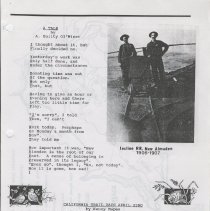
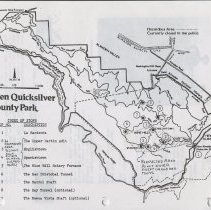
TITLE: Quicksilver County Park News SUBTITLE: Newsletter of the New Almaden Quicksilver County Park Association Issue # 19 Winter 1989 QUICKSILVER COUNTY PARK NEWS Newsletter of the New Almaden Quicksilver County Park Association ISSUE 19 WINTER 1989 PRESIDENT'S MESSAGE by KITTY MONAHAN COULD YOU BELIEVE? 6 FULL YEARS! Congratulations to all the Members of New Almaden Quicksilver County Park Association on the beginning of the Seventh year of active participation on Park Activities. On Feb 1, 1983 a small group of historians, equestrians, hikers, preservationists and other citizens of Santa Clara County who love the Quicksilver Park formed this Association to help with the protection and enhancement of all facets of this, the second largest park in the county. In six years, the Association has grown to 400 members who have helped establish this group as a viable force in shaping the vast resources in New Almaden. Our accomplishments have been extensive and your Board of Directors is very proud of these. For our 7th year there is much to do: 1.) There is a great need for a Director for the Museum. 2.) Trails in the Park need Name Signs. 3.) Plans for Pioneer Day need upgrading. 4.) Auto tours, hiking tours and horseback riding tours need organizing. 5.) Newsletters need help in publishing! 6.) The need for an election committee for the nomination of Board Members is imminent. The March Board Meeting will be held at the Museum on March 8 starting at 6 PM. We will be working on the museum to upgrade some cases and set up projects for the year. You are all welcome to the Board Meetings. Please join us for Pizza, etc on March 8 and help our 7th year off to a terrific start. Kitty Many many thank yous are in order to the Almaden Valley Women's Club. Once again they have generously given to our Association. This time it was enough money to buy for our Museum a television set and a VCR which allow us to have on tape all our artifacts and trips through the park. This greatly enhances our Museum. Thank you again, blessed ladies. Dates to Remember 1. January 13-March 24 - "Artists Locale" at the Octagon, Santa Cruz County Historical Museum, 118 Cooper St., Santa Cruz 95060. Museum hours: Tuesday through Sunday, 12-5 P.M. 2. Wednesday, February 15 - 7:30 P.M. Winter History Night at San Jose Historical Museum, 635 Phelan Ave. Topic is Mission Santa Clara archaeology. 3. Friday, February 17 - 9:45 A.M.-3 P.M. - meeting and networking to support history in the Santa Clara Valley, California History Center, DeAnza College, 21250 Stevens Creek Blvd. For further information call 996-4712. 4. Thursday, February 23 - New Almaden Community Club FUND RAISER at the Opry House. Cost is $10.00 for pizza at 7 and melodrama at 8. Information and reservations call Peggy at 268-8331. 5. March, April, and May are the best months for wildflowers and for seeing the Park in all its spring beauty. If you wish to take and/or organize an all-day Saturday tour call Kitty at 268-6541 or Virginia at 269-6068. March 18, May 6 and May 13 are full. 6. Wednesday, March 8 - from. 6 P.M. on - working on upgrading Museum displays, and Board meeting. All are welcome. 7. March 14-May 21 - "John Steinbeck in Los Gatos" exhibit at Forbes Mill Museum, 75 Church St., Los Gatos. Information 395-7375. Thursday, March 16-Saturday March 18 - forum at San Jose State commemorating and exploring "The Grapes of Wrath, 1939-1989". 8. March 19, 20, 21 - Trail Days Symposium at Assilomar. Daily registration fee is $6.00 per person. Two nights lodging and 6 meals costs $120. Reservations due by February 8. There are 60 on-site reservations. Information call Kitty at 268-6541. 9. Saturday, April 1 - Museum Docent Training Day. This is a chance for all who are interested in working at the Museum on Saturdays to get a good background on the Museum exhibits and the history of the area. 10. April 22-23 - Trail Days. Meet at Reduction Works at 9 A.M. with gloves, shovels, machetes, clippers, power saws. 11. Saturday and Sunday, May 20-21 - Living History Days, San Jose Historical Museum, 635 Phelan Ave., San Jose. Information 287-2290. 12. Saturday, October 14 - Pioneer Day. TOXIC STUDY MOVES FORWARD Dames & Moore (D&M), consultants to the Parks and Recreation Department (P&R), completed the first round of Almaden Quicksilver soil sampling. Field sampling of soils concluded in late December. D&M sampled four types of soil deposits in the park. Two areas of stream sediments, calcines (roasted mercury ore) and road-base were sampled. One area of colluvium (soil) over silica-carbonate rock (host rock for the mercury ores) was also sampled. D&M will summarize the results of the sampling in an interim report scheduled for transmittal to P&R in February. This report will present recommendations for the scope of the second round of sampling, scheduled to begin in May or June of 1989. Second-round sampling will probably continue through to late-August or September. About 34 areas throughout the park are tentatively scheduled for spring and summer sampling. At the conclusion of the second round of sampling, D&M will begin to compile the project data into a final report. The report is scheduled to be issued to P&R about three months after all samples are analyzed. Data presented in the report will be used in the preparation of a risk assessment for the park. The risk assessment will define areas which may require further study or remediation. It is suspected that areas of potential health risk will be small and concentrated around the principal sites of former mining activities. Because most mining activity was concentrated in and around the currently off-limits Mine Hill restricted area, a larger portion of the park which is open to the public should be relatively unaffected by future remediation. This, however, is provided that the cinnabar (HgS, mercuric sulfide) which occurs naturally in much of the soil in the park, is not found to be a potential source of significant health risk. STANFORD UNIVERSITY'S LIBRARY COMPLETES WORK ON NEW ALMADEN COLLECTION by Nancy Mason After nearly ten years, Stanford has completed the meticulous and demanding task of cataloguing the New Almaden collection, most of which was donated by the widow of Jimmie Schneider, longtime miner, mine manager, and friend of New Almaden. For most of the past four years, cataloguing was performed by a student, Carmen Heiser, under the supervision of professional library staff. Among those most interested are Roxanne Nilen, University Historian and Archivist, and librarians Margaret Kimball and Sara Timby. The collection is a very large one: 124 boxes occupying 60 linear feet. In addition there are 100 flat maps and plans and 70 rolled maps. In a recent interview, Carmen commented, "The collection is in nice, new boxes, with new folders. This experience was part of my life at Stanford, both as an undergraduate and a graduate student. The most important thing to me were the photographs.-' Many of the photographs are duplicated in other places: San Jose City Library and New Almaden Museum in particular. A Protected and Secured Library Seeing these photographs, documents and maps is not a casual affair. The Special collections are kept on the second and third floors of the venerable Green Library, which was upgraded in 1986 to the highest library standards while restoring the Victorian elegance of the late nineteenth century. After entering the huge doors, you ascend a wide marble staircase to the rotunda under its glass dome. The Special Collections are on the left--but don't expect to walk right in. The receptionist will politely but firmly instruct you to sign the register and deposit your purse, backpack, or large briefcase by her desk: She will then unlock the glass doors of a huge, high-ceilinged room surprisingly devoid of books. Instead there are small tables and chairs, with a few scholars studying documents and making notes (in pencil--no pens are allowed), all under the discreet scrutiny of one or two librarians. Each scholar or student has already perused the directory of the collection of interest, then requested one or more boxes from it. A librarian goes to the '-inner sanctum," a two-story storage facility adjacent to the study room and specially designed for the storage of rare books and documents. The area has elaborate fire protection systems, and the air is controlled around the clock to provide optimum temperature and humidity--acid-free. And to guard against theft, only a few librarians may enter, using sophisticated entry systems. After a scholar requests one or more boxes, there's a wait of five or ten minutes until the sound of the elevator is heard. Then the librarian emerges from the storage facility with a large cart containing the desired material. Collection is Comprehensive. Complete The New Almaden collection provides a broad sweep of the history of this mine, including managerial styles and techniques in the mid-nineteenth century, working conditions for miners, the importance of mercury in the Civil War, the possibility of government seizure of these valuable mineral resources, and above all the rise and fall of the greatest quicksilver mine in America. The series of photographs is the most extensive in this collection; the correspondence series is also very large, spanning 1853 to 1945, or close to 100 years. It is especially rich from 1865 to 1890, when J.B. Randol was mine manager. He carried on detailed correspondence and required his assistants to do likewise. Reading his memos and letters, one soon has a sense of the day-to-day operation of a great mine. One also develops an understanding of Mr. Randol and his style. He would not tolerate one of his miners living with a woman out of wedlock and he frowned on drinking. In his view clean, sober Christian miners were the most productive. To this end--and because he truly cared about the welfare of his men and their families--he founded the Helping Hand Club which provided medical care and help in time of trouble. The correspondence series is the largest in this collection. other series include corporate records (1864-1946), mine operations and production (1850-1960), legal documents (1846-1945), financial records (1851-1942), employee papers (1848-1945), maps and plans (1841-1974), research notes (1933-1960), publications and printed materials (1843-1970), and photographs. McMurry. Schneider Notes Included The research series contains the notes made by George McMurry in his thorough research on the mine's history. Here too are Jimmie Schneider's notes, which led to the writing of his work, More Music than Gold: The Story of the New Almaden Mine. The New Almaden collection at Stanford has stimulated widespread interest among scholars, geologists, mine historians, mining engineers, political scientists, labor historians, and economists, among others. Several doctoral dissertations and other scholarly papers have been written, and are included. But the use of this collection is not limited to scholars and Stanford students. Members of the public with a sincere interest in some aspect of New Alamden's history may climb the marble stairs, sign the register, choose one or two boxes from the directory, and delve into the vivid history of the mighty New Almaden mine. A TRIP UNDERGROUND by Afelonious Miner It was the anticipation of the trip which had kept him awake all night. Now with his friend, the two boys were walking up the old winding mining road. It was a crisp early spring morning. Drifting up from the valley below were the dull sounds of civilization stirring to life. Occasionally they would pause and look back while listening to the sounds. These pauses never lasted long, as an intense desire to reach their goal pushed them on. Their goal was the La Cora Blanca mine, "The White Heart" of New Almaden. A twisted maze of tunnels, shafts, and stopes, the workings lay at the southern edge of the New Almaden mine. La Cora Blanca had been hand-cut by the sturdy Mexican minero of the 1860's. Lost for over 100 years, the mine had lain dormant until a small entrance was found and dug open by the boys. Lost for 100 years - at least in the mind of two teenage boys. When they reached their goal, the boys excitedly uncovered the "secret" entrance. As on the few trips before, the wind sucked wildly into the tunnel. Sliding down the low slope of the entrance, they began their descent underground. This time the goal was clear - the magnificent Harry Stopes. For months the pair of explorers had pondered over old maps, trying to discern some order out of the chaotic Cora Blanca workings. No such organization could be reasoned, however, as the very purpose of the workings lay in their lack of symmetry. These were workings which were intended to follow each lead of ore, and only the ore, no matter which way nature chose to convolute its already twisted path. The original miners had neither the time nor the cash for putting in the extra luxuries of full-sized galleries and neatly-spaced haulage tunnels. None of this mattered to our later day explorers. While pouring over their maps, they had discovered on unthinkable prize - a small hole in the floor of a tunnel. Just big enough for a man to squeeze through, it was the type of opening which would seem totally unimportant; an accident created by the misguided handywork of some former Patron of the Quicksilver Mining Company. But this insignificant hole dropped into the roof of a tunnel, and that tunnel sloped downward to an 8-foot vertical shaft. Down the shaft, another tunnel passed directly under the upper one, paralleling it's course in the opposite direction. Following this for some distance through forgotten turns and twists, the boys came to their goal - a twenty foot shaft leading to the Harry Stopes and perhaps the Main Mine! As they peered up the shaft, one thing became clear. Their were no ladders leading to the gallery visible at the top of the shaft. The ladder had long since collapsed into a heap at the bottom of the rise. A chill wind howled up the shaft. For awhile the boys played at dropping little scraps of paper and watching the wind pull them up the shaft into unseen workings. The play was only nervous diversion. They knew their goal was merely a tantalizing 15 feet above them, and so the straws were drawn. One boy had to work his way up the shaft on ladder scraps and small foot holds. once at the top, a rope could be secured for the second. As soon as the plan was thought, it was done. Both now stood in a small tunnel. A tunnel which disappeared around dark curves in both directions - the excitement ran wild. "To the right!" shouted one of the pair. With energy boosted by anticipation, they churned along the tunnel as it twisted this way and that. It was a fine tunnel, a full six feet high and wide enough for a single ore car. "This is it, this is it!", they shouted as their footsteps quickened. Each intersection was hastily checked on the map, and each was reconciled. They were on the 600-level crosscut between the ponderous Harry Stopes and the smaller Machine Stopes. The last great ore body of the New Almaden mines was extracted from these stopes. It was not long before they reached the intersection of the crosscut with the stopes. Once there, however, the excitement was quickly replaced with disappointment. The tunnel was a mass of rock and timber, and tightly caved. The boys turned to start a long glum walk back to the surface. It was not even twenty steps back when they saw it. Somehow, under the weak and ruddy illumination of their lights, they had passed right by it. "It" was a small hole in a massive timber crib-wall. Carefully they crept up the rubble which spilled down through the hole and into the tunnel. with each step the walls swept away into perennial twilight and the enormous darkness engulfed them. Massive forms began to materialize under their weak lights. This was the Harry! The boys could only be awed by the spectacle. In front of them lay a square set of massive timbers. Twenty-inch square redwood, the framework stood like solders in neat formation. But these soldiers no longer supported the massive roof, for it was now a ruin of blocks at their feet. Sometime after the stope was abandoned, the back collapsed around the original timbering. The sight of timbers, bolted four together, smashed as if they were mere balsam wood, brought nervous caution to the pair's eager footsteps. As they moved slowly through the Harry Stope, its size became more apparent. Being about 100 feet across, their weak flashlights scarcely illuminated the opposite wall. Over 1,000 feet long, the ends of the stope were nowhere in sight. The ceiling was low at the stope edges, but near the middle it rose to fifteen, sometimes even twenty feet high. Not only this, but at one point the stope turned upward, rising nearly vertically along a floor of rocky debris. Old timbers lay scattered through the ruins. In some places only the caps of the old sets protruded from the rocky debris of former cave-ins. Here and there, the boys found old wooden airducts and rusting metal tools. From their maps, they could see that the old stopes connected with the main mine, both toward the north and south. They chose to try the northern route first. As they moved carefully along the stope, they noticed conditions were becoming more unstable so they had to abandon their exploration. There was no time to go south, so they returned to the surface. The route back seemed shorter than it did on the way in. when they emerged at the surface, it was already dusk. The explorers had been underground over ten hours! Invigorated, the walk down the old mining road was brisk. The boys discussed their adventure, excitedly planning the next trip. The goal of the main stope area had not been reached, but they had not even begun to explore the southern Harry Stope. Somehow they sensed their goal was now within their grasp, thanks to the secret entrance of La Cora Blanca. THE COMMUNITY CLUB by Peggy Melbourne Come join the New Almaden Community Club at the Opry House, February 23, Thursday night. It will be a fun-filled evening and is a fund raiser for the Community Club. The New Almaden Community Club is a non-profit organization in the village of New Almaden. The Club holds social events throughout the year to raise money to keep up the Club House located on Bertram Road, and to maintain the community togetherness and friendship unique in New Almaden. There are annual Easter Egg hunts and Christmas parties for children. Also, there are various pot luck dinners, bingo, progressive dinners, outings and the New Almaden Day Barbeque in the fall. The Community Club building is the organization's big concern. Taxes, insurance, utilities and upkeep have to be paid. Since the founding of NAQCPA, the Community Club and the Association have been working together. Thanks NAQCPA. The Community Club For information and tickets to the Opry House, Feb 23, call Peggy Melbourne 268-8331 A TALE By A. Guilty O1'Miner I thought about it, but Finally decided no. Yesterday's work was Only half done, and under the circumstances Donating time was out Of the question. Not only That, but Having to give an hour or Evening here and there Left too little time for Play. "I'm sorry", I told Them, "I can't Work today. Perhaps On Monday a month from Now". They told me How important it was, "New Alamden is the root of our Past. A sense of belonging is Preserved in its legacy". "Even so", thought I, "No, not today". Now it is gone, how sad: CALIFORNIA TRAIL DAYS APRIL 22ND by Nancy Mapes Incline RR, New Almaden 1906-1907 We are looking forward to another successful Trail Days in the Quicksilver Park - Gather up your tools - wear long sleeves and gloves. Hopefully we will be able to do the April Trail, adding to our scenic and historical trails in the park. We will meet at the Reduction Site in New Almaden at 9 A.M. Everyone is welcome. Come help make the trail |
People |
Monahan, Kitty Heiser, Carmen Schneider, Jimmie McMurry, George H. Melbourne, Peggy Mapes, Nancy |
Cataloged by |
Meyer, Bob |