
Archive Record
Images
Additional Images [8]
Metadata
Catalog number |
1997.2.2626 |
Object Name |
Newsletter |
Date |
1999 |
Description |
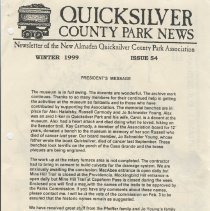
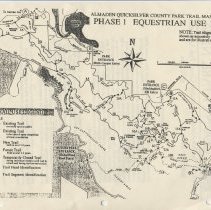
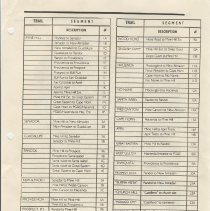
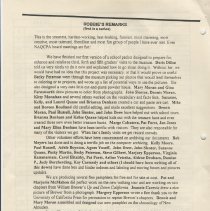
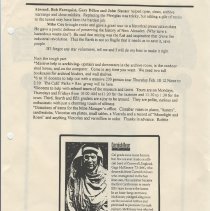
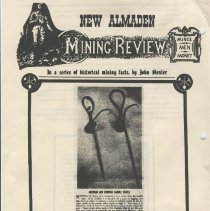
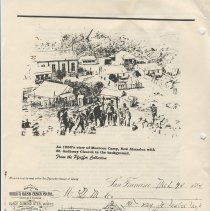
TITLE: Quicksilver County Park News SUBTITLE: Newsletter of the New Almaden Quicksilver County Park Association Issue # 54 Winter 1999 Newsletter of the New Almaden Quicksilver County Park Association WINTER 1999 ISSUE 54 PRESIDENT'S MESSAGE The museum is in full swing. The docents are wonderful. The archive work continues. Thanks to so many members for their continued help in getting the activities at the museum so fantastic and to those who have contributed by supporting the Association. The memorial benches are in place for Alex Hataisky, Russell Carmody and Jo Schneider Young. Alex was an avid hiker in Quicksilver Park and his wife, Carol, is a docent at the museum. Alex had a heart attack and died doing what he loved, hiking on the Senador trail. Kay Carmody, a member of the Association board for 12 years, donated a bench to the museum in memory of her son Russell who died of cancer last year. Our board member, Jo Schneider Young, whose father wrote the book Quicksilver, died of cancer last September. These benches look terrific on the porch of the Casa Grande and the brass plaques are being engraved. The work up at the rotary furnace area is not completed. The contractor had to bring in cement to build culverts for the drainage system. We are anxiously awaiting the conclusion. MacAbee entrance is open daily but Mine Hill Trail is closed at the Providencia. Mockingbird Hill entrance is open daily but Mine Hill Trail at Capehorn Pass is closed during the week. Enclosed you will find a map, with the names of the trails to be approved by the Parks Commission. If you have any comments about these names, please contact me. I will be at the vote of the commission on Feb. 3 to be assured that the historic names remain as suggested. We have received great str;ff from the Pfeiffer family and Jo Young's family and we will try to reproduce these stories in this newsletter and future publications. Docents arebusy archiving these items. We hope you enjoy them. Kitty Monahan "The following table of Trails within the Park refers to a map which Was entitled Phase 1 Equestrian use Plan. The trails were marked with number and letter designations." TRAILSEGMENT DESCRIPTION# MINE HILLMcAbee to SenadorIA Senador to New AImadenI B New Almaden to GuadalupeI C Guadalupe to RandolI D Randol to ProvidenciaI E Providencia to ProvidenciaI F Providencia to Prospect1G Prospect to Bull RunI H Bull Run to San CristobalII San Cristobal to AprilI) April to AprilI K April to Mine Hill Ext..I L Mine Hill Ext. to Great EasternI M Great Eastern to Cape HornI N Cape Horn to PG&E/Hacienda10 PG&E/Hacienda to Hac. Ent.IP SENADORMineto New AImaden2A New Almaden to Guadalupe2B GUADALUPEMine Hill to Senador3A Senador to Mine Hill38 RANDOLMine Hill to Prospect4A Prospect to Santa Isabel48 Santa Isabel to Santa Isabel4C Santa Isabel to Great Eastern4D Great Eastern to Cape Horn4E NEW ALMADENSenador to Mine HillSA Mine Hill to Webb Canyon5B Web Canyon to HaciendaSC PROVIDENCIAMine Hill to Mine Hill6A Mine Hill to Providencia6B PROSPECT #3Randol to Mine Hill7A "CASTILLERO"Bull Run to Wood Road8A Wood Road to PG&E8B PG&E to Mine Hill8C TRAILSEGMENT DESCRIPTION# WOOD ROADHicks Road to Mine Hill Ext.9A :ENGLISH CAMP'Mine Hill Ext. to Deep GulchI OA Deep Gulch to Mine HillI OB HACIENDAMockingbird to New AlmacenI IA New Almaden to Cape HornI B Cape Horn to No NameI C No Name to Mine HillI D NO NAMEMockingbird to Hacienda2A SANTA ISABELRandol to Randol3A WEB CANYONWeb Canyon to New Almaden4A CAPE HORNHacienda to Mine HillSA APRILMine Hill to April Trellis6A April Trellis to Mine Hill16B GREAT EASTERNMine Hill to RandolI7A DEEP GULCHHacienda Entrance to PG&EI8A "ENRIQUITA"Providencia to ProvidenciaI 9A PROSPECT # 3 EXRandol to New AImaden20A 'BUENA VISTA'Randol to New Almaden21A "CHURCH HILL"Castillero" to church site22A 'HIDALGO CM.'"Castillero" to cemetery23A 'HACIENDA CH.'"Deep Gulch" to chimney24A "YELLOW KID""Castillero" to "Wood Rd"25A "CATHERINE T."Bull Run to Catherine Tunnel26A "DAY TUNNEL"Randol to Day Tunnel27A ROBBIE'S REMARKS (first in a series) This is the smartest, hardest-working, best-looking, funniest, most charming, most creative, most talented, friendliest and most fun group of people I have ever met. Even NAQCPA board meetings are fun! We have finished our first version of a school packet designed to prepare for, enhance and reinforce third, forth and fifth graders' visits to the museum. Doris Dillon told us very nicely to do it now and explained how to go about doing it. Without her, we would have had no idea that this project was necessary, or that it would prove so useful. Becky Peterson went through the museum picking out photos that would lend themselves to coloring or to projects, and wrote up a list of potential ways to use the pictures. She also designed a very cute little cut-and-paste powder house. Mary Moran and Gina Farnsworth drew pictures to color from photographs. John Slentor, Dennis Moran, Kitty Monahan and several others worked on the vocabulary and facts lists. Suzanne, Kelly, and Laurel Quane and Brianna Denham created a cut and paste ore cart. Mike and Doreen Boulland did careful editing, and made excellent suggestions. Dennis Moran, Paul Russell, John Slenter, and John Drew have helped out with school tours. Brianna Denham and Kellee Quane helped kids out with the treasure hunt and even created three new even better treasure hunts. Marge Calcatera, Pat Forst, Jan Jones and Mary Ellen Denham have been terrific with visitors. They are also responsible for many of the visitors we get. When Jan's family visits we get record crowds. Other volunteer efforts have been concentrated on archiving our documents. Bob Meyers has done and is doing a terrific job on the computer archiving. Kelly Moore, Paul Russell, Adele Boynton, Agnes Yuseff, John Drew, John Slenter, Susanne Quane, Pinky Martin, Becky Peterson, Steve Gilbert, Marjory Epperson, Virginia Hammerness, Carol Hitalsky, Pat Forst, Arline Veteska, Aldene Denham, Damian P., Judy Borcherding, Kay Carmody and others (I should have been writing all of this down) have done box and binder indexes and labeling and moving boxes and pictures upstairs. We are producing several fine pamphlets for free and for sale at cost. Pat and Marjorie McMahon did perfect work on the new walking tour and are working on two chapters from William Brewer's Up and Down California. Jeannie Carevic drew a nice picture of Brewer from a photograph. Margery Epperson wrote a fine thank you to the University of California Press for permission to reprint Brewer's chapters. Dennis and Mary Moran assembled and designed our new pamphlet on the chronology of New Almaden. Leroy Epperson refinished an old cabinet from the mining officc that we are using for archive binders now, but we hope to use for the front area if we redesign it as a mine office (That is Kitty's brilliant idea.) John Atwood and Gary Dillon designed steps for kids to use to see over the panel in front of the tunnel diorama, and Dennis Moran made them and brought them in. Kids were using them right away without any instruction! He headed home to work on an ore cart mailbox! Dennis also designed a case and lectern to add to the end of the sales counter. Underneath the lectern will be a display that changes monthly (another one of Kitty's brillaint ideas). Paul Russel, Bill Goldman, John 4 Atwood, Bob Farnquist, Gary Dillon and John Slenter helped open, clean, archive rearrange and close exhibits. Replacing the Plexiglas was tricky, but adding a pile of rocks to the tunnel may have been the hardest job. Mike Cox brought rocks and gave a great tour to a historical preservation class. He gave a poetic defense of preserving the history of New Almaden. (Why save a hazardous waste site?) He said that mining was the fuel and inspiration that drove the industrial revolution. That the Earth is not so fragile that it needs us to save it, save people. If I forgot any star volunteers, tell me and I will do my best to make it right. Now the tough part: *Massive help in archiving- upstairs and downstairs in the archive room, in the outdoor shed boxes, and on the computer. Come in any time you want. We need two tall bookcases for archival binders, and wall shelves. *6 to 10 docents to help out with a massive 200 person tour Thursday Feb. 18 12 Noon to 2:30. The Calif. Parks + Rec. group will be here. *Docents to help with school tours of the museum and town. Tours are on Mondays, Thursdays and Fridays from 10:00 AM to 1:20 for the museum and 11:30 to 1:30 for the town. Third, fourth and fifth graders are a joy to be around. They are polite, curious and enthusiastic with just a charming touch of silliness. *Donations of items for the Mine Manager's office: Cinnabar vases or plates, "lusters", candlesticks, Victorian era plates, small tables, a Victrola and a record of "Moonlight and Roses" and anything Victorian and vermillion in color. Thanks in advance. Robbie Cal grads earn many honors, but few are ever made an official bard of Cornwall, England. Gage Mchinney'73 (left), who descends from Cornish miners who immigrated to the San Jose area, this summer became the first Californian in nearly fifty years to earn the honor. In an hour-Iong ceremony, McKinney pledged allegiance on the sword of Arthur and promised to promote Cornish culture. McKinney was selected by the Gorsedd, the congress of bards in the old country, especially for his recent book, A High and Holy Place, a social history of the New Almaden quicksilver mine. "California Monthly", Dec. 1998, vol. 9 no.3 NEW ALMADEN MINING REVIEW In a series of historical mining facts, by John Slenter Mexican and Cornish Candle Sticks Nothing is closer as a companion to a miner than his candle stick. If by accident it is knocked off a post, or lagging, and falls down an chute, or manway, a miner is helpless onless he has another candle in his pocket and a match to light it. Even then it is difficult to work as there is no place handy to put a candle without the stick. These artistic sticks, used at New Almaden Mine in the `80s and `90s are a work of art, especially the one made by the Mexican. Both are hand wrought, tempered by a process of heating and cooling in oil and pounding out on an anvil. A good candle stick is indespensible to a miner and has been since early days. Many of them don't like the carbide lamps, although the shift bosses carry the "blue light". Electricity is not practicable close to blasting which a miner has to do after drilling his holes. Mr. Bulmore's article tells an interesting story.of an important item almost wholly forgotten in history. His candle sticks will probably repose in the museum at New Almaden which is now taking shape as a rality. This remarkable, clear photo courtesy Gersh Photo, Berkely, California. THE MIGHTY MANZANITA Most people readily recognize manzanita. They may see it as they hike through the Quicksilver Park or even see it being grown as an ornamental in someone's yard. Its bright green evergreen foliage and striking red to purple bark make it a botanical standout. Several varieties bloom in January and February when other flowers tend to be scarce. The attractive white to pinkish bell-shaped flowers are a welcome treat to hummingbirds and insects that emerge from their winter sleep on sunny days. Manzanita comes in all shapes and sizes - that's because there's about 50 species - 38 in California alone. Some of these 38 have several distinct forms and varieties that are adapted to very specific sites. Most grow as mid-sized shrubs, but some grow along the ground like a mat while others are quite tree-like. Many are able to stump-sprout after fires while others seed-sprout quickly in fire-ravaged areas. Because they are thin-barked, most are readily done in by fire. They usually have many dead branches that cling to them as they age. The wood is very dense and burns with unusual intensity. Frequent fires keep manzanita small and under control but our penchant for putting out every little blaze allows manzanita to proliferate in both quantity and size. The result is often a prodigious conflagration that destroys trees and everything else in the immediate area. Manzanita, the diminutive form of manzana, is a Spanish word that means 'little apple'. As you might guess, the fruit looks like a tiny apple. I guess we could call New York la Manzana grande (the big Apple).Of course manzanita also has a scientific name - Arctostaphylos. Arcto is from the Greek 'arktos', which means bear, and 'staphule', which means grape. Bears and lots of other mammals, birds and insects partake of the fruit of the manzanita. Manzanitas are in the Heather family, of which there are about 1400 species worldwide. They join many other proud plant families that make up the flora of the Quicksilver Park. Make plans for your family to visit them along the trails this year. Bob Clement Missionary Visits New Almaden, 1847 The Rev. William Roberts (1812 - 1888), a pioneer American clergyman, left an account of an 1847 journey on horseback from Monterey to San Francisco that included a visit to the New Almaden mine. The account was recently discovered in the archives of the United Methodist Church in Berkeley. Dr. Stephen Yale, director of the archives who has previously spoken at New Almaden, sent NAQCPA a typescript, and Gage McKinney edited it for this newsletter. Bark Whiton, Harbour of Monterey Upper California May 28th 1847 To the Rev. Dr. Pitman, Corresponding Secretary of the Missionary Society of the Methodist Episcopal Church Dear Brother: At the close of my last, I was surveying Monterey; visiting the old Presidio studying Californian habits and gazing with eager interest at the dexterous manner in which they lasso a bullock. But as it was now decided that the bark Whiton must visit Monterey before going to Oregon, we hastened to purchase horses to return to San Francisco. We bought three for $50 and Thursday noon commenced our journey under the guidance of Mr. Hyde, a gentleman from the states, who had frequently traveled the road. Our route for several miles was over barren sand hills covered with scrub oak, until we came to the Salinas plains. This is a beautiful valley of 6 or 8 miles extending far as the eye could reach, covered with rich grasses and wild oats in luxurious abundance for the bands of cattle, and horses which here abound. . . . We now crossed over a range of hills which separated the Salinas plains from the valley of San Juan. While on the hills the evening fog came over from the ocean, and we hastened down the steep sides to get into quarters before dark. About two miles from the mountain gorge out of which we issued into the plain stands the mission buildings of San Juan Bautista, occupying decidedly the most commanding position and constructed on the largest proportions of any mission I have seen in California. The Padre very kindly received us, and although our "muy poco" of Spanish was soon exhausted the evening was spent very agreeably and at an early hour, we stretched our weary limbs upon a couch spread on the floor, after a ride of 12 leagues. . . . Early the next morning, we were on our horses, crossing the valley in a northerly direction, until we came to the San Juan river, a low sluggish stream at present easily forded, but which bears the appearance of being swelled into a torrent in the rainy season. Our course now lay over a ridge of hills for an hour, where we opened upon another valley that of the Pueblo of San Jose. Before us as far as the eye could reach lay a fertile plain of from 15 to 30 miles in width, skirted on either hand by ranges of mountains which are covered with red wood and abound in game. This valley like most others in California is well supplied with a kind of oak, growing at distances almost as regular and having the general appearance of very thrifty trees in an apple orchard in the states. . . . Toward evening, we came to that Estaucia of Capt. Fisher, an old acquaintance of Capt. Gelston [commander of the Whiton], where we stayed until morning.... On Saturday he accompanied us to his residence in the Pueblo, 12 miles distant from his farm, where we rested our horses until Monday morning. There is a quicksilver mine in this vicinity, which I visited on Saturday; it lies in a range of mountains between the valley through which we had passed and the ocean. Taking a guide and fresh horses we rode 12 miles through the valley and there entered a gorge in the mountains at the base of which stand a few log cabins to accommodate the miners. Here we found Mr. Alden the superintendent, who informed us that the average yield of quicksilver is 18 percent; though mines of the rich [paper cut out] yield from 25 to 30 percent. The mine is nearly 3000 feet up the side of the mountain [paper cut out] was toilsome. There is an excavation some 130 feet square out of which much valuable ore had been taken. Many of the pieces of blasted rock sparkle with the metal, and all is red with cinnabar. The title to the mine is disputed at present but it is in the hands of English capitalists [Barron & Forbes] at present. I obtained several very rich specimens of the ore. Corn. Biddle has prohibited the exportation of quicksilver from the country, so that the results of the company's labors is at present detained in Monterey. The reason I understand is to keep it out of the hands of the Mexicans who need it greatly to work their gold mines. [The Treaty of Guadalupe Hidalgo, ending hostilities between Mexico and the United States was not signed until the following January]. If I remember correctly most of the Quicksilver of commerce, is obtained from Almaden in Spain and Idria in Hungary . There are traces of this metal in almost every part of this country and it is very likely to yield an abundant product. The following Sabbath was spent in the village, but there was no chance to hold a meeting of any kind, but few persons here could understand English and even they could not be collected together at this time. But this fertile valley will soon fill up with American residents and I have made application to the Authorities of the place for a lot upon which to erect a church. Early on Monday we resumed our journey having yet 19 leagues to travel. The first three of the road miles was skirted by groves of willow and cotton trees planted years ago by the Padre of Santa Clara, who resolved to leave no excuse to keep the people away from church. They extend from the Pueblo to Santa Clara Mission. Our course now lay down the side of the bay, on the other side of which we could directly see the Mission buildings of San Jose, at the base of the mountains which separate this valley from that of the San Joachin, As we came within 10 miles of San Francisco we met its boisterous winds, and after toiling with tired horses over barren sand hills until nearly night, arrived in safety again on board the bark. I am yours truly [signature cut out of paper] The Rev. Roberts had been sent by the Board of Bishops of the Methodist Episcopal Church (now the United Methodist Church) to direct mission work in Oregon and survey conditions in California on the way. He left New York with J. H. Wilbur and their families on the bark Whiton and entered the Golden Gate 1 48 days later. He preached at Brown's Hotel in San Francisco on 25 April 1847, the first Protestant service in the region since the time of Sir Francis Drake. "The bar was closed and the billiard room locked up until the service was over," Roberts reported He spent six weeks in California, visiting Monterey and making the journey recounted in his letter. Later he organized the Oregon and California Mission Conference for the Methodists and was involved in establishing churches in Coloma, Sacramento and elsewhere in California and Oregon. William Roberts lived out his life in Oregon. The pioneer California bishop William Taylor remembered him as "one of God's noblemen." The bark Whiton, a two-masted, square-rigged sailing ship, has its own place in church history. Her master, Captain Gelston, was a willing Methodist who returned from Oregon at his own expense with lumber for a church in San Francisco. Later the Whiton was at the embarcadero in Sacramento serving as a storeship and church. A NIGHT IN CONSPIRACY The most exciting event of my original Almaden sojourn occured in the liquor emporium of Mr. Morales, an establishment which offered little in the manner of invitation for the connoisseur. No mirrors, no crystal chandeliers, no comfortable lounges from which one might gaze in meditative alcoholic haze at large and gaudy pictures of concupiscent ladies were evidenced. Aside from the bar, a long, rough table fronting a bottle crowded shelf, and two coal oil lamps which exhuded a small quantity of light at the expense of a vast amount of smoke, there were only a few dilapidated chairs and tables. Otherwise the ten by twenty room was bare. Bare, that is, except for some fifty swarthy, half drunken men fighting for every available inch of space. In this elite atmosphere, Jose Garner was literally rocking the room with invectives, the major portion of which were exclusively for the benefit of the Quicksilver Mining Company. My very presence would have been questioned seriously, had I not been well screened with oratory, bottles, and smoke. As I listened to the adjectives lavished on mine and officials, I mentally reviewed events leading up to this particular eruption. Labor troubles had roosted at New Almaden for years. The very fabrication of the QMC lead to more, for not only was it capitalized for a vast sum of money, but in addition, it had assumed a staggering load of obligations, both in money, and in promises to stockholders and backers-to whom the mine had been rightly represented as the `richest on the globe'. Faced with a landscape garnished with debts, this company had to speed production almost beyond possibilities. And production depended entirely upon the abilities of the Mexican miner. There the QMC encountered calamity by running into Latin temperament without due consideration for Latin tradition. The Mexican valued his liberty to a degree even greater than the rough forty niner. For centuries, he had enjoyed a certain pattern of life based on the blessings to be found in today's living. According to his philosophy, it was up to the company to provide tomorrow's shelter. The Barrons, discretely interfering not at all with Mexican morality and customs, had followed a course which was more or less mutually honored. But with the coming of the Butterworth regime, a variety of regulations was set up without the necessary dictatorship to make them effective, and trouble inevitably followed. The establishment of a toll gate marked the beginning of a very real fermentation. Another thorn in the Mexican side came with a virtual insistence that everyone trade at the company stores, which were apparently not satisfied with the 90% of business already enjoyed. With a census came two rules, one that all single men were to live in specified boarding houses, and another demanding that rents be charged for houses as well as for the land on which they stood. On these points, the pot of Mexican patience boiled over. Such impositions were, however, practically unenforceable because the company executed all its work under the contract system and made no pretense of knowing its employees. Much to their chagrin, the officials soon discovered that many of their employees were quite as tough as their own financial problems. Many were not concerned with the mine at all, while others were as much concerned as the company but in quite a different manner. Spanishtown, like the settlement at the Enriqueta Mine, was more than a local congregation of miners. It included many native Californians who, during the Americanization of California, received the rankest kind of treatment from the Yankee invaders whose injustices were sometimes of the most framed nature. Some Mexicans turned outlaw, and while some came peacefully to Almaden or New Idria, others came with fire in their eyes. An incident concerning Murietta and his gunmen was typical. Under Sheriff Adams, a posse from San Jose, searching for the outlaw who was reported to be hiding on the northern slope of Loma Prieta, arrived at Hacienda. Adams boasted that on his return he would have the gentleman's head in a bottle, then pushed on immediately lest his quarry get word of his coming. It happened that the outlaws, camped beside a immense fallen Redwood, had been surprised and cornered. Covered from every angle, they were commanded to throw up their arms and march out in single file. One by one, they did so until the last man, Murietta. As he gained the open, he broke and ran. Amidst a hail of gunfire, he reached his horse and galloped off. Such was the luck and daring of Murietta. Many other questionable characters took refuge in Spanish Town, but glory to the sheriff who could touch one if his compatriots elected to shield him. I have distinct recollections of having seen Garcia and Vasques, but such men were on the Hill for recluse, not for mischief. However, others among this fine fraternity of ruffians were dextrous with knife, bottle, and card, and from such a crew anything might breed. At the time of the gathering in Morales' Saloon, three of the hardest villians imaginable had come to be regarded by their fellows as more or less heroes. Amriano Ayalo, Lazara Higuera, and the loud mouth Jose Garner, had already dwelt long and often on their many grievances. They felt that the Company was shortening them on their ore deliveries. The census was in their opinion a scheme to further taxation, and incidentally, a plan to route all ambitious individuals like themselves out of camp. As if to add fuel to this fire, the company, that day, had posted notices that thereafter the men would pay for their own candles, fuses, and powder, and further, that new miners would take half their pay in store boletos. At the climactic explosion in Mr. Morales' emporium of alcohol, I, in the line of duty, was fortunate enough to count myself among those present, a thoroughly interested spectator. Stories from Jimmie Schneider's collection donated by Jo Schneider Young's children. |
People |
Hatalsky, Alex Carmody, Russell Young, Jo Garner, Jose |
Cataloged by |
Meyer, Bob |