
Archive Record
Images
Additional Images [8]
Metadata
Catalog number |
1997.2.2597 |
Object Name |
Newsletter |
Date |
1991 |
Description |
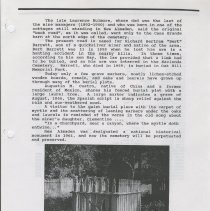
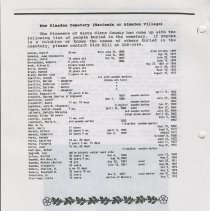
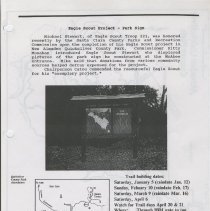
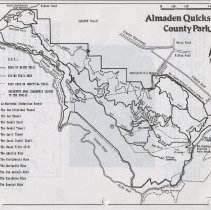
TITLE: Quicksilver County Park News SUBTITLE: Newsletter of the New Almaden Quicksilver County Park Association Issue # 25 Winter 1991 "The Capitancillos ridge was a virtual botanical wonderland of flowers, shrubs and trees. There was never a day in the year that any household could be without a bouquet of flowers - from spring's magical array of shooting stars, pink, magenta and white, to the Indian pinks in late summer, perhaps the most brilliantly colored scarlet flower on the ridge. Even more startling was the Indian paint brush or Indian warriors. The Bull Run flatlands in early spring were a solid mass of Johnny-jump-ups and small hollyhocks, while columbine and white violets along with the wake robin and hound's tongue came up in sheltered spots. In endless places on the ridge there were massed displays of so many wild flowers that it was like viewing the heavens on a clear night. The Senador road was a virtual garden of poppies, blue gilia, and babyblue eyes, and there were areas of iris, farewell to spring and yellow and white Mariposa lilies. In the winter the red Toyon berries animated the colorless scene and in the summer the headwaters of Deep Gulch were aflame with the bright yellow of Spanish broom and now China lilies mark the remains of long-forgotten homes." So writes Jimmie Schneider in his manuscript on the New Almaden mines. This manuscript, along with classic pictures will be published in 1991. Jimmie Schneider finished the text in 1973, but he died before it could be printed. The NAQCPA has agreed to sponsor the publishing of this marvelous account of the history, geology and mining operations of the area. A group of members is organizing the manuscript and inserting the pictures in their proper place in the text and Leonard McKay will publish the book. The group has agreed to be responsible for the cost of 500 copies while McKay Printing will be responsible for the remaining 2000 copies. We are applying to various organizations for financial support of this big undertaking. Meanwhile, the Museum and Tours of the Park continue to be very successful. The trailer at the reduction site, designed to be a ranger office, continues to be prepared for ranger use. We hope it will be completed soon! The firm that has been accepted to do phase 4 of the toxic study has not been announced yet. So we wait! An eagle scout has installed a magnificent park informational sign at the McAbee entrance to Quicksilver Park. We commend Mike Stewart for his excellent work on this project. We now have great NAQCPA shirts. They are silver gray with cinnabar writing, the logo on the front, and a map on the back ($15 each). Want to order some? Call the museum: 268-1729. If you have some time to help organize artifacts that we have received lately, please give me a call. We can work out times at your convenience. Thanks, Kitty H E L P ! Does anybody know what happened to the Association's carousel projector and the slide carousel? Pioneer Day 1990 Pioneer day 1990 started out with a bang! This was the eighth of the annual events, and on Wednesday, October 10, 1990, the San Jose Mercury News printed an article by Michelle Guido which announced the celebration. This caused a quandary for the Quicksilver Board of Directors: How many people to prepare for? When Saturday, October 13th arrived, the weather was fine and an even greater than expected number of guests was ready to ascend Mine Hill to the Powder House area. Dick Forst reported that there were 150 paid attendees, which did not include children, so the total audience was perhaps 200 (over twice the previous gatherings which may say something for the power of the press). Kitty Monahan announced before the meal that we might be short on food and those assembled seemed to accept that in good spirit. Perhaps it wouldn't have mattered because at picnics whatever food or drink available will be consumed. During the meal, slim John Goldsworthy serenaded us with dinner music which made a pleasant interlude. Kitty had coerced Mark Frederick, Quicksilver Park Planner, into being Master of Ceremonies. Mark told of Kitty educating him in the history of Quicksilver Park and its abundant plant growth and wildlife. He then introduced chuck Rich, one of the last miners on the hill. Chuck told us that his wife and he had raised a family in that area. He said that the Powder House was built with two walls because old-time dynamite was unstable and a change in the weather could set it off. He understood that the insulation between the walls was horse manure. The dynamite that Chuck used was not as touchy. Chuck did everything underground. One day he was ahead of the locomotive when an ore car came off the tracks. Everything but Chuck stopped. OSHA condemned the mine, so Chuck and three other partners ran the operation and fed the furnace for five years. A prodigious feat! Chuck talked his wife into coming to live on the Hill. During those five years his children were born. Chuck and Ruth were the last couple to have a baby (now 28) born up on the Hill. Chuck was able to buy his house, a pickup truck and a car during that time. That was in 1964. Next, John Slenter, member of Quicksilver Association, presented a history of explosives. Alfred Nobel invented dynamite in 1867. Before that, black power was used. Dynamite consists of measured amounts of sawdust and nitro-glycerine. It was short tempered and so was replaced by sodium nitrate. Explosives require a fuse and a blasting cap to detonate the charge. John did not set off a charge. He explained the various patterns used in drilling the face of the mine. He demonstrated a fuse burn. Misfire is the worst problem. The miners would count and wait 45 minutes to assure that a charge was indeed a dud. Freezing was not a problem in this area. John did not know of any mishaps at this mine, but Chuck knew of a fellow who was blasted with dynamite. He bet his partner on how long he would wait. The charge went off before the challenged fellow left and he only lost his hearing in one ear. Chuck would arrange to set off the charges at quitting time, counted the blasts and did not return until the next day. Charges that did not explode were called "sleepers". Frank Fenton, of Santa Clara County Parks and Recreation and the liaison for the Historical Heritage Commission, informed the guests that the earthquake damaged the Powder House and FE14A has approved funds to repair the vaulted brick roofing which had come down. The Historical Heritage Commission is working to preserve and protect places and things of historical value. Frank hopes that within the next year the work on the Powder House will be completed. Next Alan La Fleur, Deputy Director Santa Clara County Parks and Recreation, explained that mitigation of the taxics issue has to be accomplished before we can proceed with developing the park. A remedial action plan should be completed by the middle of 1991, and the master plan should be done by 1992. The toxics issue must be solved before work can proceed. Alan said the community spirit in New Almaden is a real advantage for getting things accomplished in the park. A risk assessment firm is to be chosen by November; this assessment must be done in 180 days. After that a draft remedial action plan, which will take three to four months, will identify problems which must be addressed. Susanne Wilson, Santa Clara County Supervisor, outlined the cost of purchasing the park property. This Hill attracts controversy. Balancing the relieving of mental stress against toxicity problems in the park, Susanne finds that the serenity of the park outweighs the hazards of toxics. She stated that beginning in 1975, with the purchase of 2,465 acres from New Idria Mining and Chemical Company for $2,000,000, until now, the county has invested a little over $5,250,000 to purchase a total of 3,605 acres for the park. She urged us to vote YES on measure A for the establishment of a Santa Clara County Open Space Authority. She said that a two thirds majority is required for the measure to pass. Kitty Monahan introduced the Quicksilver Association Board of Directors. She explained that in April of each year trails are upgraded by the Association, that a quarterly Newsletter is published, and that Pioneer Day is sponsored by the Association. This year the Association has also undertaken the job of publishing a book written by Jimmie Schneider. Jimmie Schneider's daughter, Jo Schneider Young, was introduced by Kitty. Jo said much of her childhood was spent on the Hill. Her father's book was 60 years in the making and it is exciting to know that it will finally be printed. Jimmie had thoroughly explored this area and knew it better than anybody else. He had been a geology-botany major at Stanford and was well equipped to write a book. Since he wanted to write about mining, he became a miner. The book is about the miners and the litigation over the mine; it will be an adjunct to Cinnabar Hills. Jimmie had a prune packing plant in San Jose where he spent five days a week. Most of the rest of the time he spent at this mine. The book was finished in the late '60's and the original publisher died before the book was printed. Now the book is soon to be printed - watch for it: Forest Goldsworthy told us that the miners' inch thick pasties were heated on miner's stoves - shovels with a candle supplying the heat. Clyde Arbuckel told of his friendship with Jimmie Schneider. Clyde has been coming here since 1932. He said that this mine is the most important mine in the state of California. It broke an international monopoly held by the Rothchilds who operated the Almaden, Spain, mines with convict labor. Until New Almaden commenced operations in 1845, the Spanish mine was the main source of quicksilver in the world. The chief reduction agent for the recovery of gold and silver was quicksilver until the cyanide process was discovered in 1887. Castillero's recognition of the New Almaden mineral in 1845 gave us control of our own destiny. Richard Wachs Victoria Shaft and the Powder House, site of the Pioneer Day celebration in October 1990. Jimmie Schneider photo. Update on Jimmie Schneider's Book A grant application was submitted to the Sourisseau Academy and reviewed favorably at the Trustees' December meeting. once a few discrepancies have been resolved, a grant of $500 will be awarded our association for the publication of the book. Now all we need is an additional $7500. The Origins of Hicks Road Hicks Road, which borders the Quicksilver Park, was named for one of the first Cornishmen to work at New Almaden and for his wife, the descendant of early Hispanic settlers. Thomas Hicks, born in Redruth, Cornwall, in 1827, was working at New Almaden by the mid-1850s. He was joined by his brothers Benjamin and Richard. In 1866 he married Josefa Bernal. Presumably through marriage he came into possession of 160 acres in the vicinity of Guadalupe Reservoir. In 1868 Hicks led a group of about 15 landowners who petitioned the County Board of Supervisors to build Hicks Road. The Supervisors unanimously voted to build the road over the objections of the Guadalupe Mining Company. The mining company was compensated $100. The original road, which was 40 feet wide, began near the current intersection of Camden and Kooser and ran the length of Guadalupe Canyon to intersect with Alamitos Road. The road was repaired in 1878 after local residents complained that it had become "a mire." In 1895 it was widened and improved by the addition of culverts and turnouts. One of the people to benefit from the road was S. F. Butterworth, of the New Almaden Mining Company, who owned property nearby. Josefa and Thomas Hicks lived on their property and used the road into the early years of this century. Gage McKinney Postscript: Thomas Hicks was Gage's grandfather's great uncle; Richard Hicks was his maternal great-great grandfather. Publications Update The Almaden Valley Women's Club has awarded $250 to the Association for the publication of the Schneider book. Hacienda cemetery by Patricia Loomis New Almaden's historic Hacienda cemetery may be restored, according to recent action by the Pioneers of Santa Clara County which owns it. The cemetery on Bertram Road has been badly vandalized over the years, tombstones removed, some destroyed, and nature has almost covered the little graveyard with poison oak, trees and native bushes. The original wooden fence is gone and will be replaced. Boundaries of the cemetery, which dates to the early 1860's, will be surveyed. Plans call for grave restoration and site marker replacement. Also planned in the project, which could total $87,750, are visitor walkways, simulated adobe walls and interpretive displays. The Pioneers are looking for the cemetery's plot plan and anyone with information should call Dick Hill at 258-3449. The tiny myrtle-entangled graveyard where sunlight filters through tall laurels to make shadow patterns on weathered markers was tax deeded to the late historian Gene Vennum who turned it over to the Pioneers in 1973. Located on the east bank of Arroyo de los Alamitos, the cemetery dates back to the days when the New Almaden Quicksilver Co. headquarters and reduction works were at the Hacienda (now New Almaden), and the Cornish and Mexican miners lived in the towns on the Hill. A search of county records in 1973 failed to turn up a map of the cemetery or any document establishing it as a graveyard and claiming tax exemption as such. Apparently the company set aside the land and when the mines shut down and the company land was sold, the little graveyard went with it. In the mid-1920s, musician Ben Black, who wrote the then-popular song "Moonlight and Roses", and his brother David bought some of the mining company land at the Hacienda and subdivided it. Their map of Lake Almaden Properties, which took in the Casa Grande, home of the mine managers, and ran along the Los Alamitos Creek through the heart of the present New Almaden community, was filed in 1927. It includes lots 43, 44, 101, and 102, but nowhere indicates they comprised a burial ground. Bertram road was cut the length of the tract east of the creek, slicing a swath through the little cemetery over the tops of an unknown number of graves. Old timers recall crosses and headstones were broken off and graves bulldozed in building the road in the spring of 1928, resulting in a law suit brought by the late Jack Villar and 15 others. The late Laurence Bulmore, whose dad was the last of the mine managers (1892-1900) and who was born in one of the cottages still standing in New Almaden, said the original "back road", as it was called, went only to the Casa Grande barn at the north edge of the cemetery. The present road is named for Richard Bertram "Bert" Barrett, son of a quicksilver miner and native of the area. Bert Barrett was 13 in 1898 when he lost his arm in a hunting accident in the nearby hills. In those times, according to his son Ray, the law provided that a limb had to be buried, and so his arm was interred in the Hacienda Cemetery. Barrett, who died in 1959, is buried in Oak Hill Memorial Park. Today only a few grave markers, mostly lichen-etched wooden boards, remain, and oaks and laurels have grown up through many of the burial plots. Augustin M. Castro, native of China and a former resident of Mexico, shares his fenced burial plot with a large laurel tree. A large marker indicates a grave of August, 1866, the Spanish script in sharp relief against the rain and sun-weathered wood. A visitor to the quiet burial place with its carpet of myrtle and its scattering of leaning markers under the oaks and laurels is reminded of the verse in the old song about the miner's daughter, clementine .... "In a churchyard, near a canyon, where the myrtle doth entwine..." New Almaden was designated a national historical monument in 1964, and now its cemetery will be perpetuated and preserved. Hacienda Cemetery - source: Mary Becker. New Almaden Cemetery (Hacienda or Almaden Village) The Pioneers of Santa Clara County has come up with the following list of people buried in the cemetery. If anyone is a relative or knows the names of others buried in the cemetery, please contact Dick Hill at 258-3449. Aceves, Daniel 16 mo. Born June 14, 1898 Died October 1899 Benales, Juan Nepomuceno June 14, 1809 May 19, 1871 Barron, child 13 years old Dec, 16, 1907 July 22, 1920 Berreyesas, Roberto 9 years old 1886 June 19, 1895 Book, Alfred E. broken heed stone May 22, 1861 or 1864 Boria, amedeo 30 years old April 28, 1861 Bryan, Hannah 13 years old Sept 19, 1855 Bryan, Martha Jane 5 years 0 mo. August 15, 1855 Castillo, Joseph -son All with wooden markers Castillo, Marian -daughter (Dates ere lost) Castillo, Nicholas - father " Castillo, Sellima -mother " Castillo, Vivien -daughter " Castro, Augustin M. 53 years 8 ea. April 11, 1866 Crawford, George (Native of England) 1820 wooden marker 1895 Danielson, Jennil Dec 7, 1886 July 27, 1888 Dieckhoff, Sadie 17 mo. 10 days wooden marker 1890 Espionsa, Jose M. (Esposos) Illegible wooden marker Feb 17, 1898 Higgins, Walter Joseph 7 mo. April 24, 7866 Mood Nov 17, 1866 Jallesio, Refujio Morantes old wooden marker July 23, 1866 Keenen, Ellen 24 years large stone marker April 10, 1862 Lethiec, Louisa 11 mo. old July 3, 1868 Lopetecui, Marie A. old wooden marker 1822 1892 May, W. C. Illegible wooden marker Metz, Harry 11 years Sept 19, 1890 Moreno, Arturo 30 years 5 mo. April 3, 1883 Sept 9, 1913 Moreno, Federico 22 years 9 mo Dec 2, 1890 August 1913 Perez, Carmen October e, 1868 Perez, Catalina 13 mo. 22 days June 10, 1873 Perez, Victoria 2 years 5 mo. 19 days June 11, 1873 Perez, Juan 14 No. 22 days Rug 24, 1874 Rodriges, Rafael Illegible wooden marker Sagrada, Ala white pickets center west Side Selaya, Eslind 30 years 7 mo. Dec 4, 1866 July 12, 1898 Sepeda, Mrs Mary W. 36 years 9 no. Aug 16,7862 May 5, 1899 Sepeda, Minnie (Marie) 18 yrs Dec 10, 1891 Mood Nov 25, 1911 Sepeda, Vincentio 56 years July 16, 1857 Mood Aug 20, 1907 Subers, Charles, W. 6 mo 13 days Oct 3, 1870 Subers, Susannah M. 25 years 10 mo. Nov 5, 1870 Ynostrosa, E. 43 years Nov 2, 1857 .. ad marker Jan 31, 1900 Yturriaga, Lucia 76 years Native of Montery pug 7, 1912 Cemetery Update The Santa Clara County Historic Heritage Commission has allocated $45,000 to the Pioneers of Santa Clara County for the purpose of preserving and defining the old Hacienda Cemetery. Eagle Scout Project - Park Sign Michael Stewart, of Eagle Scout Troop 221, was honored recently by the Santa Clara County Parks and Recreation Commission upon the completion of his Eagle Scout project in New Almaden Quicksilver County Park. Commissioner Kitty Monahan introduced Eagle Scout Stewart who displayed pictures of the park sign he constructed at the McAbee entrance. Mike said that donations from various community sources helped defray expenses for the project. Chairperson Catou commended the resourceful Eagle Scout for his "exemplary project." Trail building dates: Saturday, January 5 (raindate Jan. 12) Sunday, Febuary 10 (raindate Feb. 17) Saturday, March 9 (raindate Mar. 16) Saturday, April 6 Watch for Trail days April 20 & 21 Where: Through IBM gate to top of hill, park behind building When: 9 am - 3 pm Bring: Water, lunch rain gear wear long-sleeved shirt, long pants and boots Provided: Tools, gloves, instruction and refreshments at the end of the day |
People |
Arbuckle, Clyde Fenton, Frank Forst, Dick Frederick, Mark Goldsworthy, Forest Hicks, Benjamin Brown Hicks, Josefa Bernal (Mrs. Thomas Hicks) Hicks, Richard "Dick" Hicks, Thomas Pascoe Brown LaFleur, Alan Loomis, Pat (Patricia) McKinney, Gage Monahan, Kitty Rich, Chuck Schneider, Jo (Jo Schneider Young) Slenter, John Stewart, Michael Wachs, Richard Wilson, Susie (Santa Clara County Board of Supervisors) |
Cataloged by |
Meyer, Bob |