
Archive Record
Images
Additional Images [10]

Metadata
Catalog number |
1997.2.2643 |
Object Name |
Newsletter |
Date |
2003 |
Description |
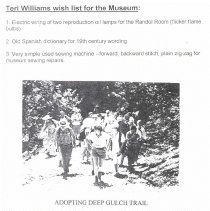
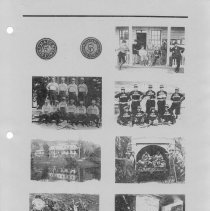
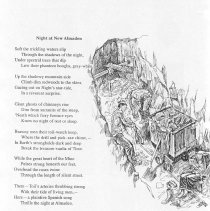
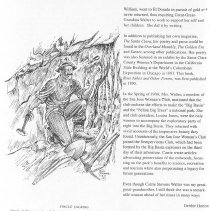
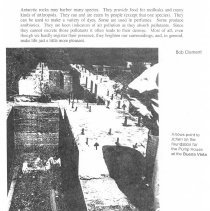
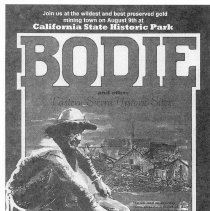
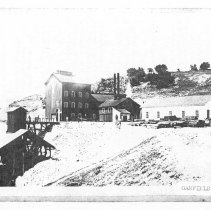
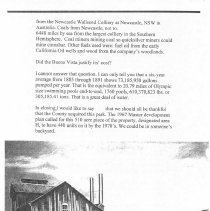
TITLE:Quicksilver County Park News SUBTITLE: Newsletter of the New Almaden Quicksilver County Park Association Spring 2003 Issue 71 QUICKSILVER COUNTY PARK NEWS Newsletter of the New Almaden Quicksilver County Park Association SPRING 2003 ISSUE 71 PRESIDENT'S MESSAGE The wildflower book is ready for printing and Art Boudreault has found a printer.lt will be a beautiful guide to the flowers in Almaden Quicksilver County Park. It will be ready for Pioneer Day in October and you could get one then. The information for the Senador plaque is prepared and Robin Schout, Interpretive Program Supervisor for Santa Clara County Parks and Recreation, will design it and have it constructed for display at Pioneer Day. Keep October 11 clear for the dedication at the Senador Mine. Invitations will be coming in September. Thank you for your support of the Opry House at the Casa Grande. The Santa Clara County Board of Supervisors voted for Option 1 which saves the building-. Now we have our work cut out for us to help make the building functional for County and Museum events. We will work with the Parks Department to create a fine showplace for the County. The Adopt A Trail program is in full swing now and your organization has adopted the Deep Gulch Trail in Almaden Quicksilver County Park. Once the trail is open, we will set up work days throughout the year to keep the coyote brush and Scotch broom cut back. A lecture series for the coming year is planned for the fall. What do you want to learn about? We have some topics ready: geology of Quicksilver Park, mining equipment, art in New Almaden, flora and fauna of the park, and music and poetry by local artists. We need more topics so send us your suggestions... P.O. Box 124 , New Almaden, Ca. 95042 Twenty years ago, 1983, Don Weden created a friends group for the New Almaden Quicksilver County Park and thus NAQCPA. He now is retiring from the Santa Clara County Planning Department. We have much to be grateful for as he wrote the first plan for the Park and set up the opportunity for our organization. His retirement party will be June 11 at Vasona County Park. We will be giving him an honorary life membership and a gift. If you would like to attend the function call me for further information. Kitty (408)268-6541 Teri Williams wish list for the Museum: 1. Electric wiring of two reproduction oil lamps for the Randol Room (flicker flame bulbs) 2. Old Spanish dictionary for 19th century wording 3. Very simple used sewing machine --forward, backward stitch, plain zig-zag for museum sewing repairs. ADOPTING DEEP GULCH TRAIL The County has begun their Adopt A Trail Program and NAQCPA has adopted the Deep Gulch Trail for our own project. The Deep Gulch is a small trail which connects the western end of Hacienda parking lot with Mine Hill. It will be a separate route with much less traffic than Mine Hill Road has. Greg Bringelson, the Parks Trail Lead, held training sessions on May 7 and 21. It was a beautiful warm day on the Hill at the last session. Larry, Marilyn, Kitty, Art, Bob, Paul and others enjoyed the chance to chop weeds and clear brush with a professional. Ask any of us for a demonstration. We would like to keep this trail clear and we expect to begin on a Wednesday morning in June. If you can help please contact one of the Board members or me (356-8283) Bob Meyer 2nd Annual mining collectors show Saturday July 19th 10A.M. - 4 P.M. Mark your calendar and join us to see and appreciate those men who spent their lives mining and the equipment they used. For more information call 488 323-1107 NEW ALMADEN PHOTOS AT TRADER JOE'S Article by Art Boudreault When we enter the Trader Joe's at the Old Almaden Shopping Center at the corner of McAbee and Almaden Expressway, we can take the opportunity to experience the New Almaden mining period. Go down the aisle facing the entrance and look at the high atrium. On the four walls are eight photographs from the New Almaden Mining Museum collection. The photos and their story are listed in this article, beginning to the left and proceeding clockwise around the atrium walls. Please let the store employees and management know how much you appreciate the publicity for the New Almaden Mining Museum. Our special thanks to Gary Nigh who selected these photos and displayed them in this large format. Boletos (about 1895) The store on the Hill and in the Hacienda carried no credit accounts. As the company advanced no wages before payday, the store would issue small cardboard or metal inscriptions called boletos. A customer without funds, wishing to make a purchase, was issued the desired amount in different denominations. In these transactions, a record was sent to the company paymaster, who deducted the stated amount from the workers wages and sent the withdrawal to the store. The boletos ranged in value from 5 cents to one dollar. There were occasions when workers wanting cash would draw boletos and sell them at a discount. Men at the Mine Hill Store (about 1897) Seven men are standing on the porch of the Mine Office at English Town. They are, from left to right: Ellard Carson, E. W. Parker, Tom Wasley, Charles C. Derby, Charles F. O'Brion, Richard E. Harry and Dr. Lowell. The New Almaden Baseball team with their batboy (about 1894) Nine ballplayers and a mascot (the young boy) composed the first uniformed baseball team for New Almaden. Games were played at the Hacienda school grounds with visiting teams from surrounding townships. The team was organized in 1891. The New Almaden baseball team (1912) Nine players in uniform. Games were still played at the Hacienda School Grounds at the corner of Bertram & Almaden Road. The Casa Grande (1885) At this time, the home of Mine Manager, James Butterworth Randol. The Casa Grande reflects in the lagoon from the creek side of the home. An unidentified man is walking on the path between the house and the lagoon. "At the gateway to the Hacienda stood the stately structure of massive stone walls, called Casa Grande." (Actually, the Casa Grande was built with brick walls eighteen inches thick and covered with a plaster-like material, which was sculptured to look like stone walls.) Planned originally as a hotel, this building, constructed by Frank Meyer in 1854 for Captain Henry W. Halleck. It became the residence of the company managers from 1854 to 1912. The five-acre setting was formally landscaped by John McLaren. He was responsible for the lagoon, gardens, floral creations and shrubs bordering the Alamitos Creek, from which water was diverted into the lagoon. Following McLaren's employment at the Casa Grande, he designed Golden Gate Park in San Francisco and served 55 years as Superintendent. The Main Tunnel entrance (1864) Six men and a large ore car pose at the entrance to the Main Tunnel. The miners are emerging with a full load of cinnabar for the sorting shed. At the extreme right is Sherman Day, surveyor and also the mine superintendent. This photo is believed to be a photo by C. E. Watkins. The New Almaden Band Music was important to the New Almaden miners. The New Almaden Brass Band consisted of the following miners from left to right, top row: Adolofo Martinez; Amado Gonzales; John Luxon, Abram Martinez; middle row: unidentified miner; Antonio Parades; Feliciano Martinez; Juan Maltos; Joe Varrote and bottom row: Arnold Vincent; Juan Pareli; Ari Mercado; Andres Sambrano; Henry Vincent and Dan Flanagan. This photo by Laurence Bulmore is not dated. Miners working in the Randol mine (1886) This is the labore (ore body) at the 1900-foot level of the Randol Shaft. Captain Harry is third from the right in the foreground. This photo is one of many from the book Views of New Almaden printed in 1886 and given as a gift to each miner by Charles N. Felton, a Republican, who was running for Congress against Frank J. Sullivan, a Democrat. Felton won. Night at New Almaden Soft the trickling waters slip Through the shadows of the night, Under spectral trees that dip Low their phantom boughs, gray-white. Up the shadowy mountain side Climb dim redwoods to the skies, Gazing out on Night's star-tide, In a reverent surprise. Giant ghosts of chimneys rise Dim from summits of the steep, Neath which fiery furnace eyes Know no night of rest or sleep. Brawny men their toil-watch keep, Where the drill and pick- axe chime,- In Earth's strongholds dark and deep Break the treasure-vaults of Time. While the great heart of the Mine Pulses strong beneath our feet, Overhead the roses twine Through the length of silent street. There-Toil's arteries throbbing strong With their tide of living men,- Here- a plaintive Spanish song Thrills the night at Almaden. THE HOT BOX Fans, ventilation and air conditioning were unknown to the old timers. The early day miners were handicapped by poor air and heat. Working places we referred to as "hot boxes" and miners always carried a dry shirt for traveling up the shaft. About the Author Carrie Stevens Walter was my great-greatgrandmother from my mother's mother's second marriage. Through my entire childhood I saw her portrait hanging over my grandfather's desk and knew it had been painted by a man whom a local high school had been named after. I also knew that she and the painter, Andrew P. Hill, were among the group responsible for Big Basin becoming the first state park in California. That was about all I knew about Carrie. Thanks to Willie Yaryan and his extensive research for his doctoral thesis I can now share so much more. Carrie was 10 years old when she came overland to California with her mother from Missouri to join her father, Josiah Everett Stevens. She could trace her ancestry through both parents back to the Revolutionary War and the Mayflower. In 1867, at the age of 21, she moved to Santa Clara County, taught at Berryessa School and married William Walter. They had four children. Her oldest son, William, died at the age of 19_ Her other son, Roy, was my great-grandfather. He worked as business manager for his mother's magazine, The Santa Clara, and later as a reporter for the San Francisco Examiner before becoming the city auditor of San Jose. Her oldest daughter, Mary, was a teacher at the state college and wrote for the San Francisco Bulletin. Her other daughter, Delmas, married newspaper publisher, Charles Shortridge, from Oakland. Carrie's husband, This book of poems was given to the Museum by Mary Ball, Postmaster, New Almaden A LETTER FROM 'OME The Cornish miners, known as "Cousin Jacks", were identified by the "nips" they wore. Pieces of fuse tied below the knees kept their overalls up. The famous Cousin Jack Pastry, their favorite lunch, was a meat pie made with meat, potatoes, and vegetables, encased in a dough shell and baked in the oven. They welcomed it like a letter from home. William, went to El Dorado in pursuit of gold art never returned, thus requiring Great-GreatGrandma Walter to work to support her self and her children. She did it by writing. In addition to publishing her own magazine, The Santa Clara, her poetry and prose could be found in the Overland Monthly, The Golden Era and Sunset, among other publications. Her poetry was also featured in an exhibit by the Santa Clara County Women's Department in the California State Building at the World's Columbian Exposition in Chicago in 1893. This book, Rose Ashes and Other Poems, was first published in 1890. In the Spring of 1900, Mrs. Walter, a member of the San Jose Woman's Club, motioned that the club endorse the efforts to make the "Big Basin" and the "Felton Big Trees" a national park. She and club president, Louise Jones, were the only women to accompany the exploratory party of eight into the Big Basin. They returned with vivid accounts of the impressive beauty they found. Unanimously, the San Jose Woman's Club joined the Sempervirens Club, which had been formed by the Big Basin explorers on the third day of their adventure. Carrie wrote articles advocating preservation of the redwoods, focussing on the park's benefits to science, recreation and tourism while also perpetuating a legacy for future generations. Even though Carrie Stevens Walter was my great-great-grandmother, I still think she was a remarkable woman ahead of her times in many ways SINGLE JACKINGDebbie Horton Single jacking on upper holes was tiring on the hand and arm. To lessen the fatigue, old timers used a thong on the hammer handle which permitted the opening and relaxing of the hand on the back stroke. Ah! - The Colors of Spring! (Summer, Fall and Winter) After a wet winter we all look forward to our just rewards - a tapestry of bright spring flowers. California has about 5,000 species of higher plants, many of which we clump together as wildflowers. Farmers clump many of those same plants together as weeds. Wildflowers of some type actually bloom all year, but spring is their real show-off time. Our parks and forests and deserts, however, are not bereft of bright colors when the flowers fade. About a thousand other plant-like organisms provide a year-long palette of color. Only a few of these strange life forms have common names and although they are one of the oldest life forms, relatively little is known about them. These are the Lichens. Lichens are a strange combination of fungi and algae. The fungal partner provides the home in which the algae lives. The algae pays the rent by photosynthesizing and providing food for both. Like wildflowers, they come in practically every possible color combination.. Unlike most wildflowers, they provide their visual display all year. Lichens come in three general groups. Foliose lichens grow on trees, rocks and soil. They appear as leaf-like colonies in a variety of colors, but lean more toward black, brown or gray. Several draw attention with orange and greenish-yellow hues. They tend to lie flat on their substrate and are loosely attached enough to have definite tops and bottoms. A few clasp so tightly to the surface that they can't be removed without tearing them apart. Foliose lichens are probably the best known of the three groups. Fruticose lichens are the most conspicuous group. They grow in the same habitats as foliose lichens but are loosely attached at a base with the main part of the organism hanging free. They frequently grow in the form of tufts or long streamers. That eerie-looking "Old Man's Beard" that festoons those fog-shrouded forests in all the old horror movies fits in this category. They are a common sight on many of our old oak trees. Brown, greenish-yellow and whitish-gray are common colors but bright chartreuse like that of the "Wolf Moss" that grows on trees in the Sierras, is a real eye-catcher. This lichen is the only known poisonous species and got its name because it was used in Europe to poison wolves. Crustose lichens are the group that has the simplest growth form. They grow on bark or rocks and growth so tightly into the substrate that they can only be removed intact by removing a layer of substrate also. This means rock-chisel work for most species. It is hard to find any combination of colors that some species in this group does not exhibit. Large boulders may have dozens of species and dozens of colors showing on a single face. Most people don't look close enough to realize that the splashes of bright colors they see are not part of the rock itself. As the lichens grow, they chemically and mechanically break down the rock and are the first step in soil building. This can also be a drawback if they establish themselves on building stones. Lichens get what they need from the air in the form of dew, fog, rain and dustfall. They are drought resistant and just become dormant during hard times. Even desert rocks or Antarctic rocks may harbor many species. They provide food for mollusks and many kinds of arthropods. They can and are eaten by people (except that one species). They can be used to make a variety of dyes. Some are used in perfumes. Some produce antibiotics. They are keen indicators of air pollution as they absorb pollutants. Since they cannot excrete those pollutants it often leads to their demise. Most of all, even though we hardly register their presence, they brighten our surroundings, and, in general, make life just a little more pleasant. Bob Clement Arrows point to lichen on the foundation for the Pump House at the Buena Vista Join us at the wildest and best preserved goldmining town on August 9th at California State Historic Park Bodie Make your motel reservations early at either Bridgeport or Lee Vining. List of names and phone numbers will be available. PIONEER DAY 2002 KEYNOTE SPEAKER: RUSSELL PEARCE BUENA VISTA SHAFT HOUSE: NEW ALMADEN [ED. NOTE: continuation of keynote speaker: Russell Pearce's lecture on the Buena Vista Shaft House: New Almaden from Pioneer Day 2002. The first part was in the Winter 2003 issue #70.] `The boilers are under steam, the hoisting engine is ready for working, the gallows frame is nearly completed and the heavier parts of the pumping engine and compressor are in position. It is expected that the hoisting engine will get to work February rt and the pump and compressor sometime in the latter part of that month, when rapid sinking with machine drills can begin. At this shaft one large building contains the hoisting, pumping and compressor engines and boilers.' Why the rush? Because the contract between Prescott, Scott & Co., W.W. Bailey, the constructing engineer and the Quicksilver Mining Co. was structured on progress payments, with a penalty clause. It would take several years to complete the shaft, install the pumps, balance bobs, piping, condenser system, drive the drain tunnels and run connections to the other shafts. The pumping engine did no go into full operation until May 1885. As with all new things a few bugs had to be worked out. In the case of the pumping engine, an expanded condenser system was needed to lower the water temperature. If the Garfield shaft was plagued, the Buena Vista had it's own challenges. Hennen Jennings reported in May 1885 that the shaft was 1378 1/2 ft. deep, or the 2300 level. That April 300 ft. of shaft timbers below the drain adit were so badly crushed by swelling ground that all work had to be suspended and (that) portion of the shaft retimbered. Jennings would add, "Whatever may be the result of the explorations from this shaft, it's situation and facilities will be of great value as long as the mines are worked, as here the pumping of all the different shafts can be concentrated and executed to the best advantage". When all the connections were made with the different shafts it would add 9 years to the exploratory life of the mine. It would be the last stand of deep level mining at New Alamden when the interior Church Shaft was begun from the 2100 in 1892. The Church shaft was abandoned in July 1893, making the total depth achieved 2450 ft. The pumps and equipment were pulled from the Buena Vista by the end of 1893 when all work ceased at this shaft. The Carbon Dioxide that had plagued the lower levels of the deepest shafts for years, the treacherous ground, the lack of new ore bodies and the costs associated with pumping read like red ink on an accountant's ledger. Pumping Engine The pumping engine has been well described in both contemporary and later literature. It was contained in the pattern list of Prescott, Scott & Co. better known as Union Iron Works in San Francisco who specialized in mine pumping engines. W.H. Patton, Chief Engineer for the Bonanza group, first introduced this type of engine on the Comstock. Modified as a rotative engine (i.e. with a flywheel) it represents the most economical expansion of steam then available. A full treatment of this engine and the Cornish rod pumping system is given in Hans Behrs' 1896 book Mine Drainage, Pumps Etc. If the 6-inch pumps at the Randol shaft, operated by the oldest steam engine at the mine were primitive, the same cannot be said for the pumping engine at the Santa Isabel. Ordered in 1877 from Risdon Iron Works. The Risdon pumping engine was 'state of the art'. In much the same way the Buena Vista engine was 'high tech.' True Cornish Pumping Engines were carefully engineered to handle known or predictable quantities of water. The amount of water encountered here proved a costly learning experience. The boilers at this shaft were fired with Sydney Wallsend coal from the Newcastle Wallsend Colliery at Newcastle, NSW in Australia. Coals from Newcastle, not to. 6448 miles by sea from the largest colliery in the Southern Hemisphere. Coal miners mining coal so quicksilver miners could mine cinnabar. Other fuels used were: fuel oil from the early California Oil wells and wood from the company's woodlands. Did the Buena Vista justify its' cost? I cannot answer that question. I can only tell you that a six-year average from 1885 through 1891 shows 73,185,950 gallons pumped per year. That is the equivalent to 20.79 miles of Olympic size swimming pools end-to-end, 1760 pools, 610,370,823 lbs. or 305,185.41 tons. That is a great deal of water. In closing , I would like to say that we should all be thankful that the County acquired this park. The 1967 Master development plan called for this 510 acre piece of the property, designated area 1-1, to have 440 units on it by the 1970's. We could be in someone's backyard.\ |
People |
Flanagan, Dan Gonzales, Amado Jennings, Hennen Luxon, John Maltos, Juan Martinez, Abe (Abram) Martinez, Adolfo (Adolph) Martinez, Feliciano (F.) McLaren, John Mercado, Cruz (Cui) (Mercardo, C.) Meyer, Frank Parades, Antonio Pareli, Juan Pearce, Russell Sambrano, Andres Varrote, Joe (Varotti, Joe) Vincent, Arnold Vincent, Henry Walter, Carrie Stevens |
Cataloged by |
Meyer, Bob |
Collection |
Perham 2 |