
Archive Record
Images
Metadata
Catalog number |
1997.2.1760 |
Object Name |
Clipping, Newspaper |
Date |
1963 |
Description |
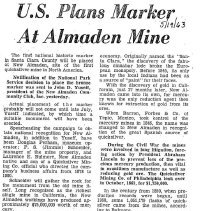
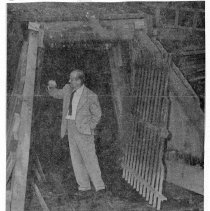
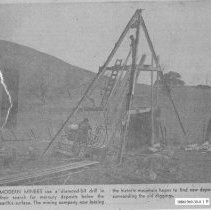
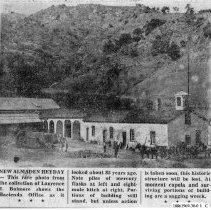
TITLE: U. S. Plans Marker At Almaden Mine PUBLISHER: May 16, 1963 The first national historic marker in Santa Clara County will be placed at New Almaden, site of the first quicksilver mine in North America. Notification of the National Park Service decision to place the bronze marker was sent to John D. Yuseff, president of the New Almaden Community Club, Inc. yesterday. Actual placement of the marker probably will not come until late July, Yuseff indicated, by which time a suitable monument will have been erected. Spearheading the campaign to obtain national recognition for New Almaden, in addition to Yuseff, have been Douglas Perham, museum operator; P. S. (Jimmie) Schneider, manager of the mine property, and Laurence E. Bulmore, New Almaden native and son of a Quicksilver Mining Co. official who directed the company's business affairs from 1878 to 1900. Schneider will gather the rock for the monument from the old mine it-self. Long recognized as the richest single mine in California, the New Almaden workings have produced approximately $75,000,000 worth of mercury. Discovered in 1845 by a Mexican officer, Andres Castillero, the mine has had a profound impact on world economy. Originally named the "Santa Clara," the discovery of the fabulous cinnabar lode broke the Euro pean monopoly. Before 1845, its only use by the local Indians had been as a source of "paint" for their faces. With the discovery of gold in California, just 27 months later, New Almaden came into its own, for mercury was the only reduction agent then known for extraction of gold from its ores. When Barron, Forbes & Co. of Tepic, Mexico, took control of the mercury mines in 1846, the name was changed to New Almaden in recognition of the great Spanish source of quicksilver. During the Civil War the mines were involved in long litigation, forcing action by President Abraham Lincoln to prevent loss of the precious mercury production, then vital in munitions manufacture as well as reducing gold ore. The Quicksilver Mining Co. of Philadelphia took over in October 1863, for $1,750,000. In the century from 1850, when production records were begun, until 1950, some 1,051,179 flasks of quicksilver came from the mines, according to Bulmore. Exact date of the dedication of the marker will be announced later, Yuseff said. Photo A Caption: CLYDE ARBUCKLE, Santa Clara County historian, finds the braces around the Day Tunnel en-trance are still sturdy. Since early in January, miners have worked more than 1300 feet back in the tunnel. Photo B Caption: MODERN MINERS use a diamond-bit drill in their search for mercury deposits below the earth's surface. The mining company now leasing the historic mountain hopes to find new deposits surrounding the old diggings. Photo C Caption: NEW ALMADEN HEYDAY - This rare photo from the collection of Laurence E. Bulmore shows the Hacienda Office as it looked about 85 years ago. Note piles of mercury flasks at left and eight-mule hitch at right. Portions of -building still stand, but unless action is taken soon; this historic structure will be lost. At moment cupola and surviving portions of building are a sagging wreck. |
People |
Arbuckle, Clyde Bulmore, Laurence (E.) (Emile) Lincoln, Abraham Schneider, Jimmie |
Cataloged by |
Boudreault, Art |