
Archive Record
Images
Additional Images [14]
Metadata
Catalog number |
1997.2.2611 |
Object Name |
Newsletter |
Date |
1994 |
Description |
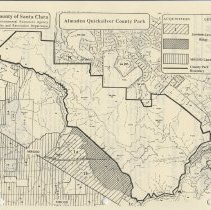
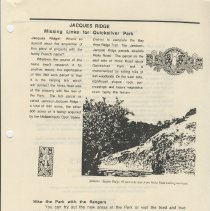
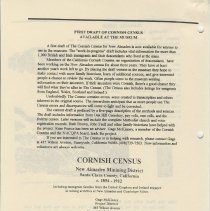
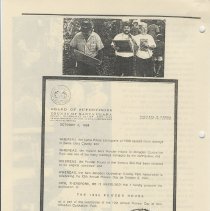
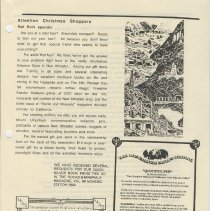
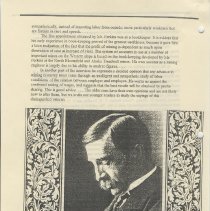
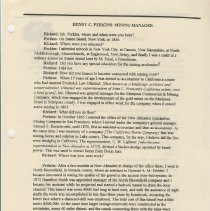
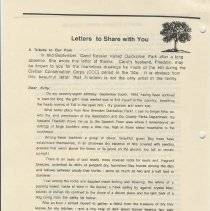
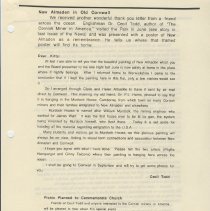
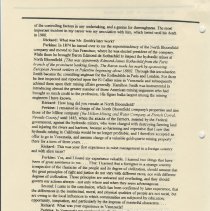
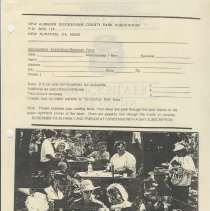
TITLE: Quicksilver County Park News SUBTITLE: Newsletter of the New Almaden Quicksilver County Park Association Issue # 39 Fall/Winter 1994 QUICKSILVER COUNTY PARK NEWS Newsletter of the New AImaden Quicksilver County Park Association FALL/WINTER 1994 ISSUE 39 FROM THE PRESIDENT 1994 - A Roundup --- 1995 - What's Ahead! Jacques provides the link At long last Jacques Ridge has been added to our New Almaden Quicksilver County Park This 360 acre addition will provide a connecting link from Lexington to the Almaden Valley. Midpeninsula Open Space District purchased the other 600 acres of Jacques Ridge to complete the Bay Area Ridge Trail. The trail is not built yet but it will be a reality in the near future. Pioneers for a day Our Pioneer Day this October was fantastic. Thanks to everyone for supporting the day and enjoying our refurbished Powder House. Now, next year, we would like to celebrate our Mexican Heritage and perhaps do a dedication of the newly acquired Jacques Ridge It you have some thoughts on the subject contact Kitty Come see our shiny clean Museum Your Board is hard at work cleaning and renewing pads of the Museum. As this goes to press we are waging for I B.M to send us our new computer. Then we can get started on cataloguing all the treasures in the Museum. If you would like to participate in either activity, please call Kitty Take a turn for the better Thanks for all your support over the years. We now have close to 500 members and we are getting great activity on Saturdays at the Museum. Call Kitty if you would like to take a turn running the Museum a couple of Saturdays a year. No experience required; it's one of the better ways to learn more about the mining process and the history of Quicksilver Park and to share your enthusiasm with others We have also been doing tours for school children and slide lectures at their schools If this interests you, contact Kitty. Monahan, President 268-6541 JACQUES RIDGE Missing Links for Quicksilver Park Jacques Ridge What's so special about the acquisition of this piece of property with the funny French name Whatever the source of the name (we'll research it for another issue), the significance characterized by rolling hills of of this 360 acre parcel is that it is the missing link which will connect the Hicks Road side of the property with the rest of the Park. The full parcel called Jamison-Jacques Ridge , a total of 960 acres, the other 600 acres of it being acquired by the Midpeninsula Open Space District to complete the Bay Area Ridge Trail. The Jamison- with the Jacques Ridge parcels straddle Hicks road. The parcel on the east side of Hicks Road abuts Quicksilveer Park and is characterized by rolling hills of oak woodlands On the west side, significant slopes, rock out- croppings and heavy vegetative cover typify the terrain Hike the Park with the Rangers You can try out the new areas of the Park or visit the tried and true under the friendly and knowledgeable guidance of County Park Ranger Bill Phelan Bill will lead monthly hikes in quicksilver Park right through the Winter months and into Spring A notice about these once-a-month hikes well appear in the Thursday Venture section of the San Jose Mercury FIRST DRAFT OF CORNISH CENSUS AVAILABLE AT THE MUSEUM A first draft of The Cornish Census for New Almaden is now available for anyone to use in the museum. The "work-in- progress" draft includes vital information for more than 1,000 British and Irish immigrants and their descendants who lived at the mine. Members of the California Cornish Cousins, an organization of descendants, have been working on the New Almaden census for about three years. They have at least another year's work left to go. By placing the draft version in the museum they hope to nuke contact with more family historians learn of additional sources, and give interested people a chance to review the work. Often people come to the museum seeking information on their ancestors. If their ancestors were Cornish, there's a good chance they will find what they're after or The Census. (The Census also includes listings for emigrants from England, Wales, Scotland and behind.) Undoubtedly The Census contains errors some created in transcription and others inherent hr the original source The researchers anticipate that as more people use The Census errors and discrepancies will come to light and be corrected. The current draft is prefaced by a five-page description of the methods and sources. The draft includes information from Oak Hill Cemetery, pay rolls, rent rolls and the federal census Later versions will include the complete Methodist church and voter registration records. Ruth Brown, John Fault and other family historians have helped with the project. Russ Pearce bas been an advisor. Gage McKinney, a member of the Cornish Cousins and the NACQPA board, leads the project If you are interested in The Census or in helping with research, please contact Gage at 485 Wilson Avenue, Sunnyvale, California 94086 (408)739-7503. New information and volunteers are always welcome. CORNISH CENSUS New Almaden Mining District Santa Clara County, California c. 1854 - 1912 Including immigrant families from the United Kingdom and Ireland engaged in mining activities at New Almaden and Guadalupe Mines. Gage McKinney Project Director 485 Wilson... Avenue Sunnyvale, California 94086 Tel (408) 739-7503 WORK-IN-PROGRESS DRAFT August 1994 PIONEER DAY XII - A CELEBRATION A celebration in the sun, that's what it was A hot, hot day, with a beautiful view of the valley below us and the marvelously reconstructed Powder House above us It was Pioneer Day XII on October 8 near the Victoria Shaft on Mine Hill. About 150 people sat down to a meal of deep gulch chili served in tin cups, miners' salad, sarsaparilla (root beer), camp coffee, hunks of sourdough bread, apples right off the tree and oven fresh cookies Guests tossed their Quicksilver Park commemorative cups in the brown paper bag "placemats" after the meal as take-home gifts. Before lunch even got under way the miners' mail came! What a surprise to see local mailman Manny Martinez drive up the hill with a really special delivery greeting from County Supervisor Michael Honda. The communique was accepted by Parks and Rec Director, Mark Frederick. He read aloud the Board of Supervisors' resolution recognizing the restoration of the Powder House and explained about the restoration funding through the Federal Emergency Management Agency (FEMA). Mr. Frederick also revealed the exciting news about the imminent acquisition of Jacques Ridge, as well as outlining the mitigation measures being taken to prepare for the relocation of the Quicksilver Museum to the old Reduction Works site. In the best old time tradition, Father Jack LaRocca gave a warm and wonderful blessing for the Powder House and the guests. You can't get a bunch of miners together without a lot of good mining stories. And that we had. John Slenter, surely California's most avid amateur collector of mining memorabilia, put on his head lamp and told us everything we ever wanted to know about explosives, aided by his explosive friend, Craig Stolburg (see sidebar). Nat to be outdone by the dynamic duo, miner Frank Kambish narrated some Powder House history and legends. Geologist Mike Cox told how his search of the Stanford archives had unearthed an 1880 drawing of the old Powder House and related some mine history. (sidebar story) Along with good stories goes good music. Our guitar playing friend John Goldsworthy dug up some tine folk and mining songs for our enjoyment. As a small Museum fund raiser copies of an old photo and map were raffled oft, as were the wonderful dynamite-stick table decorations made by John Atwood and Jeanne Carevic. Miners and their families were hard workers and so were all the folks who made this event go so smoothly. Extraordinary thanks to the Park Rangers who hauled all the tables and benches - including some brand new ones -up to the site. They also hauled load after load of guests up the hill and back again, taking the scenic route and offering nuggets of information on the way The miners' grub, including the outstanding beans, was prepared by Nancy and Dutch Mopes Cookies, table setting and serving, and all the other coordination of the day were provided by the Board and assorted Association members. As always, Kitty Monahan was the hub of the wheel. We were proud to welcome Bob Amyx, who was the first Santa Clare County Director of Parks and Recreation, and more importantly, the Director when negotiations for the Park took place We were also happy to welcome Danielle Kelly, representing Supervisor Honda. By far the most important person there was YOU, and we were really glad you came. Story and sidebars thanks to Dick Wachs SIDEBARS MINERS' TALES FROM PIONEER DAY John Slenter's Explosive Story or Why We Have A Powder House Black powder is what they called it, the explosive used in mining before Alfred Nobel invented dynamite in 1867. All blasting was done with black powder but there were major problems with it. If was totally unsuited for use in wet working conditions, which was, of course, common in underground workings It created an enormous volume of fumes and lacked the shattering power which is typical of dynamite Additionally, it was relatively inefficient in hard ground Dynamite solved all these problems but brought a host of new ones with it As originally designed, dynamite was made by the simple process of soaking a measured amount of sawdust with a measured amount of nitroglycerine. The resulting product, while safer to handle than nitroglycerine by itself, was still highly unreliable II was a "shod tempered" type of explosive that was prone to explode without warning or apparent cause It was subject to freezing and intolerant of much rough handling It was also poisonous to men and animals' A special place had to be provided for storage and new rules had to be formulated for its usage. Thus men had to be trained on how to use it. Dynamite was generally purchased in carload lots and delivered to the mine by the manufacturer. There it was stored in specially prepared magazines (powder houses!) that were sale, waterproof, and insulated against both excessive heat and freezing. Small amounts for daily use were brought and stored in especially prepared underground magazines. These would normally hold five or ten boxes of dynamite. They were kept locked and the keys kept in possession of the shift and slope bosses who were responsible for keeping daily records of the amount used and the location of use Mike Cox's Tales from the Mines or Who Was James Randol? The Powder House was known as the Victoria Powder House because of its proximity to that shaft. But actually it was built to service the Randol Shaft And who indeed was Mr. Randol for whom the shaft was named? Not a miner but a New Yorker with a brief education in business. The Quicksilver Mining Company of New York hired him as secretary. Then in June, 1869, Samuel Butterworth offered Mr Randol the position of general manager of New Almaden. He accepted and started work in 1870 at $7,500 a year Since he had no experience in mining, he allowed the operations to continue as they had But he processed all the paperwork and soon realized that the mines were in poor condition He then consulted with Samuel Christy of the University of California. Christy recommended sinking a new exploratory shaft, the work began in June 1877 Hamilton Smith and Henry Janin planned the shaft and James Pearce was mine superintendent at the time Survey notes from 1872 indicate that the total depth of the shaft was 205 feet. It was 4x9 feet with a 4x4 foot area far pumping. It reached the level of the Day Tunnel, 500 feet, in 1879 by hand drilling, using timbers 1o protect the opening. At 800 leaf they struck good ore. Shaft sinking accelerated and by 1881 the shaft was 400 feet lower. By 1882 they knew they were in a rich ore body. Between 1880 and 1896, 200,000 flasks of mercury were extracted through the Randol Shall If the shaft had been sunk 25 feet to the southeast they would have missed the ore body The Randol Shaft went down dip (a dip is the angle from horizontal of the ore body) 700 ;feet to a depth of 7.800 feet This east-west stope (stope is an underground excavation) was 200 feet wide and 15 feet high For the mines going to work meant dropping perhaps 700 feet free fall in a double-decked cage because soil creep had caused a pinch point in the shaft. It badly needed fixing but the mine was yielding too much rich ore to consider shutting it down for renovation. The furnaces could process 400 tons a day but the maximum delivery to the furnaces was only 300 tons a day The continual need to get out more ore meant that no time could be taken out to enlarge the shaft In 1891 the Victoria Shaft was sunk to relieve the Randol Shaft The Victoria Shaft was 4 x 7 feet and ultimately 600 feet deep it was used until 1895 The Randol Shaft, at 1,340 feet, was making a maximum of 184 trips a day. With skips containing three tons of ore which was 20-30% mercury They were averaging four trips an hour Randol resigned in 1892 to become superintendent of the Mirabel Mine in Lake County He died in 1901 at the age of 68, leaving a widow Isabel. and five children He also left behind 20 years of prosperity while he was general manager at New Almaden An Aside About the Powder House The Powder House is of double wall construction with the arch, or roof, less sturdy than the walls It. was designed this way so that an explosion would blow upward, not outward in order to minimize surface damage The double walls also were intended for Insulation to maintain even temperatures for the dynamite And what did they use for insulation? Word has it that it was manure!' BOARD OF SUPERVISORS COUNTY OF SANTA CLARA Michael M Honda Supervisor First District OCTOBER 8, 1994 WHEREAS, the Loma Prieta Earthquake of 1989 caused much damage in Santa Clara County, and WHEREAS, the, historic black Powder House in Almaden Qucksilver Park was one of the many buildings damaged by the earthquake; and WHEREAS, the Powder House at the Victoria Site has been restored to its original condition: and WHEREAS, the New Almaden. Quicksilver County Park Association is celebrating the 12th Annual Pioneer Day on October 8, 1994:, NOW, THEREFORE, BE IT RESOLVED that I hereby proclaim the dedication of THE 1866 POWDER HOUSE as a part of the celebration of the 12th Annual Pioneer Day of The Almaden Quicksilver Park. Michael Honda Supervisor, First District. Attention Christmas Shoppers . '' Red Rock specials Are you at a total loss? Absolutely stumped? Ready to tear out your hair? All because you don't know ` what to get that special friend who seems to have everything? Put aside that fear' We think we've got the answer to your problem right here at the newly refurbished Museum Store in New Almaden. Among our gift items _ are T-shirts in all sizes and several interesting: designs, two excellent hardback books on life and mining in the Hacienda and on The Hill; Pioneer Day enamelware miner's coffee mugs: Friedolin Kessler linoleum prints of CCC days on the Hill; notecards and posters of the New Almaden area, and the latest issue of "Rocks and Minerals" magazine devoted entirely to California For stocking stuffers we offer you old square nails: Mount Umunhum commemorative collector pins, ' postcards of various New Almaden scenes, nuggets of cinnabar, several fascinating booklets and more. For the easiest gift just send in the membership form on the back of this newsletter; $10 buys a year round gift for a whole family, their ticket to picnics, moonlight hikes and all the activities members enjoy. WE HAVE RECEIVED SEVERAL REQUESTS FOR OUR QUICKSILVER BOOK FROM THIS AD IN THE ROCKS8 MINERALS MAGAZINE, VOL.69 NOV/DEC 1994. This certificate is worth $4 off a new subscription or $2 off a subscription renewal to The Californians Magazine. The magazine of California history when presented with payment for the balance of the regular $18.95 price. NEW ALMADEN BEGINNINGS: HENRY C. PERKINS By T A Rickard edited by Gage McKinney (Editor's note: Continuing his series of interviews with prominent mining engineers, editor and publisher T. A. Rickard printed his conversation with Henry C. Perkins Perkins worked for the QuicksilverMining Company under general manager Samuel F. Butterworth from 1865 to 1870. He is rare among the men Rickard interviewed in that he had no formal education in engineering. Perkins began as a bookkeeper, though he had the aptitude for much more. He became a practical engineer and a successful mine manager to South America and South Africa, and an authority on mining in Korea. Rickard's interview emphasizes Perkin's enlightened thinking on labor management. In introducing Perkins, Rickard alludes to other prominent men who got their starts at the New Almaden mine--Hennen Jennings, James B. Randol, Samuel B. Christy, Charles Butters, F. W. Bradley and E. H. Benjamin. (For Rickard's interview with Jennings, see the Summer 1994 issue of this newsletter.) James Butterworth Randol (1836-1903), the most prominent figure in the history of NewAlmaden, began as secretary of the mining company, at its New York office. He came West to serve as general manager from 1870 to 1892, peak years of mining activity. Samuel Benedict Christi, (1853-1914) became a professor and dean of the College of Mining at the University of California, Berkeley. He translated a paper on the .Almaden Mine in Spain and made extensive comparisons of the old mine and its namesake in the New World In 1885 his paper, "Quicksilver Condensation at New Almaden, "was read before the American Institute of Mining Engineers in Philadelphia. Charles Butters (born in 1854) graduated from the University of California in 1879. He began his career as a chemist at New Almaden, but wasn't there long. He worked as a metallurgist in Colorado, California, and South Africa. He made a gold mining fortune in El Salvador. One of the leading metallurgists in the world a "metallurgical hero, "Rickard called him-he devoted his later years to private consulting and experimenting in a home laboratory in Berkeley. Frederick Worthen. Bradley (born in Nevada County, California to 1863) studied mining at the University of California. He became president of Alaska Juneau Gold Mining Company and had extensive commercial interests in Juneau. In the 1920s his and his wife's names regularly appeared in the society pages of the San Francisco newspapers. Edward Hewlett Benjamin (born in Vallejo, California in 1859) graduated from the University of California. He worked at New Almaden to 1879-80, and at various times between 1880 and '87. He moved between mining and civil engineering, accepting an assignment as engineer of the Oakland Street Department He organized the firm of Benjamin, Hunt & Meredith, consulting engineers, and became president of the California Mining Association anal president of the Mariposa Commercial & Mining Company. Like Bradley, he lived in San Francisco. He joined Bradley (and Rickard) as a member of San Francisco's Bohemian Club. One of the things that all of these professionals had in common was a friendship with Hamilton.Smith, the apparent dean of mine engineers in California. Perkier gives an account of Smith and this installment concludes with the little additional information we have aboutt this widely respected man. The following interview appeared in Rickard's magazine, Mining and Scientific Press, in Mary 1917, and was later reprinted with others in his book Mining and Scientific Press, San Francisco, 1922. It begins with Rickard's editorial). In this issue we publish an interview with a veteran of the profession, Henry C. Perkins, one of the engineers to achieve distinction in the period when Hamilton Smith and his friends were leaders in the business of gold mining The mines in which he obtained his first experience, the Mariposa and the Almaden, are still active and the mention of them recalls the fact that many members of the profession served their apprenticeship at these famous properties. Mines are places where men as well as lodes are developed. New Almaden more particularly, enabled Henry C. Perkins, Hennen Jenings, James B. Randol, Samuel B. Christy, Charles Butters, F. W. Bradley, and E. H. Benjamin to cut their wisdom teeth comparatively early in life. The quicksilver mines made money for their owners, but even if they had not done so they would have declared human dividends of a kind that money does not measure. The engineering work done at the North Bloomfield represented a notable achievement of the early days; it included several miles of bedrock-adit, big dams, and long pipe-lines; it was all dime at a moderate cost and so well that it compares favorably with similar work in more recent years. It is a pleasure to read the tribute paid by Mr. Perkins to Hamilton Smith The latter was not only an engineer of fine acumen and high character but by his association with the Rothschilds he helped to introduce many young Americans to a wider career than California by itself could have offered. H must be remembered that 40 years ago the mining industry of the United States was of small dimensions compared with what it is now, and an ambitious engineer was lucky to obtain an opportunity abroad Ile El Callao mine, in Venezuela, famished experience to a large number besides Mr. Perking and Hamilton Smith: for example, there were Hennen Jennings, Thomas Men, George Webber, and W. L. Austin. None of them learned more from his sojourn there than did Mr. Perkins. He tells of two of the thing he learned: that straight dealing is the beat policy even with crooked people, and that human beings as workers arc much the same the world over if they are given a chance. He does not care much about the 'bluff he 'called' while he was manager of the El Callao, but we have heard how mining inspectors, governors, even Guzman Blanco himself (the Venezuela dictator, 1870-89), found it useless to blackmail or bulldoze the quiet young American who attended strictly to his business and assumed that others would do likewise. Nothing is so disconcerting to South American indirection as North American directness. Concerning the labor question he has more to say, and it is highly interesting. His experience in California, Venezuela, Mexico, South Africa, and Korea, among the districts in which he supervised mining operations, appears to have furnished him with decided ideas on the subject, We accept them as coming from a man wise rather than smart, sagacious more than merely clever. To the younger men we command the advice to employ the indigenous population of a mining district, teaching them and treating them sympathetically, instead of importing labor from outside, more particularly workmen that are foreign in race and speech .... The first appointment obtained by Mr. Perkins was as a bookkeeper. It is evident that his early experience in bookkeeping proved of the greatest usefulness, because it gave him a keen realization of the fact that the profit of mining is dependent as much upon diminution of cost as increase of yield. The system of accounts in use at a number of important mines on the western slope is based on the book-keeping developed by Mr. Perkins at the North Bloomfeld and Alaska Treadwell mines. His own success as a mining engineer is largely due to his ability to analyze figures .... In another pan of the interview he expresses a decided opinion that any advance in mining economy must come through art intelligent and sympathetic study of labor conditions, of the relation between employer and employee. He warm us against the continued raising of wages, and suggests that the best results will he obtained by profit-sharing. This is good advice . . . . The older men have their own opinions and are not likely now to alter them, but we invite out younger readers to study the sayings of this distinguished veteran. HENRY C. PERKINS: MINING MANAGER Rickard: Mr. Perkins, where and when were you born? Perkins: On Staten Island, New York, in 1846. Pickard; Where were you educated? Perkins: I attended schools in New York City, at Canaan, New Hampshire, at North Middleborough, Massachusetts, at Eaglewood, New Jersey, and finally I was a cadet at a military school on Staten Island kept by M. PujoL a Frenchman. Pickard: Did you have any special education for the mining profession? Perkins: I did not. Pickard : How did you chance to become connected with mining work? Perkins: When 17 years of age I was invited to accompany to California a cousin who had married Frederick Law Ohnsted. [Best known as a landscape architect and conservationist. Olmsted was superintendent of John C. Fremont's California estate, once a land grant]. Mr. Olmsted was general manager for the Mariposa Commercial & Mating Company, which was engaged in the development of the gold mines on the Mariposa Oraant in Mariposa county. I was engaged in office work for the company when it ceased active mining in 1865. Rickard: What did you do then? Perkins: In October 1865 1 entered the office of the New Almaden Quicksilver Mining Company in San Francisco, where I served under the company's general manager, Samuel F. Butterworh, until 1870, first as assistant-account and then as accountant. At the same time I was secretary of a company [The California Borax Company] that was mining borax and sulphur in Lake county. This company, by the way, I believe did the first mine dredging in California The superintendent, C. W Lightner [who became superintendent at New Almaden in 1870, devised a bucket-dredge operated by hand-power. This was used to extract borax from Borax lake. Rickard: Where was your next work? Perkins: After a few months at New Almaden in charge of the office there, I went to North Bloomfield, in Nevada county, where as assistant to General A. M. Dobbie 1 became interested in testing the quality of the gravel in the ancient river-bed system. In 1871 Hamilton Smith was appointed manager of the North Bloomfield company and I became his assistant while he projected and started a bedrock tunnel to drain the deep channel. This tunnel was some 8000 feet long in hard rock, and with the assistance of eight shafts the work was accomplished in less than three years by handwork, excepting the lower face where a diamond-drill was employed. The total cost of this tunnel was a tittle under $500,000. At the same time larger storage-reservoirs were constructed in the mountains, some 40 miles distant, and the canals connecting them with the mine were enlarged and improved. (The North Bloomfield Company included the Malakoff mine, known today as the Malakoff Diggins State Historic Park). Pickard: Was Hamilton Smith a trained engineer? Perkdns: Yes, he had trained himself by practical work in his father's coal mines in Indiana. Rickard: He was a man of great natural capacity for engineering work? Perkins: Yes. of the controlling factors in any undertaking, and a genius for thoroughness. The most 'important incident in my career was my association with him, which lasted until his death of 1900. Rickard: What was Mr. Smith's later work? Perkins In 1874 he dined over to me the superintendency of the North Bloomfield company and moved to San Francisco, where he was elected president of the company. While there he brought Baron Edmond de Rothschild to inspect the hydraulic mines at North Bloomfield. [This was apparently Edmond James Rothschild from the Paris branch of the prominent banking family. The Baron made has mark by sponsoring European Jewish settlers in Palestine beginning about 1888]. Through this introduction Smith became the consulting engineer for the Rothschilds in Paris and London- For them he first inspected and reported upon the El Callao mine in Venezuela and subsequently advised them upon them mining affairs generally. Hamilton Smith was instrumental in introducing abroad the greater number of those American minting engineers who had brought so much credit to the profession His figure bulks largest among the mining engineers I have known. Rickard: How long did you remain at North Bloomficld? Perkins: I remained in charge of the North Bloomfield company's properties and also those of the Milton company (the Hilton Mining and Water Company, at French Corral, Nevada County) until 1883, when the attacks of the farmers, assisted by the Federal government, against the hydraulic miners, who were charged with destroying farming land and injuring the rivers and harbors, became so harassing and expensive that I saw that hydraulic mining in California would he no longer profitable, and I therefore accepted an offer to go to Venezuela, and assume charge of a valuable gold-quartz mining property there for a term of three years .... Rickard: This was your first experience in mine management in a foreign country and with alicn races? Perkins: Yes, and I found my experience valuable. I learned two things than have been of great assistance to me .... First: I learned that a foreigner in a strange country irrespective of the character of the people and its degree of civilization, should assume that the great principles of right and justice do not vary with different races, nor with different degrees of civilization. Those principles are universal and everlasting, and they should govern our actions always-not only where and when they seem advantageous .... Second: I came to the conclusion, which has been confirmed by been experience, that the differences in the intellectual, moral, and physical qualities of people are not racial, but are owing to the local influences to which communities are subjected by education, opportunity, temptation, and particularly by the impress of masterful characters .... Rickard: What was your experience in Venezuela? Perkins: In Venezuela we employed chiefly Negroes from the West India islands, them being practically no local supply of labor. These Negroes, whose only previous training had been in agricultural work, for which they were paid about 25 cents per day, came to the mines and were paid $3 per day. They soon became expert in nearly all kids of mining labor, and, after some improvement in organization, with these roar we produced and reduced the ore from the gold veins nearly as cheaply per ton as they did at the time at the Mysore mites, in India, where the laborers received only some 20 cents per day. The mining difficulties so far as width of lode and hardness of ore were concerned were practically the same .... Rickard: Then you consider that the rate of wages is not an important factor in the cost of mining? Perkins: In certain cases it is an important factor, but I have come to the conclusion that usually its importance is much exaggerated. In estimating the value of a mining property I do not consider the rate of wages prevailing, however high or low it may be, as a vital consideration .... Pickard: Where did you go after leaving Venezuela? Perkins: I went to London and joined the firm of Smith & De Crano . . . . Rickard: How long did you remain in London? Perkins: For five years; until 1893 it continued to be my headquarters; during this period, however, I traveled extensively on mining examinations (especially in Mexico, Montana and Alaska,' and undertook the development of a gold mine in Wales, which proved to be unprofitable. Rickard: Where else did you go? Perkins: In 1891 Lard Randolph Churchill decided to make a trip into Mashonaland [now, northeastern Zimbabwe], which m August of the previous year had been occupied by the British South Africa Company. Having been introduced to Lord Randolph by Lord Rothschild~ I was invited to accompany the former as consulting engineer. Mashonaland was reported to contain valuable rue deposits. [As a consequence of this journey, Perkins toured the mining region in the vicinity of Johannesburg known as the Rand He eventually accepted an assignment to manage a gold mine there] .... Rickard: You finished your term of three years on the Rand, and then? Perkins: I returned to Europe in 1896 and formed a partnership with Hamilton Smith. This association continued until his death in 1911. I remained in Europe until 1898; in that year I returned to New York, where Mr. Smith and I established an office in which we cared far our various mining and other interests. In the following year I inspected mines in Korea, Siberia, Canada and the United States, and in all of these regions I became interested in mining properties. (Perkins then recounted the success of the Oriental Consolidated Mining Company in Korea. As the interview concluded, Rickard returned to general questions. Rickard: What do you consider the best method that can be employed for increasing the efficiency of labor? Perkins: A sympathetic study by the employer of the point of view of the employee, and a system of profit-sharing that will tend to give the employee the point of view of the employer. The raising of wages cannot go on indefinitely without resulting in the closing down of the poorer mines .... Pickard: What is your opinion of mining as a business investment Perkins: . . . The risk of mining, of course, is obvious to any man with mining experience; it is obvious to us mining engineers just as the risk of farming and real-estate speculation is obvious to farmers and real-estate agents. That man is wise who deals in the things the risk of which he understands .... Rickard: To what in your mining experience do you look back upon with the most satisfaction? Perkins: To the development of personalities and to the advancement of my subordinates from inferior positions to those of greater responsibility. I have been able to start a considerable number of young men on careers of great usefulness, and I have not felt that they were in debt to me for there successes, for the benefits arising from the association have been mutual .... Mr. Perkins furnishes the fullest account we have of his mentor Hamilton Smith. During his career in California Smith wrote influential reports on the North Bloomfeld Gravel Miring Company, mentioned above, and the Bald Mountain and Ruby Drift Gravel Mine, in Sierra County. His theoretical studies of hydraulics were essential to large-scale placer operations. Investors and mine managers relied on his counsel. As evidenced-from the surviving correspondence, New Almaden general manager J. B. Randol sought Smith's advice over many years, and especially when it came to employing professional engineers. Smith was in robust health during his last visit to San Francisco, in May 1900. He died three weeks later while returning to London. LELAND PLUS NEWSLETTER This year's Plus staff has made a special effort to arrange for learning outside of the classroom. : Thanks to the wonderful and gracious tour guiding of Kitty Monahan of the New Almaden Museum, Plus students learned about mercury mining and life in the community's early days. we saw pictures of Paul Tobar's and Carolyn Dale's ancestors, making a personal Plus connection with local history. And. . did you know that Castillero Middle School was named after Andre Castillero ("No way Andre"?), the man who discovered our quicksilver (mercury) .... or that a hammer won't sink in a tub of mercury? Letters to Share with You A Tribute to Our Park _ In mid-September, Carol Kessler visited Quicksilver Park after along absence. She wrote this letter of thanks. Carol's husband, Friedolin, may be known to you for the marvelous drawings he made of the Hill during the Civilian Conservation Corps (CCC) period in the '30s. It is obvious from this beautiful letter that Friedolin is not the only artist in the family Dear Kitty: On my seventy-eighth birthday, September fourth, 1994, having been confined to town too long, the gift I most wanted was to find myself in the country, breathing the heady scents of Fall in the open hills - dry grasses and warm sun What better place than New Almaden Quicksilver Park! I can no longer hike, so, with the kind permission of the Association and the County Parks Department, my husband Friedolin drove me up to the Spanish Town area where I remembered an outcrop of large boulders atop a little rise, high in those steep mountains to the southwest Among these boulders a group of clever, beautiful, green Bay trees have established themselves, in an otherwise dry expanse of hills covered with seeding grasses that swish above the knees or lie prone on the ground, too tall to remain upright There is an oasis of cool shade, moss covered rocks for seats and fragrant breezes, underfoot lie drifts of pungent dry, burnished Bay leaves among the dips and hollows between sturdy tree trunks - some as much as two and a half feet in diameter. I sat among the rocks and dappled shade looking and listening; the whine of a passing insect, rustle of wind in the leaves: a hawk sailing by against crystal blue; sounds of civilian life confined to the drone of a distant plane and the faint bark of a dog rising from the valley far below. After an hour I stirred myself to gather a fistful from the treasure of dry Bay leaves for my kitchen - and a tiny twig of dark green leaves bearing two pale green, round fruits about the size of black walnuts, for their beauty For these gifts, I thank all of you dedicated people who have worked so hard to preserve this heritage landscape. Carol Kessler New Almaden in Old Cornwall We received another wonderful thank you letter from a friend across the ocean Englishman Dr. Cecil Todd, author of "The Cornish Miner in America," visited the Park in June (see story in last issue of He was a masterful character, he had a powerful intellect, a great grasp the News) and was presented with a poster of New Almaden as a remembrance He tells us where that framed poster will find its home Dear Kitty: A1 last I am able to tell you that the beautiful painting of New Almaden which you and the Board presented to me one night last June is now safely at home in the place where it rightly belongs After I returned home to Warwickshire I came to the conclusion that if I kept the painting here in this flat, only a few visitors would see it. So I arranged through Clyde and Helen Arbuckle to have it sent by air mail direct to Cornwall. This morning my old friend, Dr F.L. Harris, phoned to say that it is hanging in the Murdock House, Camborne, from which town so many Cornish miners and their families emigrated to New Almaden and elsewhere Murdock House is named after William Murdock, the mining engineer who worked for James Watt. It was the first house ever to be lit by gas, the system being invented by Murdock himself, who lived there. Today it is set aside for housing all the material regarding emigration to the U.S.A Many students and visitors go to Murdock House, so this glorious painting will always be on view, linking in visual form connections and association between New Almaden and Cornwall. I hope you agree with what I have done. Please tell the two artists (Phyllis Hensperger and Ginny Falcone) where their painting is hanging here across the ocean. I shall be going to Cornwall in September and will try to get some photos for you Cecil Todd Picnic Planned to Commemorate Church Friends of Cecil Todd and anyone interested in the Cornish miners in America will be pleased to hear about this special event On April 29, 1995, the NAQCPA will sponsor a picnic on Mine Hill to commemorate the 120th anniversary of the Methodist Church at New Almaden In April, 1875, the Rev C.V Anthony preached a dedicatory sermon in the church that perched above the mining settlement, offering a vista of Santa Clara Valley and the bay The picnic will be held near the spot The event is being planned in cooperation with the Methodist Historical Society, several churches, and the California Cornish Cousins Mark the date when you get your 1995 calendar |
People |
Amyx, Bob Anthony, Charles Volney (Rev.) Atwood, John Carevic, Jeannie Christy, Samuel B. (S.B.) Cox, Michael Frederick, Mark Goldsworthy, John Janin, Henry Kessler, Carol LaRocca, Jack Mapes, Dutch (Warren J.) Mapes, Nancy McKinney, Gage Monahan, Kitty Pearce, James Phelan, Bill Randol, James Butterworth Randol, Mrs. James Butterworth (Isabel) Slenter, John Smith, Hamilton Stolburg, Craig Todd, Arthur Cecil Wachs, Richard |
Cataloged by |
Meyer, Bob |