
Archive Record
Images

Additional Images [9]
Metadata
Catalog number |
1997.2.2617 |
Object Name |
Newsletter |
Date |
1996 |
Description |
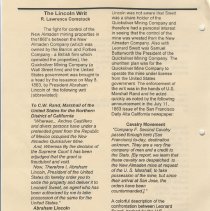
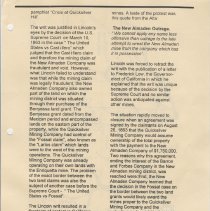
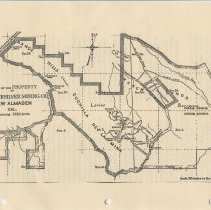
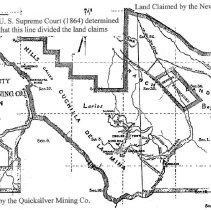
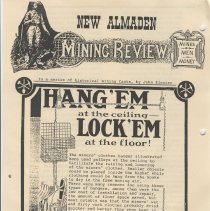
TITLE: Quicksilver County Park News SUBTITLE: Newsletter of the New Almaden Quicksilver County Park Association Issue # 45 Summer 1996 Newsletter of the New Almaden Quicksilver County Park Association SUMMER 1996 ISSUE 45 PRESIDENT'S MESSAGE Work began on the Hacienda site in June of '96. The main problem came when the red-legged frog was put on the threatened list by the Federal Government on June 24, 1996. All work around construction sites near creeks was curtailed until the Federal Fish and Wildlife could examine the area and feel comfortable that the frog was protected. Work continued on the site but not near the creek. Dirt was brought in to stock-pile until the go ahead was issued by the Fish and Wildlife. Tailings from the site are being transported to the San Francisco Open Cut and the Mine Hill Trail is closed to recreation users during the week as the trucks are making 20 trips a day up and down . As we go to press, the red-legged frog has been protected and work around the creek proceeds. The firm doing the work has a deadline of November 15, 1996 to prepare the land for construction of the Museum and the development of a fine entrance to the New Almaden Quicksilver County Park. Philippe and Virginia Hammerness donated their flat-bed truck to the Association for tours In the Park. Your Association Board Members have made an agreement with the Santa Clara County Parks Dept. for the safe keeping of the truck. The maintenance crew from the Calero-Quicksilver Unit has built a terrific cover for the truck at the Hacienda entrance to the Park. The Unit will maintain the truck, use the truck for needs in the Park and tours will continue, led by Association members or Rangers. The Museum continues to be a nice attraction and the fine docents maintain a great atmosphere. If you are interested in helping out, please call Kitty at 268-6541. We are working steadily on the inventory so that we will know exactly what we have before the move to the new Museum. We will certainly be calling for help when the move begins. Till then keep up the good work paying dues, and bringing others into the Association membership. Kitty Monahan THE ORIGIN OF THE WORD CINNABAR In the summer of 1984, Connie Perham, long-time resident of New Almaden and at that time owner of the New Almaden Museum, received a letter from Kurt Servos, Professor of Geology at Menlo School and College. The portion of the letter regarding the naming of the mineral cinnabar is quoted below: 01 consulted several references about the origin of the name cinnabar. Dana's system was little help -- it gives the origin as being due to Theophrastus and dating from about 315 B. C. I struck paydirt, however, in a small book I have owned for 27 years. It is von Kobell's "Die Mineral-Namen and die mineralogische Nomenklatur" ("Mineral names and mineralogical nomenclature"(, published in Mu-nich, 1853. For cinnabar ("Zinnober" in German), von Kobell gives the Greek root and says that in the sense of dragon-blood, it comes from the Arabic konou spar, which means very red dust. That is the origin I remembered and mentioned during our conversation. I could find no confirmation of it, however, but certain concepts in minera-logy become perpetuated by authoritative references. I consulted several editions of Dana's System. "So far as you are concerned, I think that you are ,just as "safe',' giving the origin as being Arabic as by retelling the story about the blood of two animals. Probably safer." To your right as you enter the New Almaden Mercury Mining Museum, the following information is given on a placard: CINNABAR (CINNABARIS) The Creeks gave the name, Cinnabaris to the color created by the mixed bloods of Bull and Elephant. Since the ore of mercury is of the same color "Cinnabar was given to the ore. INVITATION This year, due to the work in the Park, Pioneer Day will be held at the Casa Grande. We will tour the building, hear our pioneers tell of their experiences enjoy a mining skit by the Ole Opri Players, dine on the Casa Grande Grand Lunch, and follow the history of the Civil War as it related to New Almaden and the Quicksilver Mines: You and all of your friends and family are invited to attend this our 13 th annual Pioneer Day. Saturday, October 12,1996 11:00 a.m. to 3:00 p.m. Casa Grande Lunch $5.00 For further information call Kitty 268-6541 THE UNWELCOME IMMIGRANT Early in the 18o0's, a silent visitor appeared in neighboring Alameda County. Interesting, not unattractive, and bred for success, the newcomer stretched out among the dry summer grasses of its adopted home. The light green of its foliage and the sunshine gold of its blossoms offered a pleasant visual contrast to the drab brown of its grassy surroundings. Eight million California acres later, Yellow Starthistle has more than worn out its welcome. Poisonous to horses and irritating to the mouths of most grazing livestock, the mature plants become dense and spiny and crowd out more desireable native plants. Originally from Greece, this far-flung traveler left its natural enemies behind. Highly prolific, seeds are produced in extravagent profusion and are readily dispersed in open sunny areas. Disturbed areas, like road cuts are particularly vulnerable to initial infestations. These drought-tolerant members of the sunflower family exhibit delayed germination ---the seeds don't all sprout at the same time of year. This insures that short favorable conditions, followed quickly by poor conditions don't jeopardize the whole year's output. Starthistle pushes this strategy to the limit. Some seeds may still be viable in the soil as long as 20 years. Despite these successful attributes and the 130+ years headstart, we've decided to fight back. From the thistle's native lands we have enlisted aid. The Bud Weevil, Hairy Weevil, Flower Weevil, Peacock Fly and Seedhead Gall Fly have all signed on as mercenaries. A native California fungus has also joined forces with us. The fungus kills many seedlings under the right conditions and of the insects only the Flower Weevil has had difficulty becoming established. The Hairy Weevil looks like a real star in this drama and the Seed Head Gall Fly is also very effective. Its going to be a long, hard battle but at least some minor initial skirmishes have gone our way. Our efforts in biocontrol were a long time in coming but someday in the future we may once again be able to look at this well-travelled immigrant as an interesting, not unattractive but thinly-scattered wildflower. ---Bob Clement GALTROPS or STAR-THISTLE Jimmie Schneider, author of "Quicksilver," was a week-end miner who never got home in time for dinner because - spending all his spare time underground - he could never tell when it was dark up top. He and a friend, whose initials were B.P., joked with each other on a regular basis about what they would write on their headstones. The following is a little note B.P. dropped off at Jimmie's house in New Almaden one early morning. "Dear Jimmie: I think the enclosed is most fitting for the stone. Have it cast in bronze and I will see the stone upon you in the little place in Bertram Road. BP "Beneath this stone Both skin and bone Is all that was J. Schneider. And, oh, my friends When you have gone Far down, far down, Beyond the black cast yonder, And you should chance Upon him, There'll be No need repining He'll be running A Satanic Company Engaged in Week-end Mining." Hint: B.P. was a Judge who lived up the Mt. Umunhum Road. The Lincoln Writ R. Lawrence Comstock The fight for control of the New Almaden mining properties in the1860's between the New Almaden Company (which was owned by the Barron and Forbes Company - a British firm which operated the properties), the Quicksilver Mining Company (a Wall Street firm) and the United States government was brought to a head by the issuance on May 8, 1863, by President Abraham Lincoln of the following writ (abbreviated): To C.W. Rand, Marshall of the United States for the Northern District of California "Whereas,.. Andres Castillero and divers persons have under a pretended grant from the Republic of Mexico occupied the New Almaden Quicksilver Mine. And, Whereas By the decision of the Supreme Court it has been adjudged that the grant is fraudulent and void. Now, Therefore I, Abraham Lincoln, President of the United States do hereby order you to seize the property and deliver it to Leonard Sweet, an agent who has been authorized by me to take possession of the same for the United States." Abraham Lincoln The writ was brought to California by Leonard Swett on the directions of the Secretary of the Interior. Swett was a close personal friend of Lincoln's. Lincoln was not aware that Swett was a share holder of the Quicksilver Mining Company and therefore had a personal interest in seeing that the control of the mine was wrested from the New Almaden Company. Also with Leonard Swett was Samuel Butterworth the President of the Quicksilver Mining Company. The unwritten plan was for the Quicksilver Mine Company to operate the mine under license from the United States government. The enforcement of the writ was in the hands of U.S. Marshall Rand and he acted quickly as noted by the following announcement in the July 11, 1863 issue of the San Francisco Daily Alta California newspaper: Cavalry Movement "Company F. Second Cavalry passed through here (San Francisco) to-day, destination unknown. They are a very fine company of men and a credit to the State. [By report, we learn that these cavalry are despatched to the New Almaden mine at request of the U. S. Marshall, to take possession of the mine, but since their arrival at San Jose, the orders have been countermanded.]." A colorful description of the confrontation between Leonard Sweet, backed by the U.S. cavalry, and John Young, the superintendent of the mine, backed by 170 armed and angry miners, is given in Norman Pope's pamphlet "Crisis at Quicksilver Hill". The writ was justified in Lincoln's eyes by the decision of the U.S. Supreme Court on March 10, 1863 in the case The United States vs Castillero" which judged that the Castillero claim and therefore the mining claim of the New Almaden Company was fraudulent and void. However, what Lincoln failed to understand was that while the mining claim was legally fraudulent, the New Almaden Company also owned part of the land on which the mining district was situated through their purchase of the Berryessa land grant. The Berryessa grant dated from the Mexican period and encompassed lands on the eastern part of the property, while the Quicksilver Mining Company had control of the "Fossat claim", also known as the "Larios claim" which lands were to the west of the mining operations. The Quicksilver Mining Company was already operating on their own lands with the Enriquetta mine. The problem of the exact border between the two land claims was also the subject of another case before the Supreme Court - " The United States vs Fossat'. The Lincoln writ resulted in a firestorm of protest in California and Nevada because the mining interests were concerned that the United States government might attempt to seize more of the mines. A taste of the protest was this quote from the Alta: The New Almaden Outrage. "We cannot apply any name less offensive than outrage to the late attempt to wrest the New Almaden mine from the company which has it in possession". Lincoln was forced to retract the writ with the publication of a letter to Frederick Low, the Governor elect of California in which he explained that the writ was unique because of the decision by the Supreme Court and no similar action was anticipated against other mines. The situation rapidly moved to closure when an agreement was signed by the claimants on August 26, 1863 that the Quicksilver Mining Company would assume ownership of the total property with the payment to the New Almaden Company of $1,750,000. Two reasons why this agreement, ending the interest of the Barron and Forbes Company in the New Almaden mining district, was reached were: First, the New Almaden Company learned that the decision in the Fossat case on the border between the two land grants would likely award the mines proper to the Quicksilver Mining Company and the reduction works and Hacienda to the New Almaden Company. The decision of the Supreme Court in April 1864 did exactly that but the decision was moot because of the purchase. The border is shown in the attached figure (information from Jimmie Schneider). Second, I share the opinion broached by Kenneth Johnson in his book, The New Almaden Quicksilver Mine, that Barron and Forbes realized the United States would no longer tolerate the ownership of this key property by a British firm. The relations of the United States government with Britain were strained at this time because of acts by the British government in support of the Confederate government during the Civil War. For example, the British government did not stop construction of commerce raiders used by the confederates against American commercial vessels. In addition, in 1835 Alexander Forbes had written a book on California, California: A History of Upper and Lower California, in which he wrote a chapter on " Upper California Considered as a Field for European Colonization". In this chapter he proposed that Mexico transfer sovereignty of Upper California to Great Britain in exchange for relief on a debt of $55,000,000 owed by Mexico to British bondholders. This proposal caused a furor in the United States at the time and some residue of this resentment toward: one of the owners of the New Almaden mines played a role in the attitude of the United States government in its persistent attempts to see the property transferred to the competing American firm. It was also of note that Edwin Stanton, the Secretary of War, was before the war an attorney for both the United States government and the Fossat claim. On the other hand, Stanton's subordinate, General Henry Halleck, was a partner in the firm representing the New Almaden Company and was himself the General Manager of the operation for ten years. None of his supporters at the time viewed the role of Abraham Lincoln in the issuance of the writ as anything but a mistake caused by the pressure of the Civil War. The Union Army had lost the battle of Chancelorsville on May 4,1863 under General Hooker and was following the Army of Northern Virginia in its invasion of the North. The victory at Gettysburg occured in July prior to the August note to Mr. Low canceling the original writ. It is uncertain if the issuance of the writ without its cancellation would have played in any significant way into the hands of those who were advocating peace and the possible secession of California from the Union - the "copperheads", however, it is of note that the convention of the California Copperheads was being held at this time in Sacramento. NEW ALMADEN In a series of historical mining facts, by John Slenter HANG `EM AT THE CEILING- LOCK `EM at the floor! The miners' clothes hanger illustrated here used pulleys at the ceiling to facilitate the raising and lowering of the miners' clothes. Smaller objects could be placed inside the basket while clothing could be hung from the hooks to dry in the free moving air. There were many reasons for using these types of hangers, among them were the 1 .low cost of installation and repair, the amount of floor space saved, but . most notably was that the miners' wet and dirty work clothes probably dried quicker and better then when kept in the ordinary closet type locker. QUICKSILVER HISTORY "The Knave: While reading The Knave, I came upon two names familiar to me because of my interest in the history of the quicksilver mines of New Almaden, California, Arthur de Witt Foote, who built the Foote Road, so well described by Peggy Trego(I have a splendid photograph of a part of the road showing the 'dry masonry' she mentions) was a surveyor at the New Almaden Mines in the middle 1870s. While residing at those mines, his wife, Mary Hallock Foote, wrote an interesting and informative article about them,'A California Mining Camp,' which was published in the February 1878 issue of Scribner's Monthly. The second name, William G. Chard, appears in the article 'Powers of Alcalde'. The first quicksilver produced in New Almaden after Capt. Andres Castillero's discovery, was by William Chard of Columbia County, New York, in 1846. Chard first used old cannons, filing them with ore, building a fire under them with muzzles placed in a trough of water. Next Chard brought whale oil try-pots which he inverted over piles of ore, building a fire over and around them. For some time four of these pots produced from 150 to 200 pounds of quicksilver daily. To William G. Chard, belongs the credit of being the first man to produce quicksilver, on a commercial basis, in California Laurence E. Bulmore, president New Almaden Historical Society. (c.1965) ---The KNAVE New Almaden TIMES Volume 17 Issue 3 NEWALMADEN DAYS Saturday, September 14, 1996 The annual New Almaden days celebration is being planned for Mid-September. This is a local, small town party for every family living in the vicinity of New Almaden. Like those of past years, this year's gathering will have something for everyone, with special attention to the small frys. So come meet your neighbors, have some food and fun. PARADE AM Start time It's Parade Time: On Saturday, Sept. 14th, decorate your car, cart, Kid, Bike, Horse, skateboard, Track, Backhoe, Tractor, Garbage Bin, Goat, Dog, Pony, etc., etc. and jump is the parade as we go by your house or at the cower of Bertram by the banner. If you have an idea for an entry into the parade, please call Kitty at 268-6541. The Parade generally starts at approximately 11:00 am and leafs about anywhere between 11 minutes and 63 minutes. We have the Santa Clare County Horsemen leading the Parade and our local "Marching Band with many horses, some clowns and more clowns. Please, antique care am needed for the parade. The Parade will go around the loop and wend its way beck to the community club for food, drinks, games, manic (live Band), raffles and lots of great neighborhood fun. See you ALL on the BIG day |
People |
Clement, Bob Comstock, Larry Foote, Arthur DeWint Hammerness, Philippe Hammerness, Virginia Giannini Lincoln, Abraham Monahan, Kitty Servos, Kurt |
Cataloged by |
Meyer, Bob |