
Archive Record
Images
Additional Images [6]
Metadata
Catalog number |
1997.2.2589 |
Object Name |
Newsletter |
Date |
1988 |
Description |
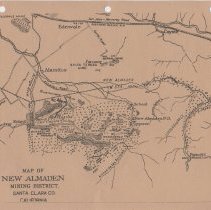
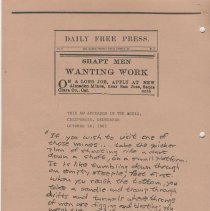
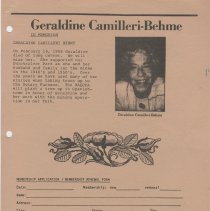
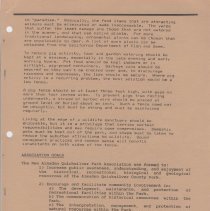
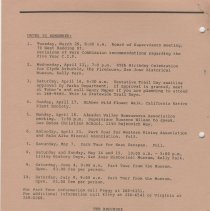
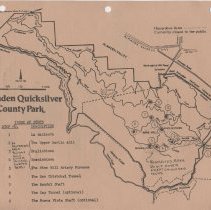
TITLE: Quicksilver County Park News SUBTITLE: Newsletter of the New Almaden Quicksilver County Park Association Issue # 16 April 1988 CONGRATULATIONS TO OUR KITTY: IN RECOGNITION OF HER TIRELESS EFFORTS TO PRESERVE THE HISTORICAL SITES AND TO DEVELOP THE RECREATIONAL ASPECTS OF NEW ALMADEN QUICKSILVER COUNTY PARK, KITTY MONAHAN WAS PRESENTED THE CITIZEN OF THE YEAR AWARD BY THE ALMADEN TIMES ON MONDAY EVENING, MARCH 21St. TO MAKE THE EVENT EVEN MORE OUTSTANDING, KITTY WAS PRESENTED TWO RESOLUTIONS, ONE FROM STATE ASSEMBLYMAN QUACKENBUSH AND THE OTHER FROM SAN JOSE MAYOR MCENERY. HEARTIEST CONGRATULATIONS, KITTY, FOR A JOB WELL DONE: P.C.N.S.T. 20th ANNIVERSARY Through the National Trails Act of 1968, Congress designated the Pacific Crest Trail a National Scenic Trail. This year the PCT National Advisory Council and the PCT Conference are preparing a commemoration program to celebrate the 20th anniversary of the event. The PCT Conference is compiling a list of hikers and equestrians who have completed the entire trail. If you have completed it, or know someone who has, the Conference would Lil:e the name, address, whether afoot or horseback, and approximate start and finish dates. It does not need to have been done all in the same year. The information, or questions about the trail, the Conference, or the celebration should go to: Larry Cash, PCT Conference, 365 West 29th Avenue, Eugene, OR 97405. In 1943, after graduating in journalism from San Jose State College, Patricia Loomis joined the staff of the San Jose News. Pat began writing her "Signposts" articles in 1971 and they appeared weekly in the News for the next ten years. We are deeply grateful to Pat for permission to reprint certain "Signposts" articles dealing with the New Almaden -Quicksilver mines area. McABEE ROAD It wasn't molehills that made mountains (of cash) for the son of Edward Macabee .....it was gopher mounds on his cousin's farm out on Almaden Road at the turn-of-the-century. The little critters with thir fat jowls and buck teeth were threatening to destoy the orchard. Zephr Macabee had a barber business in Los Gatos, but his doctor had advised him to get out into the fresh air and sunshine. So he decided to turn the barber business over to someone else and took on the gopher problem. Nothing seemed to work. He tried poison and traps, but could not stem the invasion of the beady-eyed little rodents. Not finding a scrap of fur in any of the traps one morning, a disgusted Zephyr Macabre vowed "there's got to be a better trap." He went home and with pliers, tinsnips and wire, he built one. Labor-saving machines designed and built by the McAbee's later eliminated much of the handwork. The Macabee gopher trap is still a favorite of springtime gardeners faced with invasions of the burrowing beasts in lawn and flower bed. Placed in the gopher's run, or tunnel, the trap is set by pushing open the wire jaws and hooking an attached wire to the trigger plate. Mr. Gopher comes along, gets his fat little body over the opened jaws and the minute his pink little nose touches the trigger plate, the trap is spring and it's goodby gopher. Now Los Gatos' oldest industry, the gopher catcher is still painted "Macabre green" and is still being manufactured in the same building on Loma Alta Avenue by members of the Macabee family. In the beginning, Macabee drove around the country peddling his traps to farmers, but it wasn't long before word of the sure-fire quality of the trap spread and orders began coming in from farmers across the nation. The gopher-trapping job the young barber took up at the turn of the century became big business, and McAbee traps will continue to be made so long as there axe gophers ....which likely will be as long as there is crabgrass in the front lawn or aphids on the rose bushes. Zephyr Macabee was a native of Malone (Franklin County) N.Y. and had come to California with his family in the 1860's. His parents, Edward and Mathilda (Francis) Macabee, first settled on a farm in the Union district, but his dad left the land for hotel-keeping, and for many years operated the Alpine House in Los Gatos. The family was part of a large clan which came out of Canada to Franklin County, N.Y., and then moved on to California. Part of the family spelled the name McAbee, and Mitchell McAbee and his family of nine children settled on farms in Almaden township. It was one of Mitchell's boys who gave his cousin Zephyr the gopher-catching job. Big families ran in the McAbee clan and most of them farmed, although several got into the lumber industry in the mountains above Los Gatos and over in Boulder Creek. Mitchell's children were Jane, who married a man named Bennett; Lena, who married Herman Kooser, one of the early settlers out on the road to the New Almaden mines, and Joseph, George, William, Herman, John, Louis and Edward (there seems to have been an Edward in every family down through the generations). Herman McAbee married Lena Bose, whose dad, George, owned a chunk of farm land south of Redmond Road, which later became the Merman McAbee farm. It was Lena McAbee who petitioned for McAbee Road in September, 1911. The petition sought to extend the existing Norton Road (named for an early land owner) from Redmond Road through lands of H.N. Mathews, Margaret Horstman, McAbee and up into the New Almaden -Quicksilver Mining Co. property where a new mine shaft had been dug. According to Mrs. Dorothy Strickler of San Jose who grew up in that area and whose mother's sister married into the McAbee clan, the road was needed to bring the ore from the new mine to the smelters at New Almaden. She remembered catching a ride on the wagons and trucks J with other youngsters who attended the old Pioneer School north of Redmond Road. It was John Pfeiffer of the family which owned nearby Greystone quarry who in January, 1912, suggested "Signposts" on the road bear the McAbee name. Mrs. Leora McAbee, widow of George McAbee who was a San Jose florist and the grandson of Mitchell McAbee, said she believed the name was originally "Machbee" but apparently this spelling was dropped in favor of Macabee or McAbee. The old two-story farm houses are gone, and subdivisions have taken over the orchards, but likely backyard gardeners along McAbee Road are introducing new generations of gophers to the Macabee trap. THE CALL HEARD ROUND THE WORLD BOB CLEMENT The call of the California Quail echos through the New Almaden Quicksilver Park and in many other places too. The perky little bird can be seen scrambling through local woodlands and residential backyards alike. You might see it in some rather out of the way places as well. - Named our state bird in 1931, it has always been one of our significantly recognizable inhabitants. It was an important food item for native indians and was later almost exterm-inated by market hunters during early pioneer days. Seven subspecies ranged from extreme southern Oregon to the tip of Baja California and eastward into a few tiny pockets in Nevada. California now shares the quail with far off lands. As early as 1865, they were transplanted into previously unoccupied parts of Nevada. British Columbia got there's in the 1870's and again around 1900. Washington received quail as early as 1857. Oregon, Idaho and Utah also enjoy populations of these transplanted California cuties. Populations may dip in some areas during cold winters but they manage to hang on over much of the west. Quail are international travelers too. Hawaii got her seed stock in 1855. In 1862 New Zealand joined the club. Australia, Fiji, Tonga and other Pacific islands were stocked as well. Some flocks flourished, some perished, and some merely persist in very small numbers. Argentina and Chile represent South America as homes for our state bird. For a bird so symbolic of California, it is ironic that Idahoans, Fijians and Argentinians can all enjoy the thrill of hearing a quail call without leaving their home. We have not always benefitted from transplants we have received from other lands. English Sparrows and Starlings have worn out their welcome. Let's hope the joy of the California Quail lasts forever---wherever! DAILY FREE PRESS. SHAFT MEN WANTING WORK ON A LONG JOB, APPLY AT NEW Almaden Mines, near San Joxe, Santa Clara Co., Cal. ocl6 THIS AD APPEARED IN THE BODIE, CALIFORNIA, NEWSPAPER OCTOBER 26, 1881 "If you wish to visit one of those mines.take the quicker plan of shooting like a dart down a shaft, on a small platform. It is like tumbling down through an empty steeple, feet first. When you reach the bottom, you take a candle and tramp through drifts and tunnels where throngs of men are digging and blasting; you watch them send up tubs full of gret lumps of ore. You reflect frequently that you are buried under a mountain, a thousand feet below daylight." Mark Twain 1871 CONTRIBUTED BY JOHN SLENTER. Geraldine Camilleri-Behme IN MEMORIAM GERALDINE CAMILLERI BEHME On February 16. 1988 Geraldine died of lung cancer. We will miss her. She supported our Quicksilver Park as she and her husband and family ran the mines in the 1940's and 1950's. Over the years we have used many of her stories when taking tours up to the Rotary Furnace. The NAQCPA will plant a tree up in Spanish-town in honor of Geraldine and her work with the mining opera-tion in our Park. Geraldine Camilleri-Behme MEMBERSHIP APPLICATION / MEMBERSHIP RENEWAL FORM Date: Membership: new renewal Name: Address: City: State: Z1p: Phone: (area code:-)- Dues: $10 per year per household, tax deductible f Additional tax deductible contribution f Total amount enclosed f Checks may be made payable to "Quicksilver Park Assn." LIVING NEXTDOOR TO ALMADEN PARK'S WILDLIFE Martha Schauss J Living on the edge of undeveloped open space or park land can 6e a unique and exciting experience. Homeowners can look out on a "backyard" of acres of grassland or woodland, and have the opportunity to view wildlife without leaving home. Almaden County Park. has a wide variety of mammals, birds, and reptiles, including deer, wild pigs, coyotes, bobcats, grey fox, raccoons, skunks, gopher and rattlesnakes, red-tailed hawks, kestrels, turkey vultures, golden eagles, wild turkeys, and even an occasional mountain lion. Unfortunately, while most people enjoy viewing these creatures over the fence, they are not always considered good neighbors. While humans often frighten wildlife, they also may create favorable habitat conditions around their homes. Since animals have little respect for- property lines, green gardens and other rich food sources lure them into areas where they are not welcome. Herbivores and scavengars often find backyards attractive. Deer, the largest native herbivore found in the area, feed on brushy vegetation, along with green grass in the winter and spring, arid acorns in the fall. In the summer, their natural food sources are at a low, and they are willing to risk. contact with humans to feed on rose bushes and other cultivated treats. Wild pigs are relative newcomers to the area. They are exotics that have been illegally introduced to many parts of California for sport hunting. They have readily adapted and have become the state's unofficial number one game animal. They have also caused many problems. The pig feeds on a wide variety of things. When the ground has been softened by tall and winter rains, pigs root far roots, earthworms, and insert larvae. Like deer, they also graze en green grasses and eat acorns and other fruit mast. Also like deer, they find cultivated gardens irresistible, especially when food is scarce in the summer months. In addition to rooting up lawns and flower beds, pigs find pet food containers and garbage cans to be good places to scavenge for food. Coyotes, raccoons, foxes, skunks and oppossums are other scavengers that will tolerate the presence of humans if food is available. Like pigs, they all. find pet food and garbage to be attractive. Even the most avid wildlife viewer may start to gnash his teeth when his favorite rose bush has been nibbled to death, hi= newly planted petunia bed has been rototilled by night visitors, or his weekly garbage has been scattered all over his lawn. There are steps that can be taken to restore peace in "paradise." Basically, the food items that are attracting animals must be eliminated or made inaccessible. The yards that suffer the least damage are those that are not watered in the summer, and that use native plants. Far more traditional landscaping, ornamental plants can be chosen that are unpalatable. to deer. A list of such plants can be obtained from the California Department of Fish and Game. To reduce pig activity, lawn and garden watering should be kept at a minimum, especially in the late evening and early morning hours. Pet food should be kept indoors or in airtight, pig-proof containers. Garbage cans should be secured so they can't be knocked over and, to discourage raccoons and opossums, tho lids should be secure. Where pig activity is a recurring problem, the best solution would be a low fence. A pig fence should be at least three feet high, with gaps no more than four inches wide. To prevent pigs from rooting underneath, a strand of barbed wire Should be placed at ground level or buried about an inch. Such a fence need not be unsightly, but must be strong and must be maintained regularly. Living at the edge of a wildlife sanctuary should be enjoyable, but it is a privilege that carries certain responsibilities and may require some compromises. Domestic pets must be kept out of the park, and steps must be taken to reduce the suburban attractions to wildlife. Sound management practices and common sense will benefit inhabitants on both sides of the fence. ASSOCIATION GOALS The New Almaden Quicksilver Park Association was formed to: 1) Increase public awareness, understanding, and enjoyment ofthe historical, recreational, biological and geologicalresources of the Almaden Quicksilver County Park. 2) Encourage and facilitate community involvement in: a) The development, maintenance, and protection of recreational facilities within the Park. b) The commemoration of historical resources within the Park. c) The interpretation, management, and protection of natural resources within the Park. d) The establishment and operation of interpretative programs and facilities within the Park. HELP IS NEEDED We need your help at the Museum on a Saturday. You will be working there with somebody else who knows the ropes and can show you what to do. Call Virginia at 269-6068. DATES TO REMEMBER: 1. Tuesday, March 29, 9:00 a.m. Board of Supervisors meeting, 70 West Hedding St. Decisions of Pars commission recommendations regarding the Five Year C.I.P. 2. Wednesday, April 13, 7-9 p.m. 85th Birthday Celebration for Clyde Arbuckle, the Firehouse, San Jose Historical Museum, Kelly Park. 3. Saturday, April 16, 9:00 a.m. Tentative Trail Day awaiting approval by Parks Department. If approval is granted, meet at Toter's and call Nancy Mapes if you are planning to attend at 268-9689. This is Statewide Trail Days. 4. Sunday, April 17. McAbee Wild Flower Walk, California Native Plant society. 5. Monday, April 18. Almaden Valley Homeowners Association meeting, 7:30 p.m. Supervisor Susanne Wilson to speak. Los Gatos Christian School, 1150 Rajkovich Way. 6. Saturday, April 23. Park Tour for Western Mining Association and Palo Alto Mineral Association. Full. 7. Saturday, May 7. Park Tour for Near Escapes. Full. 8. Saturday and Sunday, May 14 and 15. 10:00 a.m. - 5:00 p.m. Living History Days, San Jose Historical Museum, Kelly Park. 9. Saturday, June 4, 9:00 a.m. Park Tour from the Museum. Open. $3.00 fee per person. 10. Saturday, July 9, 9:00 a.m. Park Tour from the Museum. Open. $3.00 fee per person. For Park Tour information call Peggy at 268-8331. For additional information call Kitty at 268-6541 or Virginia at 269-6068. THE BROCHURE This month we received our long-awaited brochure. It is beautiful. Friedolin Kessler, Kay Carmody and Don Weden put it together for the Association. We have distributed them to the Chamber of Commerce, Parks Department and various libraries around town. We will mail one to you with our next announcements. If you would like some to distribute now, come to the Museum on Saturday afternoon (12 noon to 4:00) or call Kitty at 268-6541. |
People |
Monahan, Kitty McEnery, Tom (Mayor of San Jose) Loomis, Pat (Patricia) MaCabee, Edward MaCabee, Zephyr Pfeiffer, John Clement, Bob Camilleri-Behme, Geraldine Schauss, Martha Arbuckle, Clyde |
Cataloged by |
Meyer, Bob |