
Archive Record
Images
Additional Images [16]
Metadata
Catalog number |
1997.2.2612 |
Object Name |
Newsletter |
Date |
1995 |
Description |
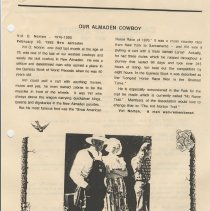
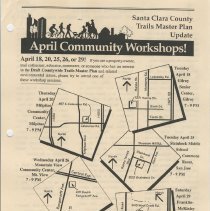
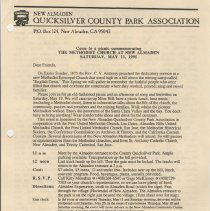
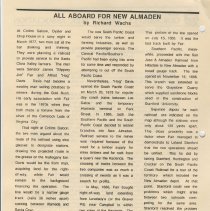
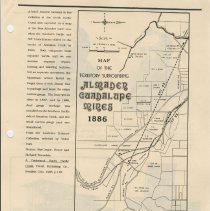
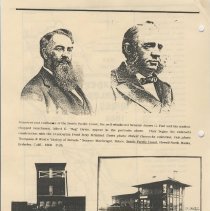
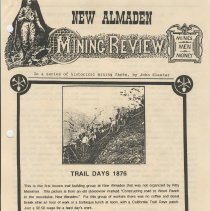
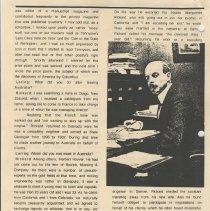
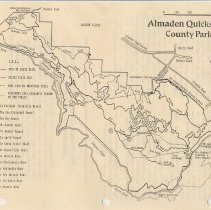
TITLE: Quicksilver County Park News SUBTITLE: Newsletter of the New Almaden Quicksilver County Park Association Issue # 40 Spring 1995 Newsletter of the New Almaden Quicksilver County Park Association SPRING 1995 ISSUE 40 FROM THE PRESIDENT Update on the Reduction Works at the Hacienda Our cherished dream for the near future is to build a replica of the old reduction works office right on the site where it once was - close to the Hacienda entrance to Quicksilver Park. We've hurdled a number of obstacles and h seems that now we are really on our way. The agreement with the firm of CH2M Hill to complete the designs for the remedial action plan has been signed and should be underway. This means that the improvements for the northern creek site will be designed during these months when the Fish and Game allows work in the creek area. However, the Department does limit the months in which this work can be done. When the designs are completed, the work season will be over so creek mitigations won't begin until April 1996! Happily, the designs will be completed this year and the designs for the actual museum can also be started, with work beginning in 1996. In April there will be a community input meeting to discuss the designs for the protection of the creek. Call for information. Your attendance is welcome. 2 6 8 - 6 5 4 1 Rains brought an obstacle One of the obstacles we've encountered lately comes from the Deep Gulch Creek. The culverts did not hold the mud this winter so they had to be removed, making it impossible to take dirt fill to the back of the Reduction Site. As the Water District and Transportation Departments cleaned up mud in rain soaked Almaden Valley, they deposited it in the parking lot of the Reduction Site. Right now, the parking lot is filled with piles of dirt. And now for the good news! Ranger Tom Berra, Quicksilver's tour guide extraordinaire, has joined the Association Board. Tom has been conducting terrific hiking tours of the Park on a regular basis. The large numbers of people attending have expressed delight in both the Park arid the Guide. Thanks, Tom. Spring tonic recommendation from Association President, Kitty Monahan: GO TAKE A HIKE! Check out your choices, daytime, evening, or moonlight in the Calendar of Events. Celebration at the site of the METHODIST CHURCH ON THE HILL Park Association to Commemorate Mine Hill's Methodist Church One hundred thirty years ago Methodist Circuit riders brought the gospel to the mining families on the hill at New Almaden. They came on horseback, preached and visited the sick. They reminded people of the civility and decency that could too easily be forgotten in a western mining camp. They rode on then to other points on their circuit--Berryessa, Saratoga, Los Gatos and Williams Chapel--where they also established congregations and built churches. On Saturday, May 13, the New Almaden Quicksilver County Park Association will remember the church that the Methodists built on the brow of a hill above "English Town" at New Almaden. Commemorating the 120th anniversary of the dedication, members of local Methodist churches and the Methodist Historical Society will join with members of the Park Association for a picnic and afternoon of story telling and music. Guests will have a taste of history as they enjoy Cornish pasties for lunch, hear a Methodist choir perform period music, and listen to a descendant of the New Almaden church tell about his ancestor who was one of the ministers in that church on the hill. Everyone will learn something new about the vital community of several hundred men, women and children who called themselves Methodists, and in many cases, descended from the old stock who had heard the voice of John Wesley. Was it an active church? "Filled to the fullest capacity," Captain James Harry (a mining superintendent and churchman) said in 1866. "In fact, our pastor is talking about enlarging," he added. "We have a fine Sunday school with an average attendance of 165 to 170; those are the children of the people who work for the company; the Good Templars' Lodge meets in the basement story, and the Miners' Benevolent Society.' Check the invitation printed in this newsletter for details on how you can participate in this event OUR ALMADEN COWBOY Virl 0. Norton - 1916-1995 February 10, 1995 New Almaden Virl O. Norton, who died last month at the age of 78, was one of the last of our western cowboys and surely the last cowboy in New Almaden. He was a unique and determined man who earned a place in the Guiness Book of World Records when he was 60 years old. Virl could pull a cart with anything; horses, mules and yes, he even trained zebras to be the muscles in front of the wheels. It was Virl who always drove the wagon carrying quicksilver kings, queens and dignitaries in the New Almaden parades. But his most famous feat was the "Great American Horse Race of 1976." It was a cross country race from New York to Sacramento -- and Virl won it pulling a cart with a mule named Leroy! Actually, he had three mules which he rotated throughout a journey that lasted 98 days and took over 375 hours of riding. Virl beat out the competition by eight hours. In the Guiness Book it was described as the "Longest Horse Race Won in the Shortest Time." He is especially remembered in the Park for the trail he made which is currently called "No Name Trail." Members of the Association would love to change that to "The Virl Norton Trail." Virl Norton. A man well-remembered. CALENDAR OF EVENTS MARCH - MAY 1995 MARCH Saturday, March 18, 7 p.m.: Full moon walk at Calero. Leader, Ranger Tom Open to Association members and friends. APRIL Saturday, April 8, 9:30 a.m.: Wildflower hike in Quicksilver Park, starting at the McAbee/Senator site, then carpool to Jacques Ridge for wildflowers. Leaders are Olive Zapacosta of the Native Plant Society and Bob Clement, botanist. This is a Greenbelt activity, open to all. Bring bag lunch, a drink and your camera. Friday, April 14, 8 p.m.: Full moon walk at Quicksilver. Meet at the McAbee entrance. Leader, Ranger Tom. Open to members and friends. Saturday, April 15, 9 a.m.: Truck tour of Quicksilver from the Hacienda. Leader is Kitty. This is a Gem and Mineral Society event, open to all. Bring lunch, drink, camera. Saturday, April 22, 9 a.m.: Hike in Quicksilver Park, beginning at Hacienda site. Leader, Ranger Tom. Saturday/Sunday, April 22/23; May 6/7 (four day course): San Jose State classes these two weekends, held in New Almaden and throughout Quicksilver Park. For credit a noncredit. Phone (408) 924-2625 for details. Saturday, April 29, 9 a.m.-1 p.m.: California State Trail Day at Quicksilver Park. Meet at Hacienda site for a half-day of trail work followed by lunch provided at Englishtown on the Hill. Sponsored by California State Trails Foundation and Volunteer Coordinating Council of Santa Clara County Parks and Recreation. Sunday, April 30, 12-4 p.m.: California State Trail Day Fair at Hellyer Park. NAQCPA and many other park and trail groups will have booths. Information about bike and horse trail use; food, fishing, hikes, and scads of information. All free. Continued.... Saturday, May 6, 9 a.m.: Hike in Quicksilver Park. Meet at Hacienda site. Leader, Ranger Tom Saturday, May 13, 11 a.m.- 2 p.m.: Dedication and anniversary of the Methodist Church in Englishtown. Food and program, $7 per adult. See invitation for details. Sunday, May 14, 8:30 p.m.: Full moon hike in Quicksilver Park. Meet at McAbee entrance. Leader, Ranger Tom. Saturday, May 20, 10 a.m.: Equestrian ride from the Hacienda through Quicksilver Park to Jacques Ridge. Leader is Kitty. Sponsored by Santa Clara County Horseman's Association and open to all. BYOH, a bag lunch and a drink. Saturday, May 20, 4 p.m.: Mother's Day special! Take mom on an evening hike in Quicksilver Park. Meet at McAbee/Senator entrance. Leader, Ranger Tom. Saturday,May 27, 9 a.m.: Hike in Quicksilver Park. Meet, at Hacienda site. Ranger Tom leads. Information on any of the above events may be obtained by calling: 268-3883 Ranger Tom Borra 268-6541 Kitty Monahan _ Friends of Santa Clara County Trails ACT NOW! Ensure the Adoption of a County Wide Trail System For Future Generations Questions? Contact Hikers: Marj Ottenb (4081867-4576 Bicycles: Bob Kai, (408)261-8608 Equestrians: Judy Etheridge (4087 2483900 Organization Contact: Mark Ivy (408)879-0742 1 Call to Action - - Protect Your Interest! Trail User Support is Absolutely Necessary. Santa Clam trail users must speak out now. Public hearings are scheduled. For the past two years, a Trails Advisory Committee has studied trail issues, prepared draft policies and proposed trail routes. The committee is completing its work and will be holding a series of public workshops. Preferred routes for regional trails such as the Bay Area Ridge Trail, Bay Trail, De Anza Historical Trail and other connector trails will be presented. Your Voice is Needed at the Workshops to Show Strong Support For the Trail Routes & Policies. There is organized opposition to the proposed trail routes! Decision makers need to See And Hear public support for trails. Your voices must be stronger than those who are aggressively opposing trails. The public workshops will be followed by public hearings before the Parks & Recreation Commission, Planning Commission and finally, the Board of Supervisors. erg At each step, testimony and letters of support from trail enthusiasts are critical. Become a friend of Santa Clara County Trails. Commit now to participating in the efforts to ensure adoption of a County Wide Trail Systems for you and future generations. Some of the Ways You Are Needed Attend and Speak at Key Public Workshops and Hearings OR Write Letters Expressing the Need For Trails and Adoption of the Santa Clara County Trails Master Plan Join Friends of Santa Clara County Trails Coalition (FSCCTC) Learn More About Trail Issues Attend Strategy & Planning Meetings 7-9 pm, Second Monday of the Month 1922 The Alameda, San Jose Santa Clara County Trails Coalition P.O. Box 10477 San Jose, CA 95157-9998 Santa Clara County Trails Master Plan Update April 18, 2U, 25, 26, Or 291 If you area property owner, trail enthusiast, educator, commuter, or someone who has an interest in the Draft Countywide Trails Master Plan and related environmental issues, please try to attend one of these workshop sessions. Thursday April 20~ Milpitas ( 457E.Calaveras Community Center, Milpitas 7-9PM Wednesday April 26 Mountain View Community center 7-9 PM April 29 Franklin-McKinley School District Offices, San Jose IOAM-12 Noon Tueday april 18 Gilroy Senior Center 7-9 PM Tuesday april 25 Steinbeck Middle School Commons Room 7-9 PM These meetings are the third in a series of public workshops about the Countywide Trails Master Plan. Contact Julie Bondurant at the County of Santa Clara Department of Parks & Recreation at (408) 358-3741 ext. 152 for more information. BEHOLD THE BUCKEYE One of our most fascinating and ancient trees The bright yellow fields of mustard carpeting the orchards tell us in the Santa Clara Valley that spring (regardless of the date) has arrived! In the foothills, another plant announces the same good news. The California Buckeye is a strange relic of a former time. Its existence here stretches back to a time when eastern-type deciduous forests covered much of California. Rain was not restricted to such a short period of the year and sunny summer days weren't as easily guaranteed as they are now. Times have changed and the buckeye's original forest-mates have pretty much disappeared. The buckeye made some physiological adjustments arid has managed to maintain a foothold among the newcomers. Harbinger of spring Buckeyes are among the very first deciduous trees to leaf out in the spring. The foliage is a beautiful vibrant green and the leaves are large, palmate and tropical-looking. Buckeyes like water and grow largest and most luxuriant near streams or other water sources. They are tough though, and even survive in relatively dry chaparral areas as small shrubby trees. Shortly after the tree fully leafs out, long, attractive spikes of white to slightly pinkish flowers engulf the tree. Pretty but strange, these flowers produce a pollen which is poisonous to honeybees. In March of 1853, the first honeybees were introduced to California at a place which is now in the city of Santa Clara. Perhaps the buckeye might be a little more compromising with honeybees if they had evolved together. Eco-wise leaves Large, delicate leaves transpire a lot of water and our usual rapid drying of the landscape as summer approaches is not conducive to such plants that have to make it on their own. The solution for the buckeye is to get rid of them when the heat of summer sets in. Sometime between June and August, depending upon where they are growing, those beautiful palmate leaves wither and begin to drop. The trees appear to be dying as they go into summer dormancy while smaller-leafed trees bask in the warm sun. By leafing out very early the buckeye gets a head start while conditions are moist and competition for sunlight is low. When conditions become less advantageous they close up shop and turn in for the year. Versatile pods When the leaves fall the trees are not left bare. Large fruits (horse chestnuts) hang like ornaments all over the trees. Eaten by squirrels, deer and pigs, they are mildly toxic to humans. Native peoples apparently baked them into acceptability as a food source. When the seeds were mashed and thrown into pools, instant fresh fish dinners floated temptingly to the surface. Behold the buckeye As you walk the trails of Quicksilver Park in search of those elusive first wildflowers, look up for a larger sign of spring. Behold the buckeye - a sign of good times coming. Thanks to Bob Clement for this interesting article. Come to a picnic commemorating THE METHODIST CHURCH AT NEW ALMADEN SATURDAY, MAY 13, 1995 Dear Friends, On Easter Sunday, 1875 the Rev. C. V. Anthony preached the dedicatory sermon at a new Methodist Episcopal Church that stood high on a hill above the mining camp called "English Town." This Spring we will gather to remember the faithful people who once filled that church end celebrate the community where they worked, prayed, sang and raised families. Please join us for an old-fashioned picnic and an afternoon of song and festivities on Saturday, May 13. We will caravan up Mine Hill, have a picnic lunch, hear music (including a Methodist choir), listen to informative talks about the life of the church, the community, pastors and preachers and the mining families. Walk where the pioneer Methodists walked. Enjoy the panorama of the Santa Clara Valley and the bay. You don't have to bring anything! Wear comfortable shoes and dress for the outdoors. This event is sponsored by the New Almaden Quicksilver County Park Association in cooperation with the First United Methodist Church, Los Gatos, Almaden Hills United Methodist Church, the First United Methodist Church, San Jose, the Methodist Historical Society, the Conference Commission on Archives & History, and the California Cornish Cousins. Several descendants of the New Almaden Methodists will attend. So will pastors or representatives from the Methodist churches, and from St. Anthony Catholic Church, New Almaden, and Trinity Cathedral, San Jose. 11 a. m. Meet by the Almaden entrance to the County Quicksilver Park. Ample parking available. Transportation up the hill provided. 12 noon Last truck heads up the hill. Then the gate must be locked. The trucks will return to the Almaden entrance at 3 p m Cost: $7 adults, $5 teens, 12 and under free. Includes tour up the hill, lunch, souvenir program. Food, beverages, plates, utensils provided. R.S.V.P. Call Kitty Monahan C@ (408)268-6541 or Gage McKinney Ca (408)739 7503 or your church's representative, so we can have plenty of food. Directions: Almaden Expressway south to Almaden Road (watch for sign). Pass through the village (Hacienda) of New Almaden. The Almaden entrance to the park is on the right just beyond the village. (Turn sheet over for map). Rain check: In the event of rain between Thursday, May l l and Saturday morning, the event will be postponed until Saturday, May 20. In the event of rain between Thursday, May 18 and Saturday morning, the event will move indoors to the New Almaden Community Center. Drive to the Almaden entrance to the park and watch for signs. New Almaden County Quicksilver Park Association Proclaim the greatness of the Lord our God and worship him upon his holy hill. Psalm 99 ALL ABOARD FOR NEW ALMADEN by Richard Wachs At Collins Saloon, Oyster and Chop House on a rainy night in March 1877, two men sat at the bar drinking and thinking. They were planning a railroad to provide service to the Santa Clara Valley farmers. The men were Senator James "Slippery Jim" Fair and Alfred 'Hog" Davis. Davis had become a wealthy man selling potatoes to miners during the Gold Rush. His early association with Fair was in the 18706 when they both made a fortune from the silver of the Comstock Lode 0f Virginia City. That night at Collins Saloon, the two men argued about the route of the railroad using shot glasses to designate stations, drawing the projected route in the grease on the mahogany bar. Davis would be the front man, acquiring land for the right-of-way, while Fair would remain in the background financing the operation. The line would be a narrow gauge track (rails 36 inches apart) running between Alameda and Santa Cruz. Other attempts at building railroads in the Santa Clara Valley had failed over financing but Fair and Davis proceeded full steam without subsidies. The new South Pacific Coast would serve the lumber and farming industries, as well as provide passenger service. The Central Pacific/Southern Pacific had been eying this area for some time and responded by attempting to cut off the South Pacific Coast. Nevertheless, "Hag" Davis opened the South Pacific Coast on March 20, 1878 for regular day coach trains between Los Gatos and the temporary Alameda terminal on Park Street. In 1886, both the Southern Pacific and the South Pacific Coast decided to extend branches into New Almaden. Railroad service to the mines was required because of the need for a lumber supply for mine timbers and for rock from a quarry near the Hacienda. The crossing of tracks between the two companies was as much a crossing of swords as H was a search for profits. In May, 1886, Fair bought right-of-way land extending from Lovelady's (or the Gravel Pit) near Campbell to within two miles of the Hacienda. The purchase of right-of-way land from the quicksilver Mining Company stipulated that the area would be kept free of noxious weeks such as mustard. This portion of the line opened on July 15, 1886 It was the last track built by Fair. Southern Pacific, meanwhile, proceeded with the San Jose & Almaden Railroad from Hillsdale to New Almaden with a broad gauge track. The line opened on November 16, 1886. This branch was extended to serve the Graystone quarry which supplied sandstone blocks used in the construction of Stanford University. Separate depots for each railroad are indicated on the map although the stations were only about 100 yards apart. This close proximity was a factor when Fair managed to demonstrate to Leland Stanford that the two operations should be unified. This he did by taking Stanford, Huntington and Crocker on the South Pacific Coast Railroad for a tour of the territory which included the New Almaden depot. At that point, Stanford could see the problems which might arise between two railroads com-peting for the same area. Stanford resolved the problem quickly - by buying the South Pacific Coast from Fair. And with the leaning of the ore, The little engines chugged no more. A brief historic moment in the evolution of the South pacific Coast was captured in a map of the New Almaden yard area when the Southern Pacific and SPC branch lines collided on the banks of alamitos Creek in 1886. Both companies built separate yards and we can assume separate depots. Turning and watering facilities. But as separate operations the bipartisan service lasted no longer than it took Jimmy Fair to package and lease the entire narrow gauge. The lease was in effect in 1887 and by 1888 dual gauge trackage was installed on the Southern pacific side of alamitos Creek and the small narrow gauge yard was abandoned. From the Lawrence Bulmore Collection redrawn by Victor Itani. Source: MacGregor, Bruce and Richard Truesdale. A Centennial South Pacific Coast, Pruett Publishing Co., Boulder, Colo. 1985, p. Founders and craftsmen of the South pacific Coast the well whiskered Senator James G Fair and his mutton chopped henchman, Alfred E "Hog" Davis appear in the portraits above. They began the railroaad's construction with the Dumbarton Point ferry terminal. Davis photo: Robert Hancocks collection: Fair photo: Thompson & West's History of Nevada. Source: MacGregor, Bruce, South Pacific Coast. Howell-North Books, Berkeley, Calif. 1968. P. 35. This home on Cahen Drive in San Jose is the former Southern Pacific depot in New Almaden. Photo Richard Wachs. South Pacific Coast Railroad Station. New Almaden was south of McKean Road and east of the Los Alamitos Creek. From a photo at the Quicksilver Museum, New Almaden. NEW ALMADEN MINING REVIEW In a series of historical mini facts by John Slenter TRAIL DAYS 1876 This is the first known trail building group at New Almaden that was not organized by Kitty Monahan. This picture is from an old stereoview marked "Constructing road to W Ranch in the mountains, New Almaden.' For this group of workers there was no coffee donut break after an hour of work or a barbeque lunch at noon, with a California Trail D patch. Just a $2.50 wage for a hard day's work. These men were doing important mining work. The furnaces at the Hacienda had never ending need for wood. They were always looking for new sources and that is what these men apparently were walking on, a road to a new source. Timber was also used in supporting the underground workings as well as in the miners' homes for heating and cooling. We continue this tradition for different reasons this April with California State Days. Mark your calendars! T. A. RICKARD: JOURNALIST & ENGINEER An Interview by Charles Butter and W. J. Loring Edited by Gage McKinney In recent issues we have republished interviews with three professional mining engineers who worked at New Almaden. We conclude the series with the story of the editor who conducted those interviews, T. A. Rickard. Next to Herbert Hoover, he was the man who best represented the profession. Though he devoted his adult life to writing, Rickard thought of himself foremost as a mining engineer. Along with his many colleagues, he deserves a prominent place in the annals of The West. Engineers contributed more to society and the development of our region than any of the gunslingers or cowhands. They rank with the frontier doctors, teachers, lawyers, entre-preneurs, and preachers and deaconesses as the builders of a civilization. Among engineers, Rickard played an even more important role because he was also an editor and publisher. Rickard edited three mining publications; the Engineering & Mining Journal of New York, (1902-05), The Mining Magazine of London, (1909-15), and the Mining & Scientific Press of San Francisco, (1906-09 and 1915-1922). He owned the London magazine until the First World War brought it down, and he owned the San Francisco magazine far 16 years. Through them he molded the opinions of the practitioners in his field and upheld professional standards. He trained a generation in the skills of technical writing. He disseminated knowledge and increased collegiality among mine managers and engineers around the word. Through the literature of Western mining many of us have learned to think of the Cornish, the pre-eminent miners from the southwest of England, as a clannish, provincial group, clinging to their antique dialect and customs. In T. A. Rickard we see a different kind of Cornishman. He descended from two generations of mining captains (the Cornish term for mine superintendents). Well educated and well connected, he was cosmopolitan in his cradle. His first language was German, and he spoke Russian before he mastered English. He passed up a place at Cambridge University to attend the Royal School of Mines. He was too large in his thinking for national boundaries. First a British subject, he became an enthusiastic American, and as such we meet him in this interview. His Americanization, though, was a failure. His English ways and accent put off his new countrymen and he never felt accepted. After retiring from his magazine he settled in Victoria, British Columbia and restored his British citizenship. He always thought of himself as a member of the "English-speaking peoples." Any influence Rickard had at New Almaden came through his magazines. We know that they were read by the management because collections of Quicksilver Mining Company materials at Berkeley and Stanford and the San Jose Historical Museum all contain clippings from the Mining & Scientific Press. Managers would have appreciated the market reports for precious metals, reports on new practices and techniques, accounts of successful operations, items on individual engineers, and advertisements from machinery manufacturers. As far as we know, Rickard only visited New Almaden once. In 1917, when W.H. Landers was manager and John Drew foreman, Rickard stayed at the Casa Grande. He probably knew a good deal of the operation, not only from his visit, bur from his acquaintance with engineers who had worked there. If Landers hoped that Rickard would write a favorable amount of the operation, he was disappointed. At a time when the mine desperately needed financial support, Rickard wrote nothing. From his vast experience he surely recognized an operation in decline. As with the other interviews, we begin with Rickard's accompanying column. He explained that he had previously interviewed 23 engineers, and he thought it neither "unfair nor inappropriate" that he should submit to the same treatment. Charles Butter and William Loring, two engineers whom he had previously interviewed, asked the questions. The interview appeared in Engineering & Mining Journal-Press (the successor to Rickard's San Francisco magazine) April 1, 1922. It was reprinted with others in his book Interviews with Mining Engineers, Mining and Scientific Press, San Francisco, 1922. AN APOLOGIA By T. A. Rickard I am proud of my Cornish ancestry and of my descent from the mine-captains of the delectable Duchy.' Our people, like many of the Cornish, are of Breton origin, for Brittany is much closer to Cornwall than most people realize, and many family names are common to St. Malo and Penzance. This sentimental tie with France pleases me, for I love France. Chacun a deux patties, la sienne et la France. "Everyone has two countries, one's native land and France.." The interview shows that as the son of a mining engineer I began to travel early and learned two foreign languages before I became fluent in my own. All this has tended to check provincialism or a narrow prejudice against the peoples of other countries. A cynic has said. "Patriotism is your conviction that your country is superior to all others because you were born in It." The cynic was G. B. Shaw, whom I dislike intensely and with whom I am glad to disagree. I was not born in the United States, and Tterefore my belief in its superiority "to all others" is not based upon an accident; but it does coincide with my self-determination in the matter of citizenship. As a boy, in my visits to Cornwall. I used to look from the cliffs at Newquay across the Atlantic with the fixed intention of going to America, of which I had heard much from my father, who had been here many times on professional work. Besides, I met many Americans at our home, and I liked their cheery ways and expensive manner. As soon as I was graduated I came across. Of my work as a mining engineer, 1 can say that the geologic aspect of it was intensely interesting, that is, the finding of ore; also the appraisal and management of mines. But the contact with promoters and their wily ways I did not like, and before long I became disgusted with them, partly because they involved me in a fiasco that was the direct consequence of disregarding my advice. [Rickard is referring to the independence Mine. Promoters sold shares in London for more than twice the value that Rickard had told them the mine was worth]. Of that I need say no more here except that was one of the reasons for my becoming an editor, a result for which I am grateful, for undoubtedly my life has been made happier, and possibly more useful, thereby. A man is fortunate if he can find scope for his abilities, however moderate. The square peg in a round hole is the symbol of discomfort; the round peg snugly filling the round hole is the type of fitness. I have enjoyed the work that I have done now for twenty years. All normal men like power; some get it by means of muscle, others by the aid of wealth, and others by the exercise of various arts. Of these, the art of writing makes its strongest appeal to educated men because it gives them power over their own kind; they become leaders of thought and molders of public opinion, and that in a civilized community, especially one based on democratic ideals, is a splendid function . . . . The urge to write is the moving spirit of journalism and the impulse to criticize is the very life of editorial writing. Of patter and comment there is more than enough; the world needs the criticism of ideas, of methods, and of men. The true editor is driven by the demon of criticism, and I use the word 'demon' to mean not an evil prompter but an indwelling spirit. Sometimes his criticism hurts the feelings of the editor's friends, and he is sorry that it should, but that will not stay his hand, for if he once started to abstain from the performance of his self-imposed duty for fear of giving umbrage to one or two individuals, his usefulness would be at an end. One must have the courage of one's opinions to sit squarely in the editorial chair. In a mining paper I reach people with whom I have much in common, whom I understand, who are to me, as the Mexicans say, muy simpatico. In short, although a journalist, I am still a mining engineer. T. A. Rickard: An Interview Butter: You are of English origin? Rickard: Cornish on my father's side, Scottish-Irish on my mother's. Butter: You were born in Cornwall? Rickard: No, I was born in Pertusola, in Italy, in 1864 [29 August]. My father was in charge of a smelter operated by a British company at that place. Loring: Your own family was connected with mining, then? Rickard: Yes, my father, Thomas Rickard, was the eldest of five brothers, all of whom were mining engineers and metallurgists. My grandfather was James Rickard, known as 'Captain' because he was a Cornish mine captain. He was one of the first accredited mining engineers to come to California, in the summer of 1850, in behalf of John Taylor & Sons, a firm still honorably active in London, for whom he examined the Mariposa grant, then under option from General John C. Fremont, 'the Pathfinder' and the rival of Buchanan for the Presidency in 1856. My grandfather brought a sectional stamp-mill to California to test the ore of the Mother Lode, and this was the first stamp-mill erected in California at Coulterville, in Mariposa county. Hermon Jennings and Edward Benjamin [two engineers, both of whom spent time at New Almaden] toll me that they had seen records to this effect, but unfortunately they were destroyed in the San Francisco fire. Butter: The firm of John Taylor & Sons is the oldest mining engineering firm in existence? Rickard: Yes. I believe it is; and I am glad to say that, as the grandson of James Rickard, I am on friendly terms with the grandsons of the founders, John and Richard Taylor. I may add that my great-grandfather was Richard Rickard, also a Cornish mine captain, who was a man of distinction in his own little world in the 'old country,' as the Cornish call it. Loring: Were you educated in Italy? Rickard: No. Two years after my birth, my father went to Andeer, in Switzerland, for John Taylor & Sons, and after two years more he went to Russia as manager for the Russia Copper Company, operating two smelters and several groups of mines close to the Russo-Asiatic border. My first recollection of mining operating is of an aerial rope-tramway in Switzerland, but my first memory of a mine is that of the copper mines at Kargalinsky, in the Ural region. In these, the copper occurred native as carbonate, that is, in a form attractive to the eye, so that I remembered it. Moreover, the copper appeared as a replacement of plant remains in the Permian sandstone, and the peculiar character of these deposits naturally arrested my boyish observation. Loring: What was your early education? Rickard: The first language that I learned to speak was German, because our nurse came with us from the German-speaking part of Switzerland, near Zurich. In Russia, my first teaching was received from a Russian tutor, and the first history I learned was the history of Russia. Until I was fourteen I thought in German, and spoke Russian better than English. While in the Ural, I used to accompany my father on some of his inspections, and I recall the fact more particularly that I acted as interpreter for him. Butter: To what school did you go? Rickard: While in Russia, my brother Forbes and I had a Russian tutor. Later, when I was eleven, the three oldest children, including my eldest sister, traveled from the Siberian border to England, to go to boarding-schools. I remember that we went up the Volga, from Ufa to Nip Novgorod, and then by train to S. Petersburg. The journey to England from the Ural took three weeks and three days. My brother and I went to [a Wesleyan] school at Taunton, in Somersetshire. In England it would be described pathetically as a middle-class school, but it was a most excellent school. It is known now as Queen's College. We had a field club and a debating society. In the debating society we learned to speak while on our feet; in our field-club rambles we obtained glimpses of natural history. I remained there for six years and then matriculated at London University. [Rickard did not see his parents during his first five years at school.] Loring: Had you already decided to follow in the footsteps of your father? Rickard: No; on the contrary, I had won a scholarship at Cambridge and was about to go there, with a view to adopting one of the so-called liberal professions, possibly the law, when I was diverted by the advice of my uncle, Reuben Rickard, who arrived in England on a visit from Berkeley, California. He was, as those that knew him will recall, a kindly and eminently sensible man. He urged me to follow the family calling, and I had so much respect for his sagacity that I did as he suggested. Butter. Don't you think you were particularly fortunate to have had the good sense at that age to be willing to accept the advice of an older man? Rickard; I cannot analyze my reasons for accepting the advice, but I feel sure that one of them was the fact that I liked the adviser; so I went to the Royal School of Mines [in South Kensington], in which at that time Huxley was dean of the .activity. [Thomas Henry Huxley, a Victorian scientist and philosopher, coined the word "agnostic" to express his own views. He made a lasting impression on Rickard. While at the School of Mines, Rickard skipped the lectures on mining because he understood from his father that practical mining could only be learned underground. He took his science courses more seriously, attended sessions of the House of Commons and visited London museums. Immediately on graduation Rickard traveled to Idaho Springs, Colorado, where he worked under one of his uncles, Alfred Rickard, a mine manager. After a couple of years he was offered the position of manager at the Union Mine in Calaveras County. California, close to the road from San Andreas to Angels Camp. There he had a Chinese servant, a house with hot and cold water, a horse and buggy and $300 a month. At first he developed new pockets of ore, but when the returns dwindled, he received an upbraiding letter from the owners. Loving: How long did you remain in Calaveras County? Rickard: Two years, from 1887 to 1889. Early in 1889 the directors sent a mining engineer to investigate conditions generally, and incidentally to criticize my management. They took pains to select a man unacquainted with my family, an Australian named Charles Lowland. He proved to be a most agreeable man, for, among other things, he expressed a favorable opinion of my youthful attempts as a manager and asked me to go with him to Australia. So, in October 1889, I went with him to London and from there to Australia. Loving: What did you do? Rickard I had saved enough money from my salary in California to be able to travel, and this I aid energetically. In the course of two years I examined eighty-five mines in Australia, all the way frorn Broken Hill to Mount Morgan. Loving: So you bought your experience? Rickard: Yes, in a measure. Here I may say that I began to write. I wrote several articles for the Melbourne 'Evening Standard.' Loving: What led you to write? Rickard: The love of writing. While at school, I was editor of a manuscript magazine and contributed frequently to the printed magazine that was published quarterly. I may add that, as a schoolboy, I looked upon poetry as rather 'sissy' stuff, but one of our masters read us Tennyson's 'Lady Clara Vere de Vere' and the 'Ode to the Duke of Wellington,' and I was so much impressed by both of them that I started to read Tennyson, and after that read four or five other poetry's right through. Shortly afterward I entered for the prize poem and was second, and the next term I wrote the prize poem, the subject of which was the discovery of America by Columbus- Loring: What did you do after leaving Australia? Rickard: I was examining a mine in Otago, New Zealand, when I received a cablegram from my father, asking me to come to France to take charge of a mine of which he was managing director. Realizing that the French mine was worked out and "not wanting to stay up with the corpse," Rickard returned to Colorado were he was a consulting engineer and served as State Geologist from 1896 to 1902. During that time he made another journey to Australia on behalf of clients Loring: Whom did you meet in Australia? Rickard: Among others, Herbert Hoover. He had just come out for the firm of Bewick, Moreing & Company. As there were a number of pseudo-experts on the gold fields at that time, and mining engineering was rather in disrepute, It was a pleasure to meet a young man so keen and capable. He was then 23 years old and I was 33. As he came from California and I from Colorado, we naturally became pleasantly acquainted, and we agreed to exchange reports on wildcats; that is to say, we let each other know of prospects that we turned down, so as to avoid useless examinations. [Richard remained Hoover's life-long friend and in later years often dined at the White House.) His cousin, Edgar Rickard, was Hoover's administrative assistant from 1914 to 1924. Rickard returned to America via London. On the way he escorted his cousin, Marguerite Richard, who was going out to join her brother in California and "I am escorting her still," he wrote They were married in the cathedral at Denver Rickard called his marriage "the cleverest thing I ever did. Resuming his work as a mining engineer in Denver, Rickard minded the constant traveling away from his new wife. Also he found himself obliged to participate in negotiations on behalf of his clients, which he often found distasteful He moved to New York to assume editorship of the Engineering and Mining Journal, a prominent trade magazine, in 1903. Wanting to have editorial control of his publication, he purchased The Mining and Scientific Press of San Francisco in 1905 "My only reason for becoming a publisher," he sale! "was to be an independent editor." Four years later he left his San Francisco magazine in the hands of an editor and moved to London to operate The Mining Magazine. He returned in 1915 when The Mining and Scientific Press had fallen on hard times. "I worked very hard to save the 'Press' and nearly lost my health in the effort, but within two years, I had the satisfaction of seeing our subscription list more than doubled and our business on a profitable basis once more. After his interview with Butter and Loring, Rickard answered questions posed by the magazine's editorial staff. Question: In what way do you think that the maintenance of a high standard in technical journalism is helpful to the profession as a whole? Rickard: The technical press reflects the ideas and ideals of the profession. It has done a good deal to stimulate the development of character in the profession and to render the profession articulate in public Question: You receive manuscripts from all parts of the English-speaking world. Do you notice the influence of well-written technical journals? Rickard: Yes, only last week I received manuscripts from Yokohama, London, and Sydney. The influence of a technical paper is a good deal more than local. Among other things, it brings together in thought men living at distances far apart, because they can use its pages for the discussion of interest common to all of them. It promotes peace and international goodwill among technical men by establishing a mutual understanding of their work and purpose. After selling his San Francisco magazine, Rickard wrote several books on mining history, including The History of American Mining, Man and His Metals two volumes, 1932, reprinted by Arno Press, New York 1974, The Romance of Mining, and an autobiography, Retrospect New York, 1937. He was rather fulln of himself, the Oxford historian A L Rowse wrote of Rickard, but there was so much in him where so many are empty. Rickard died in 1953. IBM Donates Computer to New Almaden Quicksilver County Park Association The president of the IBM Storage System Division in San Jose, Dr. Edward Zschau, has arranged a gift of a computer to the association. The IBM Value Point computer will be used to assist the archivist, Nancy Valby, in cataloguing the artifacts associated with the museum of the New Almaden Mines. Ms Valby requires software for her cataloguing that can only run on an IBM PC with an Intel microprocessor at least at the 386 level, which made obsolete our older computer. Larry Comstock of the Board of the NAQCPA arranged to request the gift and has forwarded the thanks of the Board to Dr. Zschau. Go Take A Hike Save June 3, 1995 National Trail Day Prepared for a fun event Santa Teresa County Park Sponsored by Friends of Parks and Trails. Special notice will be sent later. |
People |
Borra, Tom Butter, Charles Clement, Bob Comstock, Larry Loring, W. J. McKinney, Gage Monahan, Kitty Norton, Virl O Rickard, T.A. Valby, Nancy Wachs, Richard Zschau, Edward |
Cataloged by |
Meyer, Bob |