
Archive Record
Images
Additional Images [10]
Metadata
Catalog number |
1997.2.2618 |
Object Name |
Newsletter |
Date |
1996 |
Description |
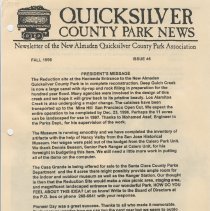
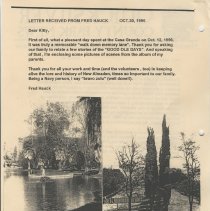
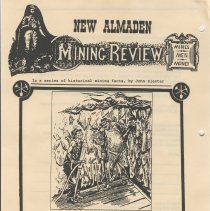
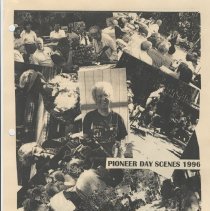
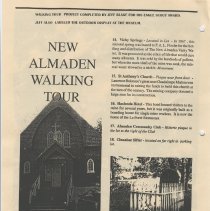
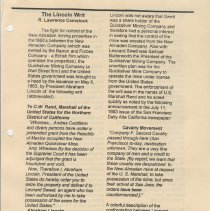
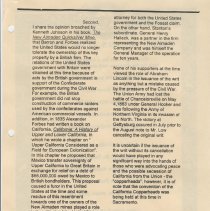
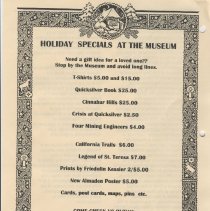
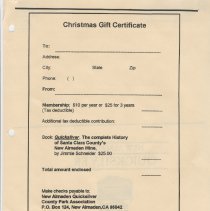
TITLE: Quicksilver County Park News SUBTITLE: Newsletter of the New Almaden Quicksilver County Park Association Issue # 46 Fall 1996 Newsletter of the New Almaden Quicksilver County Park Association FALL 1996 ISSUE 46 PRESIDENT'S MESSAGE The Reduction site at the Hacienda Entrance to the New Almaden Quicksilver County Park is in complete reconstruction. Deep Gulch Creek is now a large canal with rip-rap and rock filling in preparation for the hundred year flood. Many agencies were involved in the design of this creek and we hope it will grow back to its pristine beauty. Los Alamitos Creek is also undergoing a major change. The calsines have been transported up to the Mine Hill San Francisco Open Cut. We expect the entire operation to be completed by Dec. 23, 1996. Perhaps the 11 acres can be landscaped for use in 1997. Thanks to Mohamed Asaf, Engineer in the Parks Dept., for his supervision of the work. The Museum is running smoothly and we have completed the inventory of artifacts with the help of Nancy Valby from the San Jose Historical Museum. Her wages were paid out of the budget from the Calero Park Unit We thank Dennis Beason, Senior Park Ranger at Calero Unit, for his foresight in budgeting this item. We still need a little more work in putting all of the items on the computer. The Casa Grande is being offered for sale to the Santa Clara County Parks Department and the 6 acres there might possibly provide ample room for the indoor and outdoor museum as well as the Ranger Station. Our thought is then that the Reduction Site would make a nice picnic area, staging area, and magnificent landscaped entrance to our wonderful Park. HOW DO YOU FEEL ABOUT THIS IDEA? Let us know Write to the Board of Directors at the P.O. box or phone 268-6541 with your response. Pioneer Day was a great success. Thanks to all who made it memorable. Each year we wonder how we can top the next year but we seem to outdo ourselves year to year. Larry and Marilyn Comstock are to be commended for their expert handling of the day and the classy presentation they brought to us. Terry Espeland was a very gracious host May Christmas bring you great joy and success in the New Year. Kitty Monahan LETTER RECEIVED FROM FRED HAUCK OCT.30, 1996 Dear Kitty, First of all, what a pleasant day spent at the Casa Grande on Oct. 12, 1996. It was truly a memorable "walk down memory lane". Thank you for asking our family to relate a few stories of the "GOOD OLE DAYS". And speaking of that, I'm enclosing some pictures of scenes from the album of my parents. Thank you for all your work and time (and the volunteers, too) in keeping alive the lore and history of New Almaden, times so important to our family. Being a Navy person, I say "bravo zulu" (well done ll). Fred Hauck FROM: New Almaden Quicksilver County Park Association Board of Directors At this time, the County of Santa Clara Parks and Recreation Department has assigned a task force to determine usage of Quicksilver County Park. We, the members of the Quicksilver Park Association Board of Directors, strongly believe that there should be no bicycles of any kind in the Park. The Park is ill suited for bicycles due to the dangerous narrow and steep trails, blind curves and inherent speed of the bikes. Additionally, this Park has an historic heritage which includes the remnants of three mining towns significant in the history of California. If you agree with the Board's opinion, please take a moment to sign, cut out, and mail the following petition: The undersigned favors keeping Quicksilver County Park for the exclusive use of hikers, runners, hikers with leashed dogs, equestrians and equestrians with buggies. Bicycles of any kind will disturb the tranquil historic nature of the Park and will pose a great danger to the above mentioned Park users. NAME ADDRESS Please return by January 15,1997 to: New Almaden Quicksilver County Park Association Board of Directors P.O. Box 124 New Almaden, Ca. 95042 NEW ALMADEN In a series of historical mining facts, by John Slenter LIGHT THE SPOT Keeping useless drill holes away from the regular wall rock was one of the responsibilities of the shift boss. To insure that the miner drilled only the ore veins, the boss marked the hole spot with the soot from his carbide lamp; his tin carbide can is in his coat pocket. The generic stoper drill shown here is a later model with a handle and a pressure release valve for the feed lea. AT THE CASA GRANDE 13 th PIONEER DAY, OCTOBER 12, 1996 It seems appropriate to have held Pioneer Day on Columbus Day, the day set aside to remember the discovery of the New World. The Casa Grande, where 250 celebrants gathered, was one of the first major structures built in California. Once again John Goldworthy's music provided a pleasant background while guests visited and ate. Kitty began the program by telling the gathering that money set aside for building the new museum had been used to prepare the land on which the museum will be located, so there is a shortage of funds. The 1984 plan must be updated . All the artifacts ,however, have been catalogued. After Paul Romero, Parks Director was introduced, Gen. Henry W. Halleck (Larry Comstock) was interviewed by Miss Marilyn Hearst (Marilyn Comstock) a reporter from the San Francisco Examiner. The General gave a brief history of the area from Andres Castillero's discovery to the beginning of the mine's full development In 1847. His connection with the mine was two-fold. In 1849 he became a founder of the law firm of Halleck, Peach and Billings. The firm was hired to represent the mining company in legal matters. Second, from 1850-1861 he held the position of general manager of the mine. He and his architect, G.T. Cummings, designed the Casa Grande, and It was built by Francis Myer, a contractor, between 1852 and 1854. General Halleck used the Casa Grande as his residence as did subsequent managers. During Halleck's tenure, the mine produced an income of 12 million dollars. Halleck improved the recovery conditions for mercury which was most important in the recovery of precious metals in the amalgamation process. Much of the mercury used in the Mother Lode and Comstock mining areas came from New Almaden. Another use for mercury was in percussion caps which were used during the Civil War. Fortifications at Monterey and at the Presidio in San Francisco were designed by Halleck. After the war with Mexico, Hallock was promoted to Captain and assigned Secretary of State to the military governor of California, Richard B. Mason. Halleck was appointed a delegate to the Constitutional Convention in Monterey where he helped write much of the California Constitution. Following the Comstocks' presentation, Cherie Gavin, Norman and Love Pope's daughter, told of her childhood at Club Almaden. Mr. Pope became the owner of the facility in the early 1950's. He moved his family to the Casa Grande in 1956, and Cherie was born there in 1959. Cherie realized how special living at the Casa Grande was, when she began Hacienda School. The Club, as the Popes called it, was busy during the summer, and for Cherie it was swim and play all day while the rest of the family had duties. There were many nooks and crannies for all the Pope children to explore. The family lived on the third floor. One chore which the children did not like was shopping as they had to carry the groceries up three flights of stairs. After Cherie's tale, Kitty asked if others had recollections of New Almaden to share with us. Forest Goldsworthy was the first to respond to that offer. He cited the obituary of his great grandfather who was born in Cornwall, England in February 1815,and at the age of 15 worked in the tin and copper mines. He then moved to Wisconsin where he mined, and in 1853 came to California. He secured a job at New Almaden and sent for his wife and children in 1857. Soon after this the mine was shut down and he was placed in charge of the property. After nine years, he purchased 120 acres of land east of Los Gatos. The first religious services were held on this property in 1880. Mr. Goldsworthy headed the list of subscribers for a church with $500. Next to speak was Fred Hauck whose father arrived in 1915 and became the treasurer for the mining company. Both his sister and he were born in New Almaden which was considered wild country at the time. The Casa Grande had beautiful chandeliers which were used as part of a movie set in Hollywood. He told us about Maude the mule. Maude would wander the hills during lunch time and return after lunch to resume work. Jeanie Verdi spoke for her daughter, Jean Mondrigan. Their grandfather from Italy was the groundskeeper for the Casa Grande. He courted and married a pretty Mexican girl, Rose Mondrigan. When Joe Tobar was 18 years old, he worked during summer vacation driving a flat bed truck. He explored the mine during the winter months; at the deepest part it was not uncommon to see a stream. World War II caused the price of mercury to skyrocket, but the men had to enter the service and missed the benefits of improved mining conditions. Chuck Rich, one of the last miners to work on the Hill, mined from 1959 to 1976 and made enough money to buy his house, a Chevy truck and Plymouth car. He also told of riding a skip down the shaft in the San Cristobal tunnel. Mike Cox, resident geologist, told of an adventure in the 1970's in which he and his brother explored the mine in order to reach the Day Tunnel level at 800 feet. They were almost caught by a Ranger. After the County bought the property, Mike convinced the right people that he should be in charge of sealing the mine openings because" it takes a thief to catch a thief'. Kitty introduced Terry Espeland , present owner of the Casa Grande. He said that when he acquired the building it needed painting and cleaning. It was run as a restaurant but now it is used for special events only. The final part of the day was spent touring the Casa Grande including the Opri House, the vault where the flasks of mercury were stored and the third floor which housed the living quarters. Dick Wachs Pioneer Day 1996 Through the Eyes of the Merchant Pioneer Day 1996, in the grand dame of New Almaden, the Casa Grande. l was back in the merchant business again and enjoying every minute of it. Years ago, I owned a ski shop in the mountains and loved the enthusiasm of ski customers. I had the same feeling when we opened our little museum gift shop - one picnic table - at Pioneer Day. It felt like being docent for a day in the New Almaden Museum combined with setting up a table at a swap meet for historic artifacts. It's hard to say who was more enthusiastic - the merchants or the customers. We did a payday kind of business, selling posters, books, pins, maps as fast as we could say "paper or plastic", and selling completely out of the New Almaden T-shirts. The special fun of it was swapping history with people who love Almaden; people who had lived or worked here or had just learned to love it through hikes, rides, recent discovery visits or visits years ago. We browsed the books together looking for a specific memory; we listened to "remember whens" as families and friends gathered around the table to reminisce and buy souvenirs. Helping out at the Museum Gift Shop Table was "General Henry W. Halleck," as Larry Comstock was later called when he and wife Marilyn acted out an interview between Halleck, former mine manager and builder of the Casa Grande, and an imaginary reporter with the famous name of Miss Hearst. The Museum Gift Shop Table was a gathering point for many members of the Pope family, owners of the Casa Grande when it was a resort known as Club Almaden. It was delightful to eavesdrop on stories of their escapades growing up in this unusual home, as they waited their turn to step to the mike or lead groups on tours of the house. Business in our little shop was brisk till nearly the end of the day. Then we packed our few remaining items in boxes, loaded them in the truck headed back to the Museum, and slipped into the house to catch the last tour with the Popes, with present owner Terry Espeland, and all the ghosts of mine managers, engineers and miners, of families, visitors and workers who have been part of this amazing house for over a hundred years. What a great day to be a merchant in New Almaden. .Jo Schneider Young PIONEER DAY SCENES 1996 WALKING, TOUR PROJECT COMPLETED BY JEFF BLAKE FOR HIS EAGLE SCOUT AWARD. JEFF ALSO LABELED THE OUTDOOR DISPLAY AT THE MUSEUM. 14. Vichy Springs - Located in Lot - In 1867 , this NEW mineral spring was leased to E A. L. Pioche for the bottling and distribution of The New Almaden Vichy Water. It was promoted as the elixir of life that would cure many ailments. It was sold by the hundreds of gallons, ALMAD EN but when the main shaft of the mine was sunk, the mineral water slowed to a trickle. Monument WALKING 15. St Anthony's Church - pagoda near front door Laurence Bulmore s great aunt Guadeloupe Madera was instrumental in raising the funds to build this church at the turn of the century. The mining company donated a large sum for its construction. 16. Hacienda Hotel -This hotel housed visitors to the mine for several years, but it was originally built as a boarding house for single mine workers. It is now the home of the La Foret Restaurant 17. Almaden Community Club - Historic plaque in the lot to the right of the Club 18. Cinnabar Sitter - located on for right in parking lot. The Lincoln Writ R. Lawrence Comstock The fight for control of the New Almaden mining properties in the 1860's between the New Almaden Company (which was owned by the Barron and Forbes Company - a British firm which operated the properties), the Quicksilver Mining Company (a Wall Street firm) and the United States government was brought to a head by the issuance on May 8, 1863, by President Abraham Lincoln of the following writ (abbreviated): To C.W. Rand, Marshall of the United States for the Northern District of California "Whereas,.. Andres Castillero and divers persons have under a pretended grant from the Republic of Mexico occupied the New Almaden Quicksilver Mine. And, Whereas By the decision of the Supreme Court it has been adjudged that the grant is fraudulent and void. Now, Therefore I, Abraham Lincoln, President of the United States do hereby order you to seize the property and deliver it to Leonard Sweet, an agent who has been authorized by me to take possession of the same for the United States." Abraham Lincoln The writ was brought to California by Leonard Swett on the directions of the Secretary of the Interior. Swett was a close personal friend of Lincoln's. Lincoln was not aware that Swett was a share holder of the Quicksilver Mining Company and therefore had a personal interest in seeing that the control of the mine was wrested from the New Almaden Company. Also with Leonard Swett was Samuel Butterworth the President of the Quicksilver Mining Company. The unwritten plan was for the Quicksilver Mine Company to operate the mine under license from the United States government. The enforcement of the writ was in the hands of U.S. Marshall Rand and he acted quickly as noted by the following announcement in the July 11, 1863 issue of the San Francisco Daily Alta California newspaper: Cavalry Movement "Company F. Second Cavalry passed through here (San Francisco) to-day, destination unknown. They are a very floe company of men and a credit to the State. [By report, we learn that these cavalry are despatched to the New Almaden mine at request of the U. S. Marshall, to take possession of the mine, but since their arrival at San Jose, the orders have been countermanded.]." A colorful description of the confrontation between Leonard Sweet, backed by the U.S. cavalry, and John Young, the superintendent of the mine, backed by 170 armed and angry miners, is given in Norman Popes pamphlet "Crisis at Quicksilver Hill". The writ was justified in Lincoln's eyes by the decision of the U.S. Supreme Court on March 10, 1863 in the case " The United States vs Castellero" which judged that the Castellero claim and therefore the mining claim of the New Almaden Company was fraudulent and void. However, what Lincoln failed to understand was that while the mining claim was legally fraudulent, the New Almaden Company also owned part of the land on which the mining district was situated through their purchase of the Berryessa land grant. The Berryessa grant dated from the Mexican period and encompassed lands on the eastern part of the property, while the Quicksilver Mining Company had control of the "Fossat claim", also known as the "Larios claim" which lands were to the west of the mining operations. The Quicksilver Mining Company was already operating on their own lands with the Enriquetta mine. The problem of the exact border between the two land claims was also the subject of another case before the Supreme Court - " The United States vs Fossat". The Lincoln writ resulted in a firestorm of protest in California and Nevada because the mining interests were concerned that the United States government might attempt to seize more of the mines. A taste of the protest was this quote from the Alta: The New Almaden Outrage. " We cannot apply any name less offensive than outrage to the late attempt to wrest the New Almaden mine from the company which has it in possession".Lincoln was forced to retract the writ with the publication of a letter to Frederick Low, the Governor elect of California in which he explained that the writ was unique because of the decision by the Supreme Court and no similar action was anticipated against other mines. The situation rapidly moved to closure when an agreement was signed by the claiments on August 26, 1863 that the Quicksilver Mining Company would assume ownership of the total property with the payment to the New Almaden Company of $1,750,000. Two reasons why this agreement, ending the interest of the Barron and Forbes Company in the New Almaden mining district, was reached were: first, the New Almaden Company learned that the decision in the Fossat case on the border between the two land grants would likely award the mines proper to the Quicksilver Mining Company and the reduction works and Hacienda to the New Almaden Company. The decision of the Supreme Court in April 1864 did exactly that but the decision was moot because of the purchase. Second, I share the opinion broached by Kenneth Johnson in his book, The New Almaden Quicksilver Mine, that Barron and Forbes realized the United States would no longer tolerate the ownership of this key property by a British firm. The relations of the United States government with Britain were strained at this time because of acts by the British government in support of the Confederate government during the Civil War. For example, the British government did not stop construction of commerce raiders used by the confederates against American commercial vessels. In addition, in 1835 Alexander Forbes had written a book on California, California: A History of Upper and Lower California, in which he wrote a chapter on " Upper California Considered as a Field for European Colonization". In this chapter he proposed that Mexico transfer sovereignty of Upper California to Great Britain in exchange for relief on a debt of $55,000,000 owed by Mexico to British bondholders. This proposal caused a furor in the United States at the time and some residue of this resentment towards one of the owners of the New Almaden mines played a role in the attitude of the United States government in its persistent attempts to see the property transferred to the ;competing American firm. It was also of note that Edwin Stanton, the Secretary of War, was before the war an attorney for both the United States government and the Fossat claim. On the other hand, Stanton's subordinate, General Henry Halleck, was a partner in the firm representing the New Almaden Company and was himself the General Manager of the operation for ten years. None of his supporters at the time viewed the role of Abraham Lincoln in the issuance of the writ as anything but a mistake caused by the pressure of the Civil War. The Union Army had lost the battle of Chancelorsville on May 4,1863 under General Hooker and was following the Army of Northern Virginia in its invasion of the North. The victory at Gettysburg occured in July prior to the August note to Mr. Low canceling the original writ. It is uncertain if the issuance of the writ without its cancellation would have played in any significant way into the hands of those who were advocating peace and the possible secession of California from the Union - the "copperheads", however, it is of note that the convention of the California Copperheads was being held at this time in Sacramento. E HOLIDAY SPECIALS AT THE MUSEUM Need a gift idea for a loved one?? Stop by the Museum and avoid long lines. T-Shirts $5.00 and $15.00 Quicksilver Book $25.00 Cinnabar Hills $25.00 Crisis at Quicksilver $2.50 Four Mining Engineers $4.00 California Trails $6.00 Legend of St. Teresa $7.00 Prints by Friedolin Kessler 2/$5.00 New Almaden Poster $5.00 Cards, post cards, maps, pins etc. COME CHECK US OUT!!!! Christmas Gift Certificate To: - --------- - -- Address: City: State Zip Phone: ( ) From: Membership; $10 per year or $25 for 3 years (Tax deductible) Additional tax deductible contribution: Book: Quicksilver, The complete History of Santa Clara County's New Almaden Mine, by Jimmie Schneider $25.00 Total amount enclosed Make checks payable to: New Almaden Quicksilver County Park Association P.O. Box 124, New Almaden, CA 95042 |
People |
Blake, Jeff Castillero, Andres Comstock, Larry Comstock, Marilyn Cox, Michael Cummings, G. T. Esplanade, Terry Esplanade, Terry Gavin, Cherie (Pope) Goldsworthy, Forest Goldsworthy, John Halleck, Henry (Wager, Sr., Jr.) Hauck, Fred (F.P., Jr., Sr.) Meyer, Frank Monahan, Kitty Mondrigan, Jean Mondrigan, Rose Pope, Love Pope, Norman Rich, Chuck Romero, Paul Schneider, Jo (Jo Schneider Young) Tobar, Joseph Valby, Nancy Verdi, Jeanie Wachs, Richard |
Cataloged by |
Meyer, Bob |
Collection |
Perham 2 |